Saturday, July 28, 2007
Lake District - July 6th

Lake District - July 5th

Well, that was an experience. My first proper day's mountain walking alone ever, not hindered by less fit and/or reckless sensible family members. I can definitely say I exploited the lack of both restrictions. Last year I did St Sunday Crag alone in an afternoon, which was absurd. The thought of ruining a great walk by going at a ludicrous pace has haunted me ever since, and I was determined to do it at a proper speed now. And I did start off relatively leisurely, circling round the foot of a hillside on a nice track. A short, gruelling haul then brought me above some crags, with the usual wonderful views of Patterdale and Ullswater behind me. Climbed gradually up the side of a steep hillside with Grisedale, another narrow, pretty and largely deserted valley, to the right. Sadly by now I could see the cloud on the mountain tops ahead was sometimes lifting, sometimes dropping but not, overall, going anywhere. And as I made the final ascent up to St Sunday Crag it stooped to embrace me like a lover. All I could do at the top was try to remember the fantastic views I'd glimpsed all too briefly the previous year. The plan then was to carry along the summit ridge to, finally, get up Fairfield. I then made a discovery, however. Walking alone through mountain clouds freaks me out. It's a completely irrational fear. The path was clear enough. I just hated not seeing what was on either side of it. Even though the choice was between fairly steep drops and very steep drops, and even though it was, in fact, a simply enough task to avoid actually dropping down any of them. At one point I got so spooked that I turned back for a minute. The cloud then lifted again, however, I saw into the void beyond (fairly steep drops, for the record) and could continue. Nonetheless, I decided to sod Fairfield once again and descended a precipitous little path to Grisedale Tarn.
The sensible option now would have been to make a leisurely stroll down the other side of Grisedale. Instead I opted for an absurdly ambitious circular route, beginning with a peak with the suitably ridiculous name of Dollywagon Pike. Climbed up to it via a steep, zig-zagging path. Fairfield remained stubbornly in the mists but the mountain on the far side of Grisedale Tarn made an impressive sight. A party of loudly shouting urchins were in the distance, a helicopter inexplicably carrying two large cylinders in a net went overhead, but thankfully both soon vanished into the valley beyond. Down came the cloud again as soon as I got some height and I started to feel put upon. But it continued ascending and descending, sometimes allowing an impressive vista of that far valley and the mountains beyond. Dollywagon, High Crag and Nethermost Pike all came and went fairly quickly. I didn't technically climb any of them, the path passing just below the summits. Even I, though, am not daft enough to scramble over shale and rock, risking a plummet down the cliffs on the far side, just to add three names to a list.
And then came Helvellyn. It's odd climbing Helvellyn this way. In the normal ascent from Patterdale, you're slogging up for hours and it's looming above you the whole time. Here it suddenly leaps out at you, announcing itself with the demonic line of jagged rocks which is Striding Edge. Ate lunch close to that ridge, telling myself that there was no way on earth I was going down on it. The final climb up to the summit was short and the scene up there familiar. A trig column, a sheep and a hell of a lot of cloud. Shortly afterwards, my irritation turned to panic again. I'd intended going down by Swirral Edge but couldn't work out where it began. Though there was a cairn, I couldn't see what lay beyond it. As with Monday, it could just have been another warning/evil cairn. Then the cloud abruptly lifted again. And it was glorious. The views were amazing. Striding Edge and the sheer cliffs beneath Helvellyn's summit were on one side; a row of mountains basking in an unearthly light rose up on the other. More practically, I could see where I should be going – or so I thought. Trekked down what felt like Swirral Edge, a passable but impressively narrow ridge which gradually broadened out as it descended. But the path then stopped running parallel to Striding Edge and started climbing another hill, neither of which were according to the map. A bunch of jokers on top of that hill reassured me that I was on the right route. However, after spying an abandoned old dam across the stream below and deciding the puddle beneath Helvellyn's flanks was in no way the Red Tarn, I realised I was in fact coming down into the wrong valley. After another few moments of panic, I assured myself I'd still get into Glenridding, just down the road from Patterdale. My impressive navigation continued after I'd zig-zagged to the foot of the valley. I followed an old industrial track for a while, then decided I needed to be on the other side of the stream. This required a scramble down to the water, some perilous leaps from stone to stone, another scramble up the far side. Consulting the map again, I noticed there was a perfectly good footbridge further on. Oh, and my original path would have served perfectly well anyway. Hey ho. Glenridding valley, incidentally, is less picturesque and more interesting than most in these parts. This is due to parts of it having been quarried to fuck at various times in history, leaving gaping wounds in the cliffs. There was a very odd little settlement too; a sprawl of buildings which resembled an old mining village, except that they were all new and pristine. I somehow made it to Glenridding itself without getting lost again, winding through woods and past a pleasant looking campsite. Was about to start tramping along the road to Patterdale when, luckily, dad's car drove past and stopped and I piled in gratefully. To paraphrase Harry Pearson: a walk with everything except full-frontal nudity.
Lake District - July 4th

Never sure if I just perceive that everyone else is in a bad mood at a certain time and go into a sulk in sympathy; or if I just go into a sulk independently. Regardless, I was in a sulk for much of the morning. It didn't help that we went back to the same town by Windermere (Bowness, I think) that we went to on Sunday. Which we hated then and vowed never to return, and hated last year and vowed etc. Hung about for a while again and had coffee at the same nasty café. The swans, though, cheered us up later. A mother, rather than chasing away anyone who ventured near her cygnets, had turned the brood into a tourist attraction. One swan was sat in a puddle, somehow not noticing that the largest lake in England was about ten feet away. And several more surrounded me pecking hopefully at my pockets while a juvenile tried grabbing the cigarette from my hand. (Typical bloody teenager.) We went on a Windermere cruise afterwards – again like last year, though at least from a different place. The ride might have been pleasant if it wasn't windy and raining. It was, however, so I stayed below deck most of the time. Windemere's an odd lake really. Sometimes it looks like Loch Ness, a big, grim stretch of water surrounded by mountains. At others it's more like the Thames around Marlow, the banks covered with garish mansions and privilege.
Lake District - July 3rd

Had a couple of hours to myself first thing this morning and the weather was decent, so I thought I might as well do Plaice Fell properly this time. Yomped up the steep climb to Bordale Haus, the 'damp little gap' and another sharp ascent up to a secondary summit. This took me onto a patch of moorland festooned with jutting outcrops of rock. Lovely views, to Patterdale and Ullswater on one side and a rather empty valley on the other. Not especially peaceful, however, thanks to the bird life. Not just the inevitable skylark, the bird which doesn't know when to shut up, but a great flock of crows which rose up cawing belligerently in a Hitchcock-esque fashion. I made the little scramble up to the rather ostentatious chimney which is the summit of Plaice Fell and enjoyed the views down to the lowlands bathed in sunshine. A feature we haven't really experienced here; I got drenched in a rather predictable shower on the return journey.
Lake District - July 2nd

Walking day today, at least for those of us – me, Gav and Bill – still able to climb mountains. And not all of the trio are, in fact, really able to do that, but more of that later. Set off from a pub just beyond Brothers Water, walking up a pretty and largely deserted little valley. We were going parallel to the main road for a while but it was inaudible, drowned out by the torrent which was Caiston Beck. Today it was mostly dry with even, God help us, a few patches of sun. Last night it rained like a bitch, however, and as a result the water was flowing down any depression in the ground with stones at the bottom. 'Pivers' we called this combination of path and river, or possibly 'strath;' though on occasion they became paterfalls.
Fortunately the ascent wasn't too steep, up the valley until we left the official river behind and reached a pass at the top. Had lunch and did a steepish little climb to what may or may not have been a summit. Got into a bit of cloud here, just thin enough for us to realise how great the views would have been if it wasn't for the damn cloud. The idea originally was to do Hart Crag, with Fairfield an additional extra. But we were going so slow that we abandoned even Plan A, leaving Hart Crag as a final peak looming over us. Unfortunately me and Gav couldn't work out where the Softie's Path began and tried relying on cairns to guide us. These just led to the tops of cliffs; and overhanging, life-threatening cliffs at that. We couldn't decide if the cairns were meant to say 'Danger! Cliffs!' and were, by an oversight, made indistinguishable from the ones proclaiming 'Follow Me! Safety!'; or if they were, in fact, evil. Finally we found the actual path, which was blindingly obvious if only we'd waited a little longer. Somewhere amidst all this blundering about I think we climbed Dove Crag though it's hard to be sure.
The path, and sometimes strath, down was one of those constructed stairways which theoretically make it easier but are agony on the knees. It led into a very nice, narrow gully with another beck gushing along the bottom. This valley, Dovedale I think, was even more desolate, with only a couple of barns which even estate agents would struggle to sell as 'fixer-uppers.' Sadly my enjoyment was hindered by Bill's worsening condition. We've been here before. He's got Parkinson's, he's in his mid 60's and he patently can't do mountain climbing anymore. He was barely able to walk for the second half today, swaying and falling over constantly. There was a terrifying moment when he plunged sideways and briefly disappeared down the slope. Luckily he only fell a few feet and had only vanished into the bracken. Still, for his own safety if nothing else, he needs to be told: that's it. Eventually we struggled back to the car, completing quite a short walk which somehow took us over seven hours. Lorna seems addicted to playing the 'Cock A Doodle Doo' game with me, a rather tedious imagination game she concocted based on the concept of cockerels crowing in the middle of the night. Though there are some interesting spins; I liked it when the hens we bought to lay us breakfast eggs instead hatched a thousand chicks which blocked out the sun.
Lake District - July 1st

Lake District - June 30th

Set off from with mum and dad from York about 10-ish. It's quite a short drive, though took longer than expected due to most of the road network apparently being replaced. Had coffee at Scotch Corner, at a Moto enlivened by a vast Geordie hen party. Turned westwards across the Pennines, the scenery getting more impressive. And grim – as I've hinted, the weather today alternated between heavy showers and light showers. More is forecasted and, what with the recent floods, Peter yesterday advised be to get onto the highest peak and start gathering two of every animal. First to hand would apparently be llamas and Highland cattle, which seem to have appeared in a great multitude across the northern English countryside. Had lunch in a particularly heavy monsoon close to one of the various half-derelict castles which lurk around here. Later stopped at Penrith, a sort of junior market town, to do some shopping. I took against Penrith actually, though on reflection that was solely because somebody had turned the signs to the toilets around. Still, prejudices have to come from somewhere; and it is a miserable little hole. Got our first views of Ullswater shortly afterwards, which is always nice to see. It's admirably basic, a big, grim and largely empty slab of water with cliffs running almost straight down to the water's edge. We drove along the sliver of land wide enough for a road, stopped for tea at an aggressively quaint café at a National Trust place, saw a lunatic swimming the lake without a wetsuit, stopped yet again at a tourist/walking resort to solve the Great Potato Crisis. (Which I'm really not going to relate here). Amazingly, our next stop was actually our last. My sister Christine and her twin daughters Emily and Gemma were already there. Christine's husband Gav, their eldest Lorna, my uncle Bill and my Grandad rolled up not long after. The twins, being about two and a half are remarkably mobile these days, more so than most of the rest of us. Though they're still young enough to be amused by silly faces; luckily as that's pretty much the only string to my bow. Especially since the Roaring Game, as practiced with both them and Lorna, was vetoed by mum and anyway seems to be knackering my throat.
Sunday, May 20, 2007
Yet More Pointless Self-Indulgence!
Goal
Dean Kiely
I was always going to be hopelessly partisan somewhere so I might as well get it over with. Kiely was part of the triumvirate of great York City players who took us from the depths of the fourth tier to near the top of the third in the early 1990's, knocking Man Utd and Everton out of the League Cup for good measure. (Jon McCarthy and Paul Barnes were the other two titans, incidentally). The big clubs were always sniffing around him but he somehow got sold to Bury, revealing a chronic lack of ambition by both us and him. He did eventually get to the Premiership, a key member of the Charlton side who punched above its weight for many seasons. In truth, Kiely was never the greatest keeper in the land. He had to pretend to be Irish just to get some caps and even they rarely used him. It's telling, though, how quickly Charlton declined after Alan Curbishley lost faith in him and flogged him to Portsmouth. What's happened to York since his departure, meanwhile, is far too painful to relate here.
Full Backs
Cafu
A marked contrast to his long-term full back partner, the flashy and useless Roberto Carlos. Rather than showboating Cafu simply worked his flank tirelessly; always skilful, sometimes dangerous but never forgetting he was part of the team. He was actually rather better at supplying his strikers with crosses than protecting his own goal. You don't want your Brazilians to be too defensive, though, and better managers like Phil Scholari could adjust to their full backs effectively being wingers in disguise. Cafu played in three consecutive World Cup finals, winning two of them. After his final one, in 2002, he was literally put on a pedestal and showered with thousands of origami swans. And why not?
Paulo Maldini
Emerged in the late 1980s as an assured, stylish and handsome star. Absurdly he's still around today, and preparing to play in yet another Champions League final, albeit somewhat slower and a little less handsome. Maldini epitomises all the virtues of Italian football, the qualities we wished it would show all the time: elegance, astuteness, composure on and off the ball. He won a bucket-load of trophies at Milan and God knows how many Best Groomed awards. The only blemish in his record is a poor showing at most international tournaments. His worst was probably 1998, probably because Italy were managed by Cesare Maldini. Little Paulo had to endure the worst nightmare of all grown up men: getting yelled at from the touchlines by his dad in front of all his mates.
Central Defence
Franco Baresi
Maldini's defensive ally for Milan and Italy for many years but, in some respects, his total opposite. Baresi had a lined, pock-marked face straight from the Middle Ages, possibly a Pieter Brueghel painting of carousing peasants. And he could represent the dark side of Italian football. He wasn't thuggish and certainly not theatrical. But if he wanted to stop an attacker then that attacker would get stopped, by whatever means available. Often a glower alone was enough to make people pause. In the early 1990's, there were few sights on a football field more terrifying than Franco Baresi in a strop.
Des Walker
Some central defenders are praised for their passing and composure on the ball. Which is fine, but not what they're paid for. They're there to protect their goal; and few could do it better than Walker in his prime. "You'll never beat Des Walker" the Nottingham Forest fans sung in the late 1980's and early 90's, a period which also included England's surprising appearance in a World Cup semi finals. He had a single-minded approach to his role, doubtless fostered by Brian Clough screaming at him whenever he dared cross the half-way line. But he wasn't dirty, able to rely on his anticipation and phenomenal pace. Sadly the second half of his career, after he left Forest, was a disappointment. Opponents of Sampdoria and Sheffield Wednesday found they could now beat Des Walker with relative ease. Still, as my friend once said, he was always just a few inches of hair away from looking exactly like Jimi Hendrix.
Midfield
Zvonimir Boban
Boban's biography would be as much a recent history of the Balkans as anything. In 1989 he entered Zagreb folklore by aiming a dropkick at a Serbian policeman when a Dinamo-Red Star match turned into anarchy. Then followed years of international exile thanks to the civil war which that riot heralded. Finally he emerged, no longer a Yugoslav but part of a new entity called Croatia. And he was a key part of the Croatian side which romped to the 1998 World Cup semi finals, as much a nationalistic campaign as a sporting one. Not necessarily all praiseworthy. But Croatia were admirable in their bloody-minded determination to make the world respect them. Also in the way they achieved this through sporting brilliance rather than just tiresome aggro. Boban was the most technically gifted of the bunch, a wonderful passer who liked to lurk dangerously behind his strikers. He did good service for Milan for years too, ironically forming a fine partnership with the Serb Savicevic. Nowadays Croatia have lost all the fervour of a new nation and never get anywhere.
Matthew le Tissier
A wonderful anachronism in the 1990's. He stayed loyal to one club his whole career, the relatively humble Southampton. He played football out of a dream rather than a coaching manual. And in an era of muscular pretty boys he was laid-back, often overweight and always hideously ugly. The much-derided Alan Ball found the best way to handle le Tissier; just give him the ball as much as possible and let him get on with it. The result was a stream of brilliant individual goals – some so good they were almost farcical – and a generally mediocre Southampton side consistently finishing high up in the league. England, of course, messed it up. Le Tissier was always played out of position and scapegoated at the first opportunity. As a result, he only won nine caps and we always exited tournaments early. He departed with a typical fairytale flourish, however. Southampton's last ever game at The Dell, and who comes off the bench to score the winner in the last ever game of his career? Well, it was never going to be Francis Benali.
Georghe Hagi
The 'Maradona of the Carpathians' first caught my eye when Romania faced Argentina in the 1990 World Cup. Not only did he have a great nickname, he comprehensively outplayed the original Maradona. Hagi remained at the centre of a string of stylish Romanian sides over the next decade. He was a standard midfield genius really, capable of orchestrating his whole team and opening up the meanest defence with an inspired pass or bendy free kick. Oddly enough, his brilliance only really showed at international level. Another fine tournament would lead to another move to a big club. Hagi would soon fall out with his employers and get kicked out to somewhere like Brescia. Then the next tournament came around… The one exception was his Indian summer at Galatasaray, who he inspired to the 2000 UEFA Cup. He got sent off in the final, mind you, but that was mainly due to the theatrics of 'Honest' Tony Adams
Stephen Gerrard
Only just got onto this list, with two factors counting against him. His protracted struggles against temptation whenever Chelsea make an offer; and his poor showing at international level. But so far he's always resisted the evil West London-Siberian alliance in the end. And if his failures for England are genuine, he can at least claim the excuse of ten team-mates under-performing alongside him. In a Liverpool shirt, Gerrard can be phenomenal. He's capable of destroying the opposition through sheer force of will. The cup finals against West Ham and Milan epitomised his value; a belligerent determination to triumph which dragged his whole side forward. There's also something endearingly juvenile about his constant runs into the box, his attempts to do almost everything. Watching his workrate makes me think that some modern players deserve, if not their full salaries – who the hell does? – then perhaps a tenth of them at least.
Attack
Hristo Stoichkov
Think 'Bulgarian' and you probably picture somebody poor, humble, inconsequential. Then you've got Stoichkov. A petulant, brutish bully, he had explosive pace and a phenomenal shot but often just seemed to terrorise defenders into getting out of his way. He swaggered into the highly impressive Barcelona side of the 1990's. With Romario alongside him and Johan Cruyff in charge, it's a miracle that even the Nou Camp was large enough to accommodate their egos. Stoichkov also led Bulgaria to the semi-finals of the 1994 World Cup. En route they knocked out Germany in one of the most emotionally satisfying games I've ever seen; definitive proof that classic Teutonic arrogance had been surpassed by new egos from the East.
Gabriel Batistuta
Unlike Stoichkov, and unlike Maradona who he replaced in Argentinean hearts, Batistuta wasn't about attitude or politics. He was about goals, basically. And he scored a phenomenal number of them from an absurd range of angles. He didn't dribble through whole defences like Henry or Weah, but nor was he simply a goal-hanger. Just give him the ball a reasonable distance out and he'd probably score, however implausible this appeared. My favourite of his was for Fiorentina against Argentina. Batistuta receives the ball but the angle is tight, there's no immediate danger. A second later, Arsenal are a goal down and heading out of the Champions League. And off the field, despite looking like a rather bad rock star, 'The Archangel Gabriel' lived up to his name. (Though presumably didn't tell any virgins that they were pregnant with Our Saviour.) Sadly his trophy chest remained rather empty, thanks to his loyalty to Fiorentina and playing for various Argentinean sides never quite as good as they first appeared.
Substitutes from: Oliver Kahn, for being the goalkeeper I should have chosen rather than Dean Bloody Kiely. Marco Materazzi, for scoring in the 2006 World Cup final, scoring in the penalty shootout, having a shot cleared off the line and getting headbutted by Zidane (but otherwise enjoying a quiet game). Ronaldinho, for being both brilliant and the most butt-ugly marketing icon in history. Zinedine Zidane, as Ronaldinho but read 'second most butt-ugly marketing icon in history'. George Weah, for being a wonderful individualist who actually wanted the job of running a basket-case like Liberia (even if the Liberians didn't want him.) Oliver Neuville, for looking and sometimes playing like a frustrated insurance salesman in a Billy Wilder satire. Roberto Baggio, for being the tragic hero of 1994 and the only man ever to get away with wearing a ponytail. And so and so on…
Monday, May 14, 2007
Stomach Churning
As I've probably mentioned before, I despair of capitalism sometimes. Not because of it's greed or callousness – it's supposed to be those things – but because of it's incompetence. We live in an age of targeted marketing and saturation-bombing advertising and zippy-zappy internet techniques to get us to buy things. And why bother? When a huge company just fiddles with its recepies to exclude millions of people from its potential market.
In Masterfoods' defence, they don't seem to fully understand the issue. A spokesman said only "extremely strict vegetarians" would be repelled while "a less strict vegetarian should be fine." Now, look. Not eating stomachs isn't just a stance taken by the fundamentalists. It's not on a par with only consuming fruit which has fallen naturally from the tree. Not eating stomachs is pretty much at the heart of the matter. Oh, and in case you were wondering, we don't eat hearts either.
I think Masterfoods have taken Dylan Moran's line a little too seriously: "I'm a vegetarian but I'm not a hardcore one. I mean, I eat meat."
The Subcomandante and the Siren
Why do writers of romantic and erotic fiction do it? Surely even a job at Burger King would be less miserable. Grinding out tale after tale of unlikely and generally undesirable liaisons between gimlet-eyed men and feisty but sweet-hearted women. Some authors are single mothers, I suppose, tied to their homes by their children; some pensioners likewise by their infirmities. And a few are Latin American revolutionaries trying to support the struggle of an indigenous people against an unjust social system.
Like Subcomandante Marcos, leader of the Zapatista revolt in Mexico's Chiapas region. Famous for sporting a quirky balaclava-and-pipe combo, he's got a new book coming out soon. It won't be Mexico's answer to Das Capital. With endearing honesty he admits his motives and adds, "There's no politics in the text this time. Just sex." The Colombian guerrillas sell cocaine to fund their rebellion. This seems a healthier option. Well, more or less healthier, all things considered.
I assume Marcos is using an assumed name on the book cover – or rather, another assumed name. He's a man rather protective of his identity. And 'The Princess and the Pauper by Subcomandante Marcos' doesn't really have the right ring to it. Which raises the intriguing question – is he the first to come up with this idea? Or are some of your Isabella Heavingbosoms and Otto von Shagathons also courageous rebel leaders in disguise? I'd like to think so. Though, of course, others, maybe be supporting less worthy causes. There may be neo-Nazis and genetic cleansers paying the troops by writing of fiery but forbidden love. Defenders of copyright are always telling us that bootleg films and albums often support hardcore criminal activities. The same warnings should go through your mind the next time you consider buying a Mills & Boon.
Monday, April 23, 2007
Giant Heads In Vases
Last week's episode, for example. This addressed one of my regular complaints – that the Tardis rarely bothers leaving Earth, or even London, anymore. Well, it kind of did. The strange planet it landed on was actually New Earth. Specifically, of course, New New York (or Really New York or something like that). It's a start, I suppose.
Incredibly New York, You Don't Get Newer Than This, has a problem, naturally. Remember all those clichéd sci-fi cities with rocket cars whizzing joyfully through the sky? Forget it here. The rocket cars are all stuck solid in a three dimensional subterranean gridlock. Whole lives can be spent travelling two miles on the motorway. Actually reaching your destination – well, that concept's so implausible that few even contemplate it. Instead the Promised Land has become the motorway fast lane where, legends say, you can almost reach 30 mph.
Unfortunately the legends also say that monsters live in the fast lane and these ones are true. Specifically, giant crab type things which live off the billowing clouds of exhaust fumes. It's not explained why they also attack cars but, well, they're monsters aren't they? And there's worst. There are no destinations any more. All of New Earth has been wiped out by a mutant happy drug. The only power left is supplied by a giant head in a vase and his catwoman attendant. (And this is why I keep banging on about Doctor Who; I can't over-emphasise how much pleasure I got from writing those last two sentences.) All there's left is the motorway.
That's one of the great things about the series. It takes a fairly obvious piece of satire and then turns it on its head. The remnants of a civilisation survive precisely because they're in a permanent gridlock. The motorway has saved them. And, by extension, cars are good. Which other wannabe fashionable show would have the nerve to say that nowadays?
There's parts of it that are less good. Forty five minutes is still too short for a whole story. In particular I'd have liked to find more out about these people stuck permanently in their cars. Not why some were half-cats – a surreal touch better for its lack of explanation. But why they were all so patient. There was no cussing or honking of horns. They even broke off occasionally to sing hymns. It certainly distinguished them from the motorists of old New York. Or even, for that matter, Really Dead Old York.
I've also still got misgivings about David Tennant as the Doctor. At times he attempts Christopher Ecclestone's intensity, at others he goes for a Tom Baker-esque eccentricity. Really, though, he's just a slightly more interesting Peter Davison. And as it's biologically impossible to be less interesting than Peter Davison, that isn't saying much. Freema Agyeman, despite being remarkably attractive, isn't my favourite either. She's settled in quickly but only by making herself a Billie Piper clone. It seems that for the foreseeable future all of the Doctor's assistants will be bright, brassy Cockney girls; just as they always used to be simpering things only good for screaming.
Side issues, however. Doctors and their assistants come and go. The series will remain great as long as there's Russell T Davies' scripts, funny, inventive and never quite going where you expect. Plus, of course, giant heads in vases and their catwoman attendants.
Thursday, April 19, 2007
This Our Manifesto
After skimming through past posts, I think I am conveying 5 central points to the world:
1. Art is nice
2. Capitalism is nasty
3. George Bush – booooo!
4. The kids are all right
5. God exists (probably)
And of course the central point, one which unites most blogs throughout the world:
I have slightly too much free time
Freedom!
Just spent the last three days in hospital. To be specific: fastened to a machine in a solitary hospital room, a camera following my every move and a microphone capturing every sound. About twenty electrodes were superglued to my head, another four selloped to my temples and shoulders. I wasn't allowed to leave the room throughout. I did leave it once, in fact, storming out on Tuesday after a dispute with the nurses far too lengthy and dull to relate here. But I returned quickly and otherwise I was good. All this was a test to find out why my brain keeps going wrong, basically; if I really do have epilepsy or if I have to tear up that membership badge and join a far more exclusive club. Or so they said. As these hospital tests get increasingly baroque, I'm getting the feeling that they've just given up and are messing with me.
I've yet to learn the results, thanks partly to leaving the hospital a day earlier than I probably should. However, you always learn some things from these experiences. Here are a few of my reflections:
Nurses are genuinely nice. All of them, without exception. The ones on Ward 38 of York District Hospital at least. Or rather, nice to your face – I overheard one, forgetting that my room was opposite the nurses' station, slagging me off to her colleagues. But I'd been a stroppy bugger just before and, in her place, I'd have said a lot worst.
Staying in hospital is embarrassing if you're not sick. And you're not sick really if you have my level of epilepsy. (Or whatever the hell it is). You have a few periods of lying helpless and twitching, and the rest of the time you're fine. So it's awkward when nurses, due to aforementioned niceness, are forever popping in to pour you glasses of water or adjust your bed. They probably get affronted too when you keep telling them you can do it all yourself. And then they slag you off behind your back.
Always being on camera makes you want to do terrible things. Rubbing my genitals in my case, I'm afraid. It was a constant temptation whenever I was lying on the bed. And it's not something I want to do normally – I'm lying on my bed right now and I don't feel the urge at all. Perhaps it was just a need to shock and get away with it. If I'd given in – and I didn't once, I'm glad to say – and been confront ed about it, I could just have yelled "There's something wrong with my brain! Why do you think I'm here?"
Hospital cleaners have a different status to other cleaners. Whenever I see them in offices or hotels or wherever, I feel sorry for them. They're doing a rubbish job for little money. Whenever I saw the woman who cleaned my room, I envied her. After all, she wasn't hooked to a bloody machine with fifty wires glued to her bloody head.
Hospital rules can be a little rigid. When they finally unplugged me, they sent a porter with a wheelchair to take me to the room where my wires would be removed. I told him I really didn't need a wheelchair. He replied that if sent with one, he had to push his target back in it "in case something happened." So if you saw a youngish man being wheeled through the corridors today, don't feel sorry for him. The look of acute embarrassment I wore wasn't the product of mental disorder. I was just embarrassed.
I smoke because I like to. I was a bit apprehensive about all those cigarette-free days, of course. As it turned out I coped absolutely fine, thanks in part to some seriously out-of-date nicotine gum pinched from my dad. And when I stepped off hospital grounds today, I instantly lit up. It was lovely; and so is the cigarette I'm smoking right now.
Freedom is wonderful, especially when abused. Upon getting home, after washing half a gallon of glue out of my head, I popped to a nearby shop for a minor purchase. Then I popped to another nearby shop for another minor purchase. Then I popped to yet another nearby shop for yet another minor purchase. Just because I could.
Being in hospital turns you into a self-obsessed narcissist. All the fussing over you, all the questions about yourself… it's natural, I think. This my excuse for lapsing into archetypal blog territory right now. Back soon, I promise, to dissecting trivial stories in The Guardian and musing on paintings I know nothing about.
Monday, April 09, 2007
Betrayals
The Easter story has always been the best in the Bible. There is, as mentioned below, death and rebirth. There's blood and sacrifice and suffering and blood. There's a great deal of blood, in fact. It's no wonder that Mel Gibson, in his Passion of the Christ, was able to make a previously unseen link between the Gospels and Quentin Tarentino.More importantly the Easter story also has a wide range of human actions. Mostly of the worst kind. There's the fickleness of crowds, the feebleness of conciliatory politicians. There are crises of faith everywhere. There's even a crisis of faith from the son of God, for heaven's sake; an astonishing passage even in a text which breaks many rules of what you should do when establishing a new religion. Above all else, there are betrayals. Judas', of course. Even though Jeffrey Archer is currently peddling line, I still believe that Judas has been slightly harshly treated by posterity. He was basically a cipher after all, taking Jesus to a death which was necessary for human salvation. Besides, Judas wasn't alone. Everyone let Jesus down ultimately.
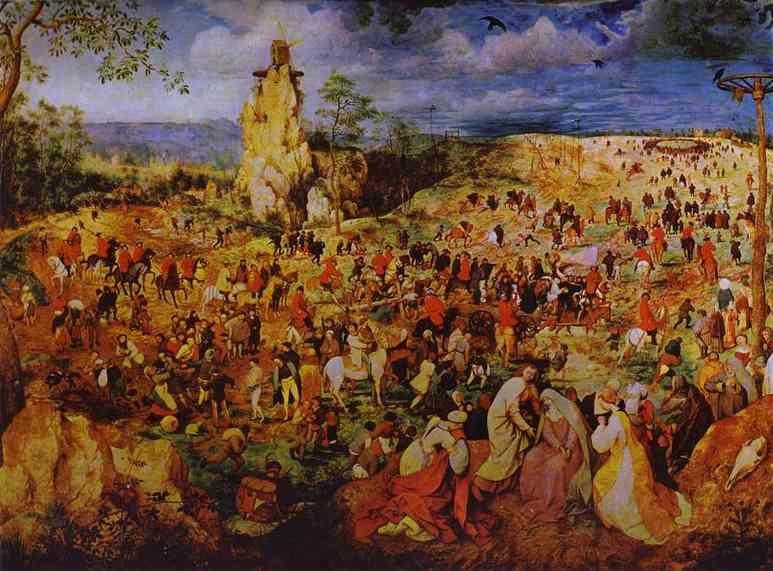
The Easter story has also inspired the best art. There are some decent images of Jesus' birth. But all painters of the Nativity succumb, to one degree or another, to an impulse known as "Ooooh, it's a liddle baby!" This sort of tweeness isn't possible in the cynicism leading up to the Crucifixion, the brutality of the event and the miracle afterwards. Pieter Brugel lashed out at the crowds in The Procession To Calvary, his astonishing depiction of the Crucifixion treated as a Sunday outing. (Pontificated on in more detail in an earlier posting.) Caravaggio played to his strengths too, showing a dark and disturbing Flagellation Of Christ by two satanic guards. Blood is missing from Andrea Mantegna's painting but only because it's all already drained from The Dead Christ; Jesus is as grey as a crypt, four gruesome holes in his body. There isn't, in fact, much optimism in most of the Easter paintings. The focus is on what we lost, not on what we've supposedly gained.
Especially in one of the defining images, Leonardo's The Last Supper. The last stage in Jesus' fatalistic trudge towards his death. The painting captures perfectly the poignancy of the event; and it anticipates the betrayals to come. Leonardo was superb at the precisely ordered group portrait and here it becomes more than an academic demonstration. Jesus sits at the head of the table and the centre of the picture, surrounded by his disciples. He sits alone, however. Those nearest him are leaning or even recoiling away. The ones on the fringes are staring at him, gossiping amongst themselves; but nobody is addressing him directly. He has lost them and he knows this. His face downturned, he spreads his hands out hopelessly. Jesus seems to be asking, what more can I do for you? Die for them – and Leonardo paints this as if it means he's failed.
It's a very human story, the Easter one. There's no constant interaction with a booming voice from the heavens. There's just a religious leader, a little too perfect for his or any other time. One who's betrayed and finally, torn apart by pain, seems to lose his own faith. It's a tragic tale too, the triumph of malice and avarice, and sometimes the Resurrection almost feels like a happy ending tacked on rather artificially. That's not the proper interpretation, I know, but maybe it's an excusable one. Because we do betray our saints and we do excuse our crooks. (Hello Mr Archer and pass on my regards to your new best mate, the Pope.) We do fail because of pettiness or greed or cowardice. We do it all the time and that's probably why somebody had to get himself nailed to a cross to redeem us.
All Your Easter Eggs In One Basket
We thought that they weren't creative enough. They could have said, for example, that the crucifix was actually oval shaped. Or perhaps Jesus himself was. Why stop, too, with appropriating eggs? Take the Easter Bunny, for example. Perhaps this came about because when Christ rose from the tomb, he hop-hoppity-hopped away from it.
Of course eggs and bunnies aren't Christian images. They are pagan ones, just like holly and mistletoe and fir trees. There was a festival at springtime and another in midwinter long before Christianity emerged. They were linked directly to the seasons and their symbols reflect this. The winter ones are reassurances, plants which remain green when everything else has died. In spring comes a celebration, images of life and rebirth. The eggs are obvious, a more direct and less gooey substitute for the womb. The Easter bunny began as the March hare, which was rather mystifyingly given great significance by the old religions. The two are linked, incidentally; it was believed that hares hatched from eggs. Which were laid by lapwings, it seems, on the basis that both creatures live in fields. Clear logic was something else yet to appear in these societies.
It's obvious why the early Christian church appropriated the old festivals. The missionaries were doing a selling job. They wanted to give people something clearly recognisable and which didn't interfere with their pleasures too much. The Nativity didn't quite fit with the old solstice festival but did offer a cause for a straightforward celebration, something always needed in the middle of a grim winter. The Easter story, meanwhile, is perfect for spring. At its heart is death and rebirth. Jesus falls, lies in a tomb and rises again. You can take that, on one level, as a metaphor for the crops withering in autumn and miraculously springing to life again when the seasons change.
There are some Christians who don't like this. Now they've got the old festivals, they want to strip the last remaining pagan symbols from them. Get the Christmas trees out of Christmas, the Easter eggs out of Easter. Let's focus on what really matters. This always strikes me as rather ungrateful, turning on your sponsors when you no longer need them. It's a peculiarly irreligious attitude too. After all, holy events aren't just ones which happened two thousand years ago to a narrow cast of characters. Look at other images of Easter: daffodils, blossom, fluffy chicks. They can be rather hard to take on a full stomach, but in their purest form they are symbols of life. Life suddenly bursting out, life at its most unexpected and glorious. And if you can't see the touch of God in these constant miracles, what exactly is the point in believing in Him?
Thursday, April 05, 2007
Well Duh pt. 67
There's been two poll s recently which studied, as Basil Fawlty would say, the bleeding obvious. A couple of months ago, The Guardian discovered that parents didn't know what their teenage offspring get up to. Mums and dads seemed to assume their little angles were sharing cups of Horlicks and playing pinball at the youth club. Instead said angels were, of course, drinking, taking drugs and fornicating with each other. This week a poll of teachers announced that schoolchildren were influenced by what they saw on television. They especially liked repeating catchphrases, the more antisocial the better.
Well, to mimic a thousand American programs, duh. I'm not sure who conducts these surveys or why they don't use a simpler methodology called 'remembering their own childhoods.' Of course teenagers break the law and don't tell their parents. It's half of the essential teenage experience. (The other half being getting depressed and telling absolutely everyone about that). When asked if she knew what I used to get up to my mum replied, no, and she didn't want to either. May this attitude be passed down many generations.
And schools are awash with bad imitations of Catherine Tate and Little Britain today? I recall being swamped with equally dreadful ones of Mr T, Lenny Henry (in his early "Ohhhhh-Kaaayy" years) and Neil from The Young Ones. Children find something they like and mimic it. It's a natural habit and, as this post has oh-so-subtly demonstrated, not confined to the young. Anyway, what do teachers expect children to talk about amongst themselves? Their bloody maths homework?
I do, however, applaud them singling out Catherine Tate's snotty girl character for special criticism. The one with the phrase "Am I bovvered?" as the sole 'joke' in each and every sketch. I know somebody who repeats this often and gratuitously, to the dismay of all around him. That person is my sixty year old father, but that's beside the point. Ban it from our screens. Ban it now.
Thursday, March 29, 2007
Widening The Gulf
So, let me se if I've correctly interpreted the stance of the British tabloids? It's morally repugnant for Iran to parade the fifteen captured British Navy personnel on television. And yet it's perfectly decent to splash pictures from that broadcast all over your front pages? Thus causing the families of the sailors, especially of Faye Turney who seems to be made the star of the show, considerably more distress?
Of course, the hypocrisies of the British media are being dwarfed by others. It's OK to patrol the waters of a country you illegally invaded on the whim of America – as long as you stay out of the waters of a country you're merely about to invade on the whim of America? Mohammed said women in public must cover their heads, but would have nothing to say about a woman being displayed as a trophy of a war that's not even started yet? It's a squalid affair and getting worst each day. And, whatever occurred in the Shatt al-Arab waterway last week, it should have been over by now. The diplomats ought to have sorted it out between themselves, quietly and behind the curtains. That's what they're there for. But Blair blundered in, strutting about in front of the EU leaders. So Ahmadinejad had to start blundering and strutting in response. Two weak men mainly held up by bluster, and they've quickly reduced it to the level of the playground. "They were in my waters." "No, they were in my waters" etc. And trapped in the middle are the only real innocents; because whichever bloody waters they were in, they would only have been there because they were sent.
However this mess resolves itself, Ahmadinejad is likely to regret it. It's unlikely to start a war on it's own. Britain isn't Israel. We don't care enough about our soldiers to fight for them. But it's got the blood of the tabloids up. They didn't care much hitherto about Iran building nuclear reactors or funding Hizbullah or any other tricky issues. Humiliating a young British woman though – that they can understand. Ahmadinejad is already being manoeuvred into the role of Brutal Arabian Dictator which was forcibly vacated by Saddam Hussein. That his name is hard to spell and even trickier to pun with could cause problems. The fact that he was actually elected could cause some qualms too, albeit rather less. That shouldn't stop the journalists, however. When they want to make someone a folk devil they usually get the job done. With the headline "Who do you think you are kidding Mr Ahmadinejad?" The Sun has already begun the Hitler comparisons.
Why should Ahmadinejad care about this? Because it will make the task of selling an Iranian war to the British public considerably easier. The one honest reason for invading Iraq, after all, was "Saddam is nasty." And a real tabloid clamour may even push a British government into attacking. Blair has always capitulated to the newspapers on all major issues sooner or later. David Cameron goes even further, making the improvement of his image his sole consistent policy. The capture of one boat won't start a war, but suddenly it feels like the build-up to one.
Tuesday, March 27, 2007
Ozymandias, King of Kings
I saw Rick Witter on Friday night. It was a bit dispiriting. You may recall Rick Witter: former schoolmate of mine, former lead singer of Shed Seven, former pop star. He wasn't on stage when I saw him. He was just having a drink in the Punchbowl, a smart but not especially fashionable pub in York city centre. Nor did the place exactly erupt when he walked in. The only people who seemed to recognise him were me and my friend; and that's just because we went to school with him.
"He's keeping it real," my friend suggested. But I've never been in favour of celebrities doing this. Like royalty and football players, they have a template they should adhere to. When Witter goes out on a Friday night, he ought to step large. He should be sniffing coke in a London nightclub, berating his agent who's angling to book him a place on Celebrity Big Brother. Not having a drink in places like the Punchbowl in provincial little York, along with the rest of us tossers.
The more depressing thought is that maybe Witter has no choice nowadays. It's been a while since Shed Seven split up, I know, and his new band don't seem to be going anywhere. I'd always assumed, though, that he was still lit up by the half-glow of former celebrities, still getting a few invites and bookings. Maybe not. His life might have become an arc so perfect that even Hollywood screenwriters would reject it as unrealistic. And he's back precisely where he started, the point most of us never left anyway, wondering if his years of chart stardom were just a dream.
Thursday, March 22, 2007
An Anti-Social Crime
The Guardian recently highlighted a new phenomenon on our streets, comical and disturbing in equal measure. The Mosquito, an ultrasonic device which apparently emits regular, high-pitched beeps only audible to the under-25's. It is designed to be fitted to shops and the like, and to make any loitering teenagers so annoyed that they will eventually skulk off. The aim is to stop them indulging in that act which has so blighted our cities – Hanging Around and Sometimes Swearing.
This is amusing because I can't imagine for a second that this dog-whistle-in-reverse can ever work. The human ear changes a little as we age, I know. But is there really a switch that suddenly flicks on one's 25th birthday preventing you hearing anything above a certain frequency? And even if the science holds, the effect surely won't be what is intended. If youths are ever annoyed by something, youths with enough time to identify the source and a propensity to petty vandalism – well, that object is going to become a lot of serrated metal and cut wires fairly soon. Besides, who's to say that teenagers will be repelled by repetitive beeps? This is, after all, the generation which rediscovered the joys of illegal raves. They just need to bring along a beatbox and the Mosquito will supply the soundtrack for their evenings.
More disturbing is the intention. Mosquitoes aren't burglar alarms. They aren't anything to do with crime prevention. They are designed to deny people access to areas which are supposedly open to the public. Not all people either – note the targeting, even if it doesn't work in practice. Mosquitoes are the next stage in an increasingly vicious campaign against youth. It's a war which has included Asbos – punishments which don't require convictions or juries or proof – and a Prime Minister talking about the handily nebulous idea of "anti-social behaviour." Now it's going to the next level. Excluding teenagers from the streets entirely, only one step away from blanket curfews.
The posters for Mosquitoes apparently show a hoodie screaming in pain. Of course they used this image. The hoodie, an object rivalled only in modern demonology by the burqa. (Why is our society so reassured by the sight of human hair anyway?) The icon of the "feral gangs," in the words of the Daily Mail, who have taken over the night time streets. Not by committing crimes all that often, you understand. But simply by the foul act of Hanging Around and Sometimes Swearing.
Moral panic towards the young is nothing new. Stanley Cohen coined the phrase in his analysis of the huge campaigns whipped up against tiny groups of mods and rockers in the 1950's. But it seems particularly intense at the moment, when hysteria is so fashionable but the choice of targets are so restricted. If journalists want to frighten their readers but don't want to seem like racists, they usually have to pick on teenagers.
Asked if they support devices like the Mosquito, people often cite their own nervousness towards groups of teenagers. They usually seem a little awkward saying this, however. There is some recognition that it's silly to be scared of undernourished youths in silly jumpers doing nothing more than HASS-ing. And it is irrational. It's a phobia and it can be beaten. The first step is to keep the Daily Mail and their ilk a safe distance away. Perhaps with some sort of ultrasonic device.
Friday, March 09, 2007
King Balthazar
Genealogy is the same most of the time. I'm sure I would have loved to meet my great-great-great uncle, even if he had been a birdwatcher. But I'm not that interested in his life. He would have been a tailor or a minister because nearly everyone's was. Or a blacksmith or a farmer or so on. Taken as a mass, the facts of ordinary people can form social history. On an individual level there's some interesting stories to b found. But generally, families aren't enthralling. They drifted around the country getting on with things, occasionally reproducing and/or dying. Genealogy is the collection of names, knowledge for the sake of it.
Occasionally, though, surprising ancestors can be found. Like those of the magnificently named Balthazar Napoleon de Bourbon. Historians are now fairly sure that Balthazar would be heir to the throne of France, if only there was still a throne of France. Which is hinted at by his name but not his person – a very Indian looking Indian lawyer living in Bhopal. The link seems to come from a rather demented sixteenth century nephew of Henry IV who 'swashbuckled' – i.e. blundered – around the world and founded a long line of Indian Bourbons. Somehow they survived, too obscure for even Robespierre to track them down and eradicate them.
Balthazar himself doesn't seem too excited by the revelations. Not surprisingly given that a) the last proper King of France got decapitated and b) there's no money. "Bourbon on the rocks" he calls his family, which is quite a good joke for someone with royal blood. Though he's filled his house with French geegaws, he isn't given himself airs. Tess of the D'urbevilles' life was ruined by genealogy. The discovery of a distant connection to the local wealthy family filled her father with pretensions, starting the chain of events which eventually destroyed her. Any daughters of King Balthazar will probably escape the same fate.
Thursday, March 01, 2007
The Man From Another Planet
My main objection to the show, however, concerns the title. It's clever enough. The Brave Old World which Simm lands on is made to look so thuggish and unrefined that it does seem like another planet sometimes. David Bowie's song Life On Mars was also released in 1973. Another notable event that year was my birth. So I've got to accept that during my lifetime, every facet of society has changed almost beyond recognition? Nothing seems all that different, to be honest.
It's going to get worst too. The decade of my adolescence, the 1980's, is currently very recognisable. It's the era of choice for the retro-bars. This is actually quite fun; I can tell people that I hated leg warmers and the New Romantics at the time and hate them just as much now. But they're going to go out of fashion soon and stay out this time. The magazine editors will move on to the 1990's and start pretending they love ripped jeans and Britpop. And the whole of my childhood will sink into an incomprehensible murk, as distant from modern life as pantaloons, rationing or Glenn Miller.
Friday, February 23, 2007
The Long And Short Of It
The biggest contrasts were between Peter Hain, Northern Ireland Secretary, and John Reid, Home Secretary. Hain's replies were multi-sectioned wonders. They weren't that badly phrased but they just never ended. On the issue of when British troops should withdraw from Iraq, for example: "We should bring our troops home as soon as the situation on the ground allows and not stay a day longer than is needed to enable a safe handover to the Iraq people and their democratically elected government."
And that was before he started squirming. Asked if an enquiry about the war should be held after Tony Blair leaves office, he really lets go. I won't quote his last sentence in full. But it's got over 60 words and turns, apparently spontaneously, into an epic saga detailing all Blair's achievements in office. It's no wonder Hain has been a success in Northern Ireland. Sinn Fein and the Ulster Unionists must agree to anything just to shut him up.
John Reid, meanwhile, simply answers "No" to three of the five questions. Even when he bothers with actual sentences there are mitigating circumstances. Saying "when the time is right" in response to the British withdrawal seems uncharacteristically chatty. But he was actually just repeating one of the three options given in the question. Effectively his answer was "Box C please, Noel." As for claiming "I cannot answer a hypothetical question" when asked if he would support a future military strike on Iran – well, it's hard to see how this could have been phrased more concisely. "That's a hypothetical question" would raise the rebuttal "So what?" "I don't know" was what he was really saying, but that would make him look at fault rather than the interviewer. And Reid is a master at transferring the blame.
Opinions will vary on whether he appears succinct or arrogant, whether Hain comes across as an intellectual or a windbag. But I can guess who's won the support of your standard lazy journalist. Reid has given them some neat soundbites in the past, mainly about how bloody awful his Home Office is. If he gets into Downing Street, though, they may have to put in some effort to fill their column inches. With Hain, they'll just have to switch the microphones on and sit back.
Saturday, February 17, 2007
Empires
I'm not sure how Livy knows these speeches so well. One, for example, was delivered as a general was preparing to flush out some barbarians from a mountain chain in the middle of Turkey. It's unlikely that a clerk was faithfully jotting down every word. I suspected that Livy invented most of them. But then a blitheness about the veracity of accounts is also a feature of traditional history. This has some advantages. Livy was exploring what was then relatively uncharted territory. When modern historians do the same (looking at the 7th and 8th centuries, for example), they spend most of their time moaning about the paucity of evidence. Livy just gets on with it. His only comments on methodology is to occasionally observe that one historian claims 40,000 enemy soldiers were slaughtered in a battle, another that ten men were slightly wounded and two more contracted nasty head colds. It's worth noting that nobody complains about the lack of sources for Roman times. After all, we have Livy. Who based his statements on… what, exactly?
Like all historians from history, Livy comes with a Handle With Care notice. He was writing as the Imperial structures were first solidifying under Augustus. Like many men at the time, he saw this as degenerating the Roman spirit. Accordingly, he sometimes over-exaggerates the dignity and grandeur of the Republic as he analysis its rise. No modern historians carry such a warning, incidentally, even though their works are increasingly subjective. We just have to remember that all interpretations are filtered through Western, capitalist, democratic minds. But Livy's approach is definitely indicative of his culture. His belief in his, often unsubstantiated, statements mirrors the confidence of the Romans. Yet this self-assurance rarely, under the Republic at least, transformed into vanity and certainly not into a dubious concept like destiny. The Romans believed they would become greater and greater, but also believed in planning for this. So they painstakingly laid out a baffling network of structures across the Empire. This meticulousness is copied in the dense mat of facts which Livy rolls out.
All histories carry parallels and warnings about modern times. Rome under the Republic was an oligarchy not a democracy. It was also a rigidly stratified society which accepted slavery as a natural condition. But the extent to which they limited the potential power of any one individual was remarkable. The highest office, that of Consul, could only be held for a single year, was hemmed in by other institutions and was always shared with another Consul of equal rank. Compare that with the Emperors who came later, enjoying untrammelled authority and turning themselves into living gods; or even with our own presidents and prime ministers. One result was a dearth of hero-worship which puts our set-'em-up-and-knock-'em-down ethos to shame. Scipio Africanus, greatest general of the Republic, who defeated Hannibal and all his elephants to save Rome – even Scipio spent his last years pursued by an embezzlement charge. He just got off through the force of his reputation, and by dying rather opportunely, but it was a close thing. Livy seems both disapproving of this treatment and also rather awestruck that it was ever possible. We can link this restriction of the individual with the lack of personal vanity in politics, the faith in institutions rather than destiny. And also conclude that the approach was the right one. After all, the Emperors didn't build most of the Roman Empire. The legions of prosaic Consuls did that. Those flashy demi-gods we love so much just inherited it. And then let it, piece by piece, fall apart.
One of the central events in this volume of Livy is the Second Macedonian War. Threatened by the ambitious Philip of Macedon, the Greek states – nominally independent but clients of Rome – appealed for help. The fascinating part of the war isn't Livy's interminable accounts of the numerous battles but the aftermath of Rome's victory. It promptly withdrew all its legions and garrisons and gave the Greek towns their independence back. Livy is as entranced by this benevolence as the grateful Greeks. The propagandist in him coming to the fore, he doesn't mention the economic interests which Rome was protecting, nor their concerns that if Philip conquered Greece he would turn to Italy next. Nonetheless, you can only be so cynical about the event. Rome had performed an action atypical of any era. Starting a war to preserve another country's autonomy and not welching on the bargain afterwards.
It reminded me of America in World War II. They never really had to enter that conflict. Pearl Harbour could just as easily have frightened them into doing a deal with Hitler. They came to Britain's aid, though, and they liberated Western Europe and then they left again. Well, sort of. I wonder what would have happened if they had withdrawn as thoroughly as the Romans pulled out of Greece, if the Soviet Union had done likewise after emancipating Eastern Europe. It would probably still just have been a matter of time. After all, Rome's hold on its Greek clients grew firmer and firmer until they were just vassals in an empire. But maybe right now we wouldn't be where we are. With America convinced it has the right to do whatever it wants anywhere in the world, with all reason subordinate to the ideology of its greatness. Led by an enfeebled Senate and an Emperor of with the common sense of Caliglua and, on occasion, the sanity of Nero.
Saturday, January 27, 2007
Montgomery Bush
His motives were similar to George Bush's, though less ambitious. Monty Burns wanted to increase dependence on his horribly unsafe power plant. Bush wishes to protect the rights of all polluters everywhere. I also wonder if the President is considering some of the other radical eco-solutions from The Simpsons. In another episode, Springfield got so horribly polluted that they just packed the whole town up and moved it somewhere else. Is Bush already scouting out other planets and collecting tugships and an awful lot of rope?
Mr Burns was eventually thwarted when he was shot by the Simpsons' baby, Maggie. I'm not, of course, suggesting that America's toddlers take such a radical step. But the current climate in Washington is so surreal, I wouldn't be surprised if it happens anyway.
Friday, January 26, 2007
Blinding Faith
So much for having the coolest Archbishop in England. When John Sentamu came to York, I thought we were getting something. The man from Uganda was a former victim of Idi Amin, a campaigner against racism and capitalism's more brutal excesses. He started well too, speaking wisely about faith and compassionately about job losses in the city. But he seems to be stumbling on the subject which trips up most of his church. Homosexuality.
The government is finally looking to bring Catholic adoption agencies into something resembling the modern era. These agencies have been freely excluding couples who can provide a happy, supportive home to orphans but happen to be of a shared sex. It's ludicrous that they have been allowed to do this for so long. As Harriet Harman said in an uncharacteristic moment of insight, "You can't be a little bit against discrimination." Labour has been hitherto largely because of a sustained lobbying campaign by church members, including some in the Cabinet. In one of those heart-warming examples of how bigotry can unite rival churches, the Anglicans have sided with their former Catholic enemies.
The Catholic defence is the usual one. Homosexuality is against the teachings of their church, full stop. Essentially each man is pointing up the hierarchy and saying "It's his fault," until the chain of guilt leads all the way to the man in Rome. Who could, I suppose, say he's just following lessons learnt when he was a young lad in the Hitler Youth. Protestants never have that excuse. So, in eerily similar statements, John Sentamu and Rowan Williams are citing freedom of conscience. Personal ethics are at stake, they say, and these should never be a matter of legislation.
Williams has caved in so often on the matter of homosexuality that the Health & Safety Executive now warn people not to stand too close to him. But, as said, I expected more of Sentamu. Never mind that all freedoms are always going to have parameters set by the government, that some individual consciences are basically evil, that Idi Amin probably thought he was following his when he locked up Sentamu. That's obvious enough, though possibly not to the Archbishop. What Sentamu maybe should have considered was whether his conscience was telling him the right thing.
What exactly is the defence anyway? It isn't the Canal Street cruisers which the adoption agencies are excluding. It is couples who can prove they are in a stable relationship and can provide a prosperous home. This isn't fair on the children being denied that, never mind the couples themselves. And what the hell is the issue with homosexuality anyway? It's condemned in the Bible a couple of times. Many things are and are freely indulged now, even by churchmen. It prevents the couples from breeding naturally. Well, the days when the human race needed to go forth and multiply are over. With over 6.5 billion of us in the world, perhaps we've multiplied a little too much. Some details in the Bible are antiquated. It's time to stop clinging onto them and focus on the main message. Gay couples can show devotion and fidelity, to each other and their families, and that's in line with God's teachings. He didn't say He was the God of Love, only to add "Oh, except for these kinds…"
The steps should be: work out if your conscience is correct. Then defend its freedom. Sentamu needs to be careful. Soon he'll be saying that government policies are political correctness gone mad, and then there will really be no hope for him.
Thursday, January 25, 2007
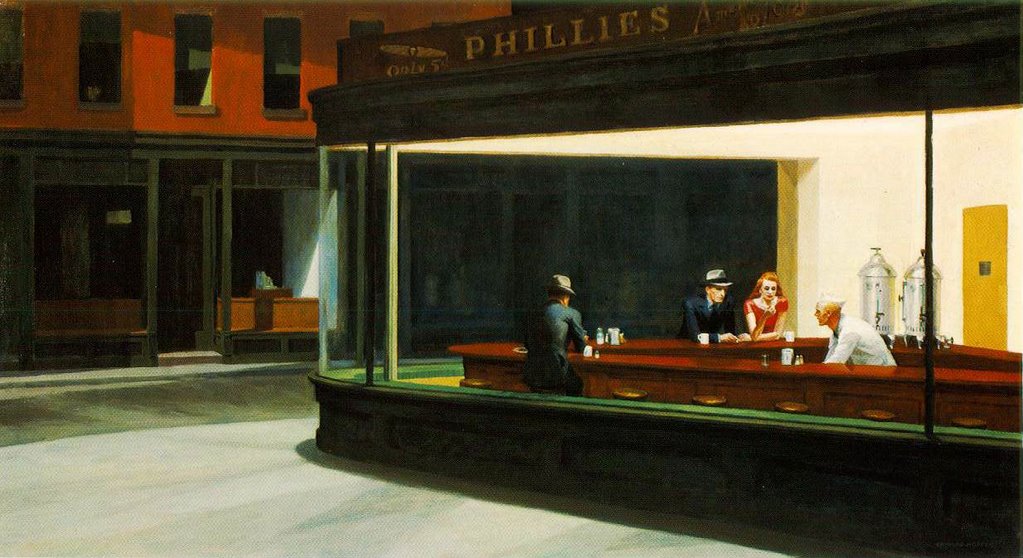
'Nighthawks'

Can you be a great artist without leading a classic artist's life? Edward Hopper thought so. He had perhaps the least eventful existence of any successful painter. It was entirely spent in the same city, New York, and mostly even in the same studio. He started as a commercial artist and made the transition to an independent one with absurd tranquillity. He married his wife Jo in 1924 and saw no reason not to stay married to her until his death forty three years later. There was no apparent turmoil, no flamboyance and no self-destruction.
Of course you don't need any of that if you're brilliant – which Hopper certainly was. Its absence, though, might influence the sort of art you create. Hopper became known as a 'neo-realist.' His scenes, apparently only one stage away from photography, are of mundane little nooks and corners, the unremarkable sidestreets of the modern world. A better word for him is actually a 'hyper-realist;. There is nothing dramatic or beautiful to distract us from his visions of normality. We are forced to focus on the real world as it is – and see the truths he has subtly placed inside.
Nighthawks is effectively a picture of two halves. The left hand side gives a classic Hopper image. Though he painted some pastorals too, he tended to focus on towns or cities. And they are urban landscapes from which all trace of nature has been removed. Take The City, where the flat tops of the buildings compose a new form of terrain which stretches to the horizon. His cityscapes lack something else too. Namely people, the things for which they were supposedly created. The shops in Drug Store and Early Sunday Morning apparently serve nobody and are served by nobody. They have no function. Likewise the dark street in Nighthawks. It could have been made picturesque or menacing. But it is simply empty in every sense, a place without a soul, and so becomes almost pitiful.
The other half of the painting is dominated by the harsh glare of the coffee house. Hopper could do light and shade better than anyone since Caravaggio. He used them quite differently, however. Caravaggio was theatrical, his striking beams of light piercing thick pools of gloom and illuminating every wrinkle of his actors. Hopper's lights are generally weak little beacons standing alone. The lamps of the petrol station in Gas, struggling to keep at bay the threatening shadows of the night forest. And those of Nighthawks' coffee shop, which is revealed to be almost as empty as the street outside. It is the epitome of bleakness. Blank walls, an unpainted door, the only adornments the two water heaters and a few scattered utensils. If we saw this place in real life, we would walk straight past. But now we are forced to stare inside.
Four figures are there, a surprisingly high number for Hopper. More typical is how he has placed them. None are looking at each other. Nobody ever does in his works, not even the young lovers on a Summer Evening. One man is turned away, half his body and apparently all of his mood swallowed by gloom. The couple in the middle may be together but there is no connection between them. The woman examines her fingernails in a classic posture of boredom. She seems thoroughly uninterested in her partner, who in turn gazes out at us with disappointment on his sharp features. The only figure who is at all animated is the bartender, pausing in a task to stare out of the window. Follow his gaze, though, and you see he is looking at nothing at all – just the empty street.
This purposelessness is everywhere in the scene. These are not nighthawks engaged in illegal pleasures or depraved hedonism. They sit in this drab little room because they have nowhere else to go. They are alienated even from each other; their loneliness emphasised cruelly by the line of empty bar stools in the foreground. Each one, you feel, comes here every night to sit in silence. And when the place closes they walk home alone through the empty streets.
What can you do if you're an artist who has never experienced true tragedy? You can try to do this if you choose. Create horribly believable visions of explicable, everyday misery.
Friday, January 12, 2007
Another Galaxy
At Real Madrid, though, he went to the opposite extreme at the wrong time. His 'private' life briefly supplanted the most tiresome of soap operas, largely thanks to an imperfect understanding of how a mobile phone text function works. He rarely shone on the pitch, however. Beckham arrived during the era of the galacticos, superannuated stars who did absolutely nothing of value but looked great while failing to do it. Here the epitome was Roberto Carlos, a hilariously inept defender whose sole function was to violently thump free kicks 50 yards over the bar. Beckham just couldn't compete. Shunted from his favourite right midfield slot, he tried proving his worth by scurrying about and playing short passes. Even his hair grew more rational. He turned himself into Nicky Butt.
Hopefully he will find a proper home at LA Galaxy. It hasn't started well, however. When news of his contract - £70,000 a day, a virgin sacrifice tied to the rocks each month and all the ambrosia he can drink – came out, Beckham assured us he wasn't moving for the money. He was attracted by the massive potential of the club and the massive potential of football in America and so on. And who in his new homeland was he trying to convince here? Fans of LA Galaxy, a team which sounds like an especially annoying nightclub, and the rest of the MLS will react like everyone in the football world – a sceptical roll of the eyes so violent it risks straining a muscle. They are only a small group, however. Most US football fanatics care solely about the Latin American countries where they were born or the high school team which their daughter plays for.
Many Americans do like money, however. They like celebrities too, and they especially like celebrities who flaunt their money shamelessly. Beckham needs to go for this market if he wants to make himself a genuine star in the States. He should wave his contract like a talisman and pretend that being the highest paid player in history magically makes him the best. He should cruise the chat show circuits, he should build a Beverley Hills mansion which makes Beckingham Palace look tasteful and humble. It's likely to help football in America. Previously a stunted, stigmatised immigrant, the sport is suddenly offering the absurd salaries of basketball and attracting the corresponding attention. LA Galaxy's attendances will surge, part of the new crowd being enthusiastic teams of auditors wondering how the hell they can afford it. And if Beckham really gives it his best, if he pushes his image to the max, perhaps nobody will notice that he's an ageing trundler who can manage about three half-decent crosses per game.
Sunday, January 07, 2007
Speak Softly And Carry A Big Neocon
Last November, though, the tone abruptly changed. The White House was embracing centrist policies, we heard. It was embracing the forbidden delights of bipartisan policies with both arms. It really, really loved the Democratic Party. This sudden passion possibly came because said party now controlled the Senate and could, if it wished, starve Bush of all funding and put his friends on trial for an astonishing array of misdemeanours.
For some Republicans, the conversion appears permanent. Arnold Scharzenegger, for example, has convincingly reinvented himself as a liberal eco-warrior. (Though the wording of his latest announcements, where he compared himself to Saul on the road to Damascus, hints that he may have damaged more than his legs in his recent skiing accident). Perhaps Bush also meant what he said for a while. Something inside him seems to have snapped, however. He listened to James Baker's recommendation for a rapid troop withdrawal from Iraq and negotiations with Iran and Syria. He listened and laughed quite a lot in private and is now preparing an alternative Blueprint For Peace. We don't, as yet, know for definite that Bush intends throwing pretty much the entire American army into the Middle East. But there are clues in Friday's reshuffling of the top military personnel. The two generals currently in Iraq, both sympathetic to Baker's report, are being withdrawn. In their place comes David 'Ripper' Petraeus and William 'Fallout' Fallon (I may have made these nicknames up myself), men renowned for tearing their enemies to bits and dancing on the fragments.
I knew it couldn't last and I'm quite glad it hasn't. In today's grey world, with identical parties battling over miniscule issues and careerist politicians propelled entirely by image, we need people who refuse to taint their beliefs. The American neocons, together with the Muslim fundamentalists, are one of the few significant groups left who are driven by ideology. Both have overlooked a few small points – that the aim should be to build a utopia rather than a dystopia, that the destruction of the world is not actually a good thing. But nobody's perfect.