Saturday, July 29, 2006

Hatred

A friend recently said he wished he understood more fully the latest Israeli/Lebanese bloodbath. My response was that it's fairly simple. It's about hatred. Religion, territory, race and water to some extent; but primarily about hatred, mutual and unquenchable. This was a slightly drunken men-in-a-pub conversation we were having, but I'll stand by that assessment. The only way to comprehend the motives of the main participants is to realise that they just hate each other, and probably always will.
My friend was also searching for an analogy. I'm also going for a simple one here: the school yard. One boy kicks a bigger boy without provocation. The big boy responds not with another kick but with a savage, unrelenting assault. That's what happened on the Gaza Strip. The Hizbullah attack on the Israeli barracks only varies in that it seemed to be an attempt to rescue the first boy as he fell bleeding to the ground. Interestingly, Hizbullah rejects this interpretation. They claimed they had been planning their raid for months. But then Hizbullah have never been easy with any justifications that a sane man might recognise.
The only strange part of this depressingly familiar cycle of events is that it's possible to sympathise with one of the governments involved. Lebanon can't have expected Hizbullah to suddenly strike after years of dormancy. They can't have expected the Israelis to respond by bombing not just Hizbullah positions but pretty much the whole of Lebanon. The excuse given for the second is that Hizbullah forms part of the Lebanese government and there's been no attempts to disband the organisation. But like it or not, Hizbullah remains very popular in south Lebanon and some of their representatives tend to get elected. And a direct move against them would have probably pushed the country back into civil war. I think Lebanon has had enough of that for the time being. Defending the Israeli reaction is like saying they would have been justified bombing Britain if the IRA killed any of their soldiers in the 1970's and 80's. Sinn Fein, after all, technically formed part of the British government; they had elected representatives in Westminster even if they chose not to take their seats.
The British and, especially, American response is another reason to sympathise with Lebanon. A democracy, a democracy striving towards peace, being bombed by a neighbour for actions it didn't carry out. They might have expected a little protection from America, the self-appointed guardian of peace and freedom. Not when the aggressor is Israel, however. Even though Lebanon is a largely Christian nation and the Bush administration contains some serious anti-Semites. Still this golden rule cannot be broken for America: Israel Is Always Right. This is one detail I do wish I understood better. Bush lives in a world of black and white, good and evil. So why does he side with Israel even when they blatantly break his own infantile rules? Perhaps the reverse of hate is being shown here. Love, which excuses and blinds whenever necessary. Or perhaps it's because this is the school yard. And nobody should expect the biggest kid of all to play fair.

Thursday, July 20, 2006

Not Fit To Speak

I did promise I wouldn't use this blog to whitter on about my personal life. (On the basis that total strangers reading it wouldn't be interested and I didn't want them knowing anyway). But since this particular episode concerns web use, I though it might be worth relating.
I'm a member of the epilepsy section of HealingWell, the health site with a link opposite. Recently a 12 year old girl did the standard introductory post to the forum - 'Hi, I'm new here, got epilepsy, don't like it, can anyone give advice' etc. Rather than helping, the forum moderator instantly put up a message telling her that she was too young to post anything. Then the site founder weighed in with the announcement that US federal law required all contributors to be 13 or older. I don't know what happened to the poor girl, but assume she instantly had her membership revoked.
Rather irked, I put a post of my own. I told the girl that there seemed to be an age limit to receiving help and support and suggest she come back in a year when her right to exist might be acknowledged. Slightly sarcastic, I know, but not especially offensive. I'm informed that some of the site regulars put up similiar posts, albeit phrased more moderately. I never actually saw them, however. Less than a day after I kicked off the debate, the moderator struck again. She deleted all the criticism and replaced them with a huffy message of her own which said that negative or unpleasant posts wouldn't be tolerated. Looking on the site today, I see that the whole thread has been wiped off.
An amusing episode on one level, less so in other ways. I don't know if the moderator emailed the girl to guide her to a children's site where she could post. (Unlikely, according to one person). I also don't know who thought to pass a law shutting children out of sites not about sex or violance but helping people through a pretty unpleasant medical condition. It's also hard to get past the censorship issue. We weren't mocking or insulting anyone. We were challenging the rules of the site. Print magazines and newspapers frequently carry letters criticising their own content. But it seems that in the free, untramelled internet, that's just something you're not allowed to do.

Wednesday, July 19, 2006

Record Breaking

As I gradually melt into a rather putrid pool, I read that this is the hottest July in Britain 'since records began'. I thought it might be. Every month seems to be the something-est one since records began - the hottest, the coldest, the wettest, the sunniest, the darkest, the fattest (particularly common in these obese times) or just the nicest. We're rarely told whose records they are or when precisely they did begin. I suspect they're reset every few years so that every month, like every child in a talent contest, can have a prize.
If the heatwave continues, be sure of another story re-emerging soon. Some, perhaps, all of the water companies will announce that their reservoirs are empty so can everyone please stop turning on their taps. And then the reaction. How much of the water from said reservoirs is actually distributed around the country through holes in leaky pipes - usually around a third - and why nobody spends any money fixing these pipes. Spokesmen from the companies will give the usual response, which can be summarised as "You think we're wasting a lot of water this year? That's nothing to how much we wasted five years ago." But just once I'd like one of them to stand up and scream, "So we're cutting back on essential repairs to maximise profits? We're a private company. That's what we're supposed to do. If you don't like it, you shouldn't have sold off the bloody water industry in the first place."
If that happens, and if the government responds by re-nationalising the water companies, they may make it the sanest month since records began.

Saturday, July 15, 2006

A Levy On The Lords

As the 'loans for peerages' scandal gets more melodramatic and the Metropolitan Police show their theatrical side again - thankfully without shooting anyone this time - a question keeps running through my head. Why does anyone actually want a title? None of my circle, which includes not just raving lefties but a few raving righties too, believe they have any prestige attached whatsoever. Several centuries of mockery have seen to that, notably PG Wodehouse and all his 'Lord Wotwotleighs.' A knighthood might, just conceivably, be desired. It would put you in the same company as Alex Ferguson and Bobby Robson, after all. But a true peerage involves sacraficing your name, one of the most crucial parts of your identity, and instead calling yourself after a piece of scrubland in Northamptonshire.

There's still a small amount of political power attached, I know. This can easily be removed by doing what should have been done a decade ago i.e. properly reform the House of Lords and make it an elected upper chamber. Even if this ever happens, though, a small group of people will still be clamouring, and paying, for titles. The rich businessmen who have the Humvee, the private jet and the mansion by the Thames and want to get one status symbol ahead of their peers. A claque who have almost entirely separated themselves from the rest of the country.

Lord Levy - an unfortunate name in the circumstances - the Labour Party and the Conservatives may have broken the rules and even the law. But have they actually done anything damaging? In the 'cash for questions' affair of the 1990's, Tories recieved personal bribes to manipulate Parliament. Here it's political parties getting money to fight elections - quite important to democracy, incidentally - in exchange for glass beads. They're fleecing some very dim men who can certainly afford to be fleeced. It's probably the only way to persuade these men to keep their money in the country and invested in something remotely useful, so how wrong is it?

The honours system has always been a phenomenal scam. It was only ever intended to formalise bribery and patronage. Lord Levy's crime isn't to pervert this system, as some have said, but to operate it in perhaps its most perfect form.

Thursday, July 06, 2006

A BBC Announcement

As a BBC-style add-on to the last post, I should say: If anyone suffers conditions described in the poem below, please click on the Healingwell link to the left. You will receive lots of useful advice and meet all sorts of nice people. And a few self-important bloggers, but that's the internet for you

Yet More Poetry

More than my usual reservations about this. It's an attempt to tackle a 'serious' subject with very limited tools. And I'm still slightly worried that, for once, I might offend people I don't want to offend. But after taking council from someone brighter than me, I'm posting it anyway. All I can say is that the second stanza is an attempt to describe what epilepsy appears to be doing to my mind when I'm having a seizure. It's a personal account and nothing else.

Sticks and Stones

No: that isn’t it.
That’s not the worst thing at all.
The taunting or the fear
Or the names: epi, spasmo.
Jokes about frothy lips.
I’m supposed to care?
Those who matter won’t make them
And anyone who does
A great excuse to loath them
As they should all be loathed.
So bring it on, archaic stigma
For I have studied you
And I will hit you right back
And I hit below the belt.

But something hits me harder
With its sticks and all its stones
They penetrate my thickest skin
Strike deep inside my being.
No words left to deflect them
No words left at all.
Just primeval rituals, ancient hopes
Expressed in gibbering prayers
That next second or next minute
The blows will start to fade
And mankind will creep back slowly
To this dumb, misfiring ape.

Monday, July 03, 2006

Reasons To Be Slightly Less Miserable

To all fellow England fans gripped with feelings of despondency and déjà vu after Saturday’s game, a few consolations.

1. We’re one of the eight best teams in the world. You can’t really argue with that now. Not after we’ve been quarter finalists for pretty much every tournament over the past millennium. And it’s not too bad, is it? We don’t have the largest, richest or most fanatical population in the world so we shouldn’t really expect the best team. And don’t try the counter-argument of how we invented modern football. After all, nobody expects Thomas Edison to design the best light bulbs any more.

2. Wayne Rooney got sent off for a proper foul. If you’re going to regress into childhood, go all the way. Stamp on somebody’s goolies. Don’t, as Deco did, just hide the ball behind your back and say “Nyahh, you’re not having it, nyahh!” What sort of a career-defining moment is that to look back on?

3. We’ve found out what Owen Hargreaves actually does. This used to be one of the great mysteries of science. The origin of the universe, the behaviour of an electron and the purpose of Owen Hargreaves. Some of us were getting ready to dismantle the Bayern Munich midfielder, possibly without an anaesthetic, in an attempt to find out. But now we know. He scuttles about the pitch and deputises adequately for superior players when they’re injured. Now the great minds can turn to the next question: If Jermaine Jenas is in a squad and nobody notices, does he really exist?

4. Frank Lampard. He’s had more shots on goal than anybody else in the tournament. And he inspired the most oft-quoted obscure fact of the tournament: that he’s had more shots on goal etc. Compared to these two achievements, his inability to hit a cow’s arse with a shovel is fairly trivial.

5. England have caught up with modern tactics. In 1998 France won the World Cup by not playing any decent strikers. Four years later, half the teams in the tournament were trying to emulate them. Clearly Eriksson saw this as the way to go when he selected two crocks, a juvenile and a freak of nature as his squad’s attack force. Portugal probably only beat us by taking the next step: going a large section of the game without any centre forwards at all.

6. Theo Walcott had a really spiffing holiday. He made some fantastic new friends. He sat on some excellent benches. He got some great photos to show his mum. Best of all, he didn’t have to do any work at all!

7. Steve McClaren is bursting with ideas. Every game was spent scribbling down notes and holding them in front of Eriksson. He only broke off to mutter intently in his boss and soon-to-be predecessor’s ear. We shouldn’t, at this stage, be too worried by the fact that Eriksson apparently paid him no notice at all.

8. There’s no single scapegoat for England’s exit. Which means no weeks of hate campaigns and (very) thinly disguised xenophobia in the tabloids. Attempts are being made to find a villain. Blame has swirled around Rooney (for stamping on someone’s goolies), Carvalho (for allowing his goolies to be stamped on), Ronaldo (for being an annoying tosser) and the Argentinean referee (for being Argentinean, presumably). But the lack of a single target suggests the real reason for our defeat lies elsewhere. We lost because we weren’t good enough. Accept it and move on.

Wednesday, June 21, 2006

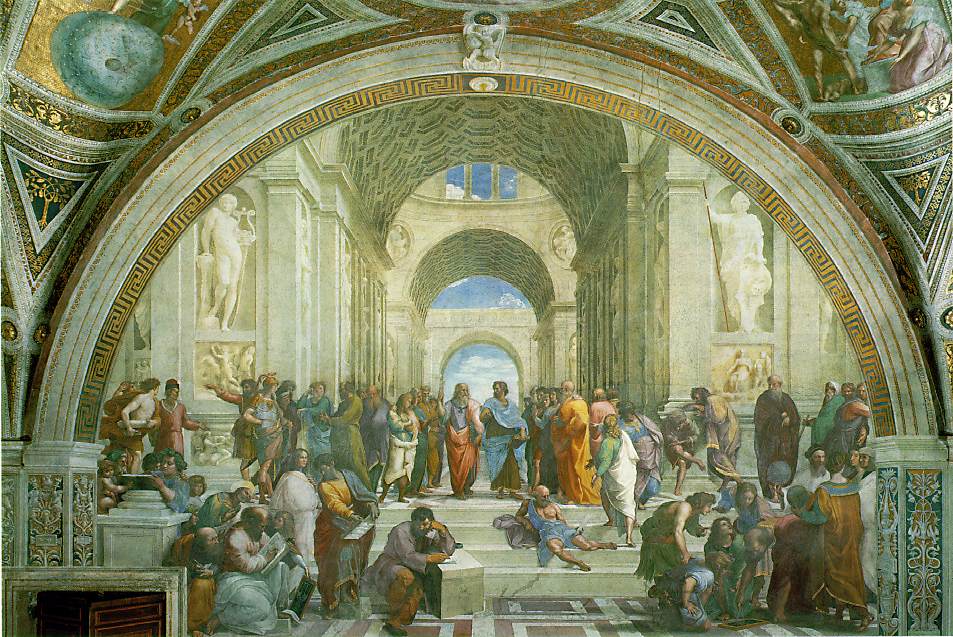
The School Of Athens'


'The School of Athens' probably isn't Raphael's most famous work or even his best. But it has to be my favourite, probably because it's the most fascinating. Its visual impact is immediate. The great decorative arch which stretches from one side of the canvas to the other. Framed inside a perfect symmetry of curved ceilings which recede towards the far gateway. Pillars and statues of Greek gods lining the walls, gentle patterns of light and shade, the whole scene coloured a warm gold. Both glorious and accessible, this is Greek architecture at its most impressive.
But the surroundings never overwhelm the inhabitants. They form the most fascinating study. Raphael shows us a busy crowd scene, addictive in its variety and charming in its realism. Plato and Aristotle are entering from almost the very centre of the canvas. A line of fawners greet them. A youth seems to have been rushing up to join them before being distracted by the splendour of the building. Beside him is a bald and scantily clad man, allegedly Diogenes, lost to everything except his pamphlet. The aged Euclid teaches geometry to a party of children in the right of the foreground. His counterpart on the other side of the foreground delves into his book, seemingly trying to ignore the crowd clustering around him. There are details like this all across the painting; the two men clad in purple and gold robes collaborating on some work, the girl looking up rather resentfully at her companion leaning over her and so on. This is a diverse, energetic group united only by their love of knowledge. It is Raphael's homage to the ideals of ancient Greece.
In a way this isn't surprising. The Renaissance was a re-discovery of the classical era, a belief that ancient knowledge surpassed the contemporary forms. But The School of Athens is still an atypical painting. While Renaissance architecture, initially at least, was just straightforward copies of Greek and Roman styles, the classic influence on painting was more oblique. The likes of Raphael and Leonardo used it to perfect form, lighting and perspective. But they mainly used these techniques for the Biblical themes which dominated medieval art. The classical mindset only directly entered art through re-enactments of some legends. And the dominance of naked Goddesses of Love and rape scenes here show their real attraction for painters. Raphael was one of the view who created a vision of what he believed the long-lost age of enlightenment to be. And this wasn't the usual wistful images of fallen pillars but a vibrant, exciting reality.
Yet The School of Athens isn't simply a look back into history. Figures from Raphael's own world enter the painting. The regal Plato is actually a portrait of Leonardo. Michelangelo, meanwhile, is Heraclitus, brooding, gloomy and isolated. (A statement of how the pair were viewed in their own time; both geniuses but one a saint, the other a sociopath). Bramante, disguised as Euclid, Sodoma and Raphael himself also appear. This is not post-modernism, though that annoying phrase would be slapped onto a similar trick today, nor is it just a wave to friends. It is a manifesto. With uncharacteristic stridency, Raphael is declaring the precise aims of his artistic movement. To recreate and resurrect the wonders of this revered epoch.
And it is, for all its realism, a utopian painting. None of the severely compromised Athenian state can be seen outside. There are tiny patches of clouds and blue sky, nothing else. It may easily be a meeting in Heaven of philosophers who, after all, came from a diversity of eras. And it is easy to see the attraction for Raphael. The two chief thinkers may be entering through a small line of worshippers; and Aristotle even has the features generally ascribed to Jesus. They do not control the scene, however. Compare it with Raphael's The Disputa, an equally epic vision where every figure is precisely ordered in relation to Christ. Most of the School of Athens are ignoring the entrance of their supposed superiors. One, Zoroaster, observes with considerable scorn. And the great men themselves are only concerned with their own discussion. It is a vision of liberty. Of rigid authority replaced by the free expression of liberty. The favourite of princes and Popes, as placid as Michelangelo and Caravaggio were furious, Raphael still created one of the most subversive visions of the whole Renaissance.

Saturday, June 17, 2006

Back In The 'Real' World

The press in Britain talk about the months of Parliamentary recess as the 'silly season'. Bereft of truly important stories, like Brown & Blair having another hissy fit or David Cameron cycling to work, journalists have to fall back on writing about fluff like murders, kidnappings and wars. Politicians, meanwhile, sometimes try to 'bury' bad news on days they know it will be ignored. A Labour Party wonk, for example, notoriously advocated releasing some unflattering statistics straight after 9/11. So far the World Cup has seen a combination of the two. A time when some really odd stuff pops to the surface, hoping everyone is looking elsewhere.

The Queen told a Groucho Marx joke during her 'official' 80th birthday celebrations. I don't know why we should celebrate her 80th birthday at all, let alone twice, but I'm eternally grateful to be able to write that sentance. The Queen told a Groucho Marx joke. Just think of that for a moment. The one about getting old being easy providing you live long enough, for the records. Personally I'd have preferred the one about not wanting to join a club which accepted her as a member. I wouldn't want to join a club which accepted the Queen as a member either.

Continuing on the topic of snobs, the Royal Institute of British Architects has discovered it has a budding Albert Speer in its midst. Peter Phillips, a contender in its upcoming presidential elections, is also a member of the ultra-right British National Party. The puzzling thing here is that Phillips - who denies he is a racist, naturally - went as far as to stand for a BNP candidate in local elections in 2003. Now I thought party candidates, even council ones, got their names published and tried to achieve a certain amount of publicity. Yet Phillips' fellow architects are howling that they've only just been made aware of his political views. Proof that unless it's got a portico or a flying buttress (another phrase I love to write) then an architect just can't focus on it.

But the best story recently has been The Guardian newspaper announcing that it's bought a smallpox DNA sequence over the internet. The Guardian, for any American readers, is the Bible for left-wing, socially concerned, hand-wringing liberals like myself. And now it can make smallpox. It claims that the purchase was only made to expose lax regulations, and that the sequence is actually perfectly harmless because it has something called stop codons built into it. But I like to think that just a hint of a threat was intended too. Perhaps not coincidentally, The Guardian carried an interview with Mel Phillips the same week. Phillips is the voice of the Mail, a foaming critic of Muslims and asylum seekers and people with dark coloured skin in general. So perhaps, after the interview, The Guardian took her aside and said, "Mel? Guess what's in this test tube. Now do you really want to carry on calling for Somalis to be thrown into the gas chambers..?"

Tuesday, June 06, 2006

More bloody football stuff

To continue the increasingly tiresome build up to the World Cup, a list of my favourite moments from recent tournaments:

1990 World Cup Argentina v Cameroon. Cameroon defending their lead and not too fussy how they do it. Caniggia streaks towards goal and is faced with a long line of flailing legs. He hurdles one, two, three! and then the fourth finally catches him and brings him down to earth.

1992 European Championships England v France. France’s hardman, Basile Boli, lays a headbut on England’s, Stuart Pearce. Pearce gets up with a look of such glowering malevolence that they haven’t dared repeat it after the watershed. He looks at Boli – then slowly turns and walks away. An entire continent breaths out again. My generation’s equivalent of the Cuban Missile Crisis.

1994 World Cup
Bolivia v Germany. Bolivia 1:0 down. At a crucial stage in the match, enter Marco Etcheverry. Their hero and inspiration, out injured for months, returning to save them. Five minutes later he kicks somebody and is sent off. Bolivia lose the match and exit at the first stage.

1996 European Championships
More a quote than a moment. Told that his team is playing well, a Scotland supporter remarks, “Unfortunately we can’t score. Before you think, ‘Pah! A mere detail. But unfortunately it turns out to be quite a central element to this sport.”

1998 World Cup Iran v US. America trailing. To avoid endless Iranian gloating about beating the ‘Great Satan’, they go on all-out attack. Which means putting every player in the last third of the field, heedless of concepts such as ‘counter attack.’ Chiefly amusing for Alan Hansen almost exploding with rage afterwards: “I have never seen anything like that in world football”, “It’s the back four of the Marie Celeste” etc.

2000 European Championships Spain v Yugoslavia. A match which, as Harry Pearson remarked, “had everything except full-frontal nudity.” The highlight: Raul scores. Runs screaming down the pitch, a journey which takes him past Dragan Stojkovic. Stojkovic, who had been using the game to regress back to childhood, completes the process to stick out a leg and trip Raul up.

2002 World Cup Hard to get past memories of the final celebrations. Brazil enter into a long group prayer. Cafu, veteran of three finals, finally emerges and is literally put on a pedestal. He lifts the cup and is promptly showered by “two million origami swans.”

2004 European Championships England v Portugal. England losing. Owen Hargreaves, the bit player’s bit player, sender of endless sideways passes across midfield, suddenly hears the voices. He sees the chance to enter the fields of glory. He surges forward, past one player, gets about 8 yards and falls over.