Saturday, July 28, 2007

Lake District - June 30th


In the absence of any more snide articles about David Cameron or religious fundementalism, or any desire to write them just now, I'm descending into the most despised area of all blogging. Namely, publishing my holiday diary to a vast audience who don't care one bit. The question 'have I no shame' has finally been answered.

Patterdale 2007
Right then. The family holiday is in the Lake District this year. Which isn't as epoch-making as it would once have been because we did the same last year. Same family members, same part of the world, same valley, even the same damn house. Only I was too lazy to write a diary then, so this one will have some semblance of originality. The house is called Broad Howe, a whopping great early 20th century micro-mansion with all sorts of unexpected chambers and a kitchen big enough for a banquet. It allegedly stands on land owned by Wordsworth, who planned to build on the plot but couldn't be arsed, though I'm not convinced by that rumour. The trio of Wordsworth, Wainwright and Beatrix Potter loom over the Lakes like Titans and all roads must lead to them. (There may have been a mixed metaphor in there). The valley is Patterdale, which stands at the head of Ullswater. It's absurdly picturesque, particularly where we are. The slopes of Plaice Fell, which I climbed last year and fully intend to climb again, rear up behind us. An anonymous but impressive nodule dominates the view across the valley. Striding Edge would be visible just beyond if the cloud wasn't so low, which it always damn well is. Strange that when you come back to a place there's all these details you'd forgotten but recall when you see again. The little lumps just outside the gardens, for example, the tree trying with insane if admirable determination to grow on top of a rock. I do, however, remember the streams of sodden walkers trudging past the gates with grim expressions; and remember the feeling of smug relief that I'm not them.

Set off from with mum and dad from York about 10-ish. It's quite a short drive, though took longer than expected due to most of the road network apparently being replaced. Had coffee at Scotch Corner, at a Moto enlivened by a vast Geordie hen party. Turned westwards across the Pennines, the scenery getting more impressive. And grim – as I've hinted, the weather today alternated between heavy showers and light showers. More is forecasted and, what with the recent floods, Peter yesterday advised be to get onto the highest peak and start gathering two of every animal. First to hand would apparently be llamas and Highland cattle, which seem to have appeared in a great multitude across the northern English countryside. Had lunch in a particularly heavy monsoon close to one of the various half-derelict castles which lurk around here. Later stopped at Penrith, a sort of junior market town, to do some shopping. I took against Penrith actually, though on reflection that was solely because somebody had turned the signs to the toilets around. Still, prejudices have to come from somewhere; and it is a miserable little hole. Got our first views of Ullswater shortly afterwards, which is always nice to see. It's admirably basic, a big, grim and largely empty slab of water with cliffs running almost straight down to the water's edge. We drove along the sliver of land wide enough for a road, stopped for tea at an aggressively quaint café at a National Trust place, saw a lunatic swimming the lake without a wetsuit, stopped yet again at a tourist/walking resort to solve the Great Potato Crisis. (Which I'm really not going to relate here). Amazingly, our next stop was actually our last. My sister Christine and her twin daughters Emily and Gemma were already there. Christine's husband Gav, their eldest Lorna, my uncle Bill and my Grandad rolled up not long after. The twins, being about two and a half are remarkably mobile these days, more so than most of the rest of us. Though they're still young enough to be amused by silly faces; luckily as that's pretty much the only string to my bow. Especially since the Roaring Game, as practiced with both them and Lorna, was vetoed by mum and anyway seems to be knackering my throat.

Sunday, May 20, 2007

Yet More Pointless Self-Indulgence!

Until I think of something worthwhile to write about, a first XI of my all time favourite football players. Bear in mind that I only really started watching in 1990 and only feel a strong bond towards people I've actually seen play. No doubt Pele and Alfredo di Stefano were better than, say, Matt le Tissier, but I've only got other people's word on that.

Goal
Dean Kiely

I was always going to be hopelessly partisan somewhere so I might as well get it over with. Kiely was part of the triumvirate of great York City players who took us from the depths of the fourth tier to near the top of the third in the early 1990's, knocking Man Utd and Everton out of the League Cup for good measure. (Jon McCarthy and Paul Barnes were the other two titans, incidentally). The big clubs were always sniffing around him but he somehow got sold to Bury, revealing a chronic lack of ambition by both us and him. He did eventually get to the Premiership, a key member of the Charlton side who punched above its weight for many seasons. In truth, Kiely was never the greatest keeper in the land. He had to pretend to be Irish just to get some caps and even they rarely used him. It's telling, though, how quickly Charlton declined after Alan Curbishley lost faith in him and flogged him to Portsmouth. What's happened to York since his departure, meanwhile, is far too painful to relate here.

Full Backs
Cafu
A marked contrast to his long-term full back partner, the flashy and useless Roberto Carlos. Rather than showboating Cafu simply worked his flank tirelessly; always skilful, sometimes dangerous but never forgetting he was part of the team. He was actually rather better at supplying his strikers with crosses than protecting his own goal. You don't want your Brazilians to be too defensive, though, and better managers like Phil Scholari could adjust to their full backs effectively being wingers in disguise. Cafu played in three consecutive World Cup finals, winning two of them. After his final one, in 2002, he was literally put on a pedestal and showered with thousands of origami swans. And why not?

Paulo Maldini
Emerged in the late 1980s as an assured, stylish and handsome star. Absurdly he's still around today, and preparing to play in yet another Champions League final, albeit somewhat slower and a little less handsome. Maldini epitomises all the virtues of Italian football, the qualities we wished it would show all the time: elegance, astuteness, composure on and off the ball. He won a bucket-load of trophies at Milan and God knows how many Best Groomed awards. The only blemish in his record is a poor showing at most international tournaments. His worst was probably 1998, probably because Italy were managed by Cesare Maldini. Little Paulo had to endure the worst nightmare of all grown up men: getting yelled at from the touchlines by his dad in front of all his mates.

Central Defence
Franco Baresi
Maldini's defensive ally for Milan and Italy for many years but, in some respects, his total opposite. Baresi had a lined, pock-marked face straight from the Middle Ages, possibly a Pieter Brueghel painting of carousing peasants. And he could represent the dark side of Italian football. He wasn't thuggish and certainly not theatrical. But if he wanted to stop an attacker then that attacker would get stopped, by whatever means available. Often a glower alone was enough to make people pause. In the early 1990's, there were few sights on a football field more terrifying than Franco Baresi in a strop.

Des Walker
Some central defenders are praised for their passing and composure on the ball. Which is fine, but not what they're paid for. They're there to protect their goal; and few could do it better than Walker in his prime. "You'll never beat Des Walker" the Nottingham Forest fans sung in the late 1980's and early 90's, a period which also included England's surprising appearance in a World Cup semi finals. He had a single-minded approach to his role, doubtless fostered by Brian Clough screaming at him whenever he dared cross the half-way line. But he wasn't dirty, able to rely on his anticipation and phenomenal pace. Sadly the second half of his career, after he left Forest, was a disappointment. Opponents of Sampdoria and Sheffield Wednesday found they could now beat Des Walker with relative ease. Still, as my friend once said, he was always just a few inches of hair away from looking exactly like Jimi Hendrix.

Midfield
Zvonimir Boban

Boban's biography would be as much a recent history of the Balkans as anything. In 1989 he entered Zagreb folklore by aiming a dropkick at a Serbian policeman when a Dinamo-Red Star match turned into anarchy. Then followed years of international exile thanks to the civil war which that riot heralded. Finally he emerged, no longer a Yugoslav but part of a new entity called Croatia. And he was a key part of the Croatian side which romped to the 1998 World Cup semi finals, as much a nationalistic campaign as a sporting one. Not necessarily all praiseworthy. But Croatia were admirable in their bloody-minded determination to make the world respect them. Also in the way they achieved this through sporting brilliance rather than just tiresome aggro. Boban was the most technically gifted of the bunch, a wonderful passer who liked to lurk dangerously behind his strikers. He did good service for Milan for years too, ironically forming a fine partnership with the Serb Savicevic. Nowadays Croatia have lost all the fervour of a new nation and never get anywhere.

Matthew le Tissier
A wonderful anachronism in the 1990's. He stayed loyal to one club his whole career, the relatively humble Southampton. He played football out of a dream rather than a coaching manual. And in an era of muscular pretty boys he was laid-back, often overweight and always hideously ugly. The much-derided Alan Ball found the best way to handle le Tissier; just give him the ball as much as possible and let him get on with it. The result was a stream of brilliant individual goals – some so good they were almost farcical – and a generally mediocre Southampton side consistently finishing high up in the league. England, of course, messed it up. Le Tissier was always played out of position and scapegoated at the first opportunity. As a result, he only won nine caps and we always exited tournaments early. He departed with a typical fairytale flourish, however. Southampton's last ever game at The Dell, and who comes off the bench to score the winner in the last ever game of his career? Well, it was never going to be Francis Benali.

Georghe Hagi
The 'Maradona of the Carpathians' first caught my eye when Romania faced Argentina in the 1990 World Cup. Not only did he have a great nickname, he comprehensively outplayed the original Maradona. Hagi remained at the centre of a string of stylish Romanian sides over the next decade. He was a standard midfield genius really, capable of orchestrating his whole team and opening up the meanest defence with an inspired pass or bendy free kick. Oddly enough, his brilliance only really showed at international level. Another fine tournament would lead to another move to a big club. Hagi would soon fall out with his employers and get kicked out to somewhere like Brescia. Then the next tournament came around… The one exception was his Indian summer at Galatasaray, who he inspired to the 2000 UEFA Cup. He got sent off in the final, mind you, but that was mainly due to the theatrics of 'Honest' Tony Adams

Stephen Gerrard
Only just got onto this list, with two factors counting against him. His protracted struggles against temptation whenever Chelsea make an offer; and his poor showing at international level. But so far he's always resisted the evil West London-Siberian alliance in the end. And if his failures for England are genuine, he can at least claim the excuse of ten team-mates under-performing alongside him. In a Liverpool shirt, Gerrard can be phenomenal. He's capable of destroying the opposition through sheer force of will. The cup finals against West Ham and Milan epitomised his value; a belligerent determination to triumph which dragged his whole side forward. There's also something endearingly juvenile about his constant runs into the box, his attempts to do almost everything. Watching his workrate makes me think that some modern players deserve, if not their full salaries – who the hell does? – then perhaps a tenth of them at least.

Attack
Hristo Stoichkov
Think 'Bulgarian' and you probably picture somebody poor, humble, inconsequential. Then you've got Stoichkov. A petulant, brutish bully, he had explosive pace and a phenomenal shot but often just seemed to terrorise defenders into getting out of his way. He swaggered into the highly impressive Barcelona side of the 1990's. With Romario alongside him and Johan Cruyff in charge, it's a miracle that even the Nou Camp was large enough to accommodate their egos. Stoichkov also led Bulgaria to the semi-finals of the 1994 World Cup. En route they knocked out Germany in one of the most emotionally satisfying games I've ever seen; definitive proof that classic Teutonic arrogance had been surpassed by new egos from the East.

Gabriel Batistuta
Unlike Stoichkov, and unlike Maradona who he replaced in Argentinean hearts, Batistuta wasn't about attitude or politics. He was about goals, basically. And he scored a phenomenal number of them from an absurd range of angles. He didn't dribble through whole defences like Henry or Weah, but nor was he simply a goal-hanger. Just give him the ball a reasonable distance out and he'd probably score, however implausible this appeared. My favourite of his was for Fiorentina against Argentina. Batistuta receives the ball but the angle is tight, there's no immediate danger. A second later, Arsenal are a goal down and heading out of the Champions League. And off the field, despite looking like a rather bad rock star, 'The Archangel Gabriel' lived up to his name. (Though presumably didn't tell any virgins that they were pregnant with Our Saviour.) Sadly his trophy chest remained rather empty, thanks to his loyalty to Fiorentina and playing for various Argentinean sides never quite as good as they first appeared.

Substitutes from: Oliver Kahn, for being the goalkeeper I should have chosen rather than Dean Bloody Kiely. Marco Materazzi, for scoring in the 2006 World Cup final, scoring in the penalty shootout, having a shot cleared off the line and getting headbutted by Zidane (but otherwise enjoying a quiet game). Ronaldinho, for being both brilliant and the most butt-ugly marketing icon in history. Zinedine Zidane, as Ronaldinho but read 'second most butt-ugly marketing icon in history'. George Weah, for being a wonderful individualist who actually wanted the job of running a basket-case like Liberia (even if the Liberians didn't want him.) Oliver Neuville, for looking and sometimes playing like a frustrated insurance salesman in a Billy Wilder satire. Roberto Baggio, for being the tragic hero of 1994 and the only man ever to get away with wearing a ponytail. And so and so on…

Monday, May 14, 2007

Stomach Churning

Another reason for friendly bombs to fall on Slough. Masterfoods, makers of Mars, Snickers and Twix amongst others, have started introducing rennet into their products. Rennet is made, charmingly enough, from cows' stomachs. Some cheeses have it too, some prefer a vegetarian substitute. When the latter is used it makes absolutely no difference to taste or texture. But now, for no good reason, you can't be a vegetarian and eat a bloody Snickers.

As I've probably mentioned before, I despair of capitalism sometimes. Not because of it's greed or callousness – it's supposed to be those things – but because of it's incompetence. We live in an age of targeted marketing and saturation-bombing advertising and zippy-zappy internet techniques to get us to buy things. And why bother? When a huge company just fiddles with its recepies to exclude millions of people from its potential market.

In Masterfoods' defence, they don't seem to fully understand the issue. A spokesman said only "extremely strict vegetarians" would be repelled while "a less strict vegetarian should be fine." Now, look. Not eating stomachs isn't just a stance taken by the fundamentalists. It's not on a par with only consuming fruit which has fallen naturally from the tree. Not eating stomachs is pretty much at the heart of the matter. Oh, and in case you were wondering, we don't eat hearts either.

I think Masterfoods have taken Dylan Moran's line a little too seriously: "I'm a vegetarian but I'm not a hardcore one. I mean, I eat meat."

The Subcomandante and the Siren

Why do writers of romantic and erotic fiction do it? Surely even a job at Burger King would be less miserable. Grinding out tale after tale of unlikely and generally undesirable liaisons between gimlet-eyed men and feisty but sweet-hearted women. Some authors are single mothers, I suppose, tied to their homes by their children; some pensioners likewise by their infirmities. And a few are Latin American revolutionaries trying to support the struggle of an indigenous people against an unjust social system.

Like Subcomandante Marcos, leader of the Zapatista revolt in Mexico's Chiapas region. Famous for sporting a quirky balaclava-and-pipe combo, he's got a new book coming out soon. It won't be Mexico's answer to Das Capital. With endearing honesty he admits his motives and adds, "There's no politics in the text this time. Just sex." The Colombian guerrillas sell cocaine to fund their rebellion. This seems a healthier option. Well, more or less healthier, all things considered.

I assume Marcos is using an assumed name on the book cover – or rather, another assumed name. He's a man rather protective of his identity. And 'The Princess and the Pauper by Subcomandante Marcos' doesn't really have the right ring to it. Which raises the intriguing question – is he the first to come up with this idea? Or are some of your Isabella Heavingbosoms and Otto von Shagathons also courageous rebel leaders in disguise? I'd like to think so. Though, of course, others, maybe be supporting less worthy causes. There may be neo-Nazis and genetic cleansers paying the troops by writing of fiery but forbidden love. Defenders of copyright are always telling us that bootleg films and albums often support hardcore criminal activities. The same warnings should go through your mind the next time you consider buying a Mills & Boon.

Monday, April 23, 2007

Giant Heads In Vases

How good exactly is the new Doctor Who? That was one of those hypothetical questions. The only answer any sane man can give is 'extremely'. Its inventiveness, humour and unabashed absurdity make it the best light entertainment show the BBC has produced for years. The best anyone has, almost. It's not quite at the level of Buffy The Vampire Slayer, the Hamlet of far-fetched drama, but sometimes it comes close.

Last week's episode, for example. This addressed one of my regular complaints – that the Tardis rarely bothers leaving Earth, or even London, anymore. Well, it kind of did. The strange planet it landed on was actually New Earth. Specifically, of course, New New York (or Really New York or something like that). It's a start, I suppose.

Incredibly New York, You Don't Get Newer Than This, has a problem, naturally. Remember all those clichéd sci-fi cities with rocket cars whizzing joyfully through the sky? Forget it here. The rocket cars are all stuck solid in a three dimensional subterranean gridlock. Whole lives can be spent travelling two miles on the motorway. Actually reaching your destination – well, that concept's so implausible that few even contemplate it. Instead the Promised Land has become the motorway fast lane where, legends say, you can almost reach 30 mph.

Unfortunately the legends also say that monsters live in the fast lane and these ones are true. Specifically, giant crab type things which live off the billowing clouds of exhaust fumes. It's not explained why they also attack cars but, well, they're monsters aren't they? And there's worst. There are no destinations any more. All of New Earth has been wiped out by a mutant happy drug. The only power left is supplied by a giant head in a vase and his catwoman attendant. (And this is why I keep banging on about Doctor Who; I can't over-emphasise how much pleasure I got from writing those last two sentences.) All there's left is the motorway.

That's one of the great things about the series. It takes a fairly obvious piece of satire and then turns it on its head. The remnants of a civilisation survive precisely because they're in a permanent gridlock. The motorway has saved them. And, by extension, cars are good. Which other wannabe fashionable show would have the nerve to say that nowadays?

There's parts of it that are less good. Forty five minutes is still too short for a whole story. In particular I'd have liked to find more out about these people stuck permanently in their cars. Not why some were half-cats – a surreal touch better for its lack of explanation. But why they were all so patient. There was no cussing or honking of horns. They even broke off occasionally to sing hymns. It certainly distinguished them from the motorists of old New York. Or even, for that matter, Really Dead Old York.

I've also still got misgivings about David Tennant as the Doctor. At times he attempts Christopher Ecclestone's intensity, at others he goes for a Tom Baker-esque eccentricity. Really, though, he's just a slightly more interesting Peter Davison. And as it's biologically impossible to be less interesting than Peter Davison, that isn't saying much. Freema Agyeman, despite being remarkably attractive, isn't my favourite either. She's settled in quickly but only by making herself a Billie Piper clone. It seems that for the foreseeable future all of the Doctor's assistants will be bright, brassy Cockney girls; just as they always used to be simpering things only good for screaming.

Side issues, however. Doctors and their assistants come and go. The series will remain great as long as there's Russell T Davies' scripts, funny, inventive and never quite going where you expect. Plus, of course, giant heads in vases and their catwoman attendants.

Thursday, April 19, 2007

This Our Manifesto

The exceedingly weak joke made at the end of the last post and all the fuss made over what's-his-name's code of conduct for blogs – you know, the one who keeps getting himself photographed holding a hammer looking really, really hard – has made me think about this blog. Not rules for it as such but an ethos, an underlying meaning. After all it's been going for over a year, with over 70 posts now and about 2 semi-regular readers. (One being my mum.) What, condensed, are the messages I am trying to say?

After skimming through past posts, I think I am conveying 5 central points to the world:

1. Art is nice
2. Capitalism is nasty
3. George Bush – booooo!
4. The kids are all right
5. God exists (probably)

And of course the central point, one which unites most blogs throughout the world:

I have slightly too much free time

Freedom!

Just spent the last three days in hospital. To be specific: fastened to a machine in a solitary hospital room, a camera following my every move and a microphone capturing every sound. About twenty electrodes were superglued to my head, another four selloped to my temples and shoulders. I wasn't allowed to leave the room throughout. I did leave it once, in fact, storming out on Tuesday after a dispute with the nurses far too lengthy and dull to relate here. But I returned quickly and otherwise I was good. All this was a test to find out why my brain keeps going wrong, basically; if I really do have epilepsy or if I have to tear up that membership badge and join a far more exclusive club. Or so they said. As these hospital tests get increasingly baroque, I'm getting the feeling that they've just given up and are messing with me.

I've yet to learn the results, thanks partly to leaving the hospital a day earlier than I probably should. However, you always learn some things from these experiences. Here are a few of my reflections:

Nurses are genuinely nice. All of them, without exception. The ones on Ward 38 of York District Hospital at least. Or rather, nice to your face – I overheard one, forgetting that my room was opposite the nurses' station, slagging me off to her colleagues. But I'd been a stroppy bugger just before and, in her place, I'd have said a lot worst.

Staying in hospital is embarrassing if you're not sick. And you're not sick really if you have my level of epilepsy. (Or whatever the hell it is). You have a few periods of lying helpless and twitching, and the rest of the time you're fine. So it's awkward when nurses, due to aforementioned niceness, are forever popping in to pour you glasses of water or adjust your bed. They probably get affronted too when you keep telling them you can do it all yourself. And then they slag you off behind your back.

Always being on camera makes you want to do terrible things. Rubbing my genitals in my case, I'm afraid. It was a constant temptation whenever I was lying on the bed. And it's not something I want to do normally – I'm lying on my bed right now and I don't feel the urge at all. Perhaps it was just a need to shock and get away with it. If I'd given in – and I didn't once, I'm glad to say – and been confront ed about it, I could just have yelled "There's something wrong with my brain! Why do you think I'm here?"

Hospital cleaners have a different status to other cleaners. Whenever I see them in offices or hotels or wherever, I feel sorry for them. They're doing a rubbish job for little money. Whenever I saw the woman who cleaned my room, I envied her. After all, she wasn't hooked to a bloody machine with fifty wires glued to her bloody head.

Hospital rules can be a little rigid. When they finally unplugged me, they sent a porter with a wheelchair to take me to the room where my wires would be removed. I told him I really didn't need a wheelchair. He replied that if sent with one, he had to push his target back in it "in case something happened." So if you saw a youngish man being wheeled through the corridors today, don't feel sorry for him. The look of acute embarrassment I wore wasn't the product of mental disorder. I was just embarrassed.

I smoke because I like to. I was a bit apprehensive about all those cigarette-free days, of course. As it turned out I coped absolutely fine, thanks in part to some seriously out-of-date nicotine gum pinched from my dad. And when I stepped off hospital grounds today, I instantly lit up. It was lovely; and so is the cigarette I'm smoking right now.

Freedom is wonderful, especially when abused. Upon getting home, after washing half a gallon of glue out of my head, I popped to a nearby shop for a minor purchase. Then I popped to another nearby shop for another minor purchase. Then I popped to yet another nearby shop for yet another minor purchase. Just because I could.

Being in hospital turns you into a self-obsessed narcissist. All the fussing over you, all the questions about yourself… it's natural, I think. This my excuse for lapsing into archetypal blog territory right now. Back soon, I promise, to dissecting trivial stories in The Guardian and musing on paintings I know nothing about.

Monday, April 09, 2007

Betrayals

The Easter story has always been the best in the Bible. There is, as mentioned below, death and rebirth. There's blood and sacrifice and suffering and blood. There's a great deal of blood, in fact. It's no wonder that Mel Gibson, in his Passion of the Christ, was able to make a previously unseen link between the Gospels and Quentin Tarentino.

More importantly the Easter story also has a wide range of human actions. Mostly of the worst kind. There's the fickleness of crowds, the feebleness of conciliatory politicians. There are crises of faith everywhere. There's even a crisis of faith from the son of God, for heaven's sake; an astonishing passage even in a text which breaks many rules of what you should do when establishing a new religion. Above all else, there are betrayals. Judas', of course. Even though Jeffrey Archer is currently peddling line, I still believe that Judas has been slightly harshly treated by posterity. He was basically a cipher after all, taking Jesus to a death which was necessary for human salvation. Besides, Judas wasn't alone. Everyone let Jesus down ultimately.

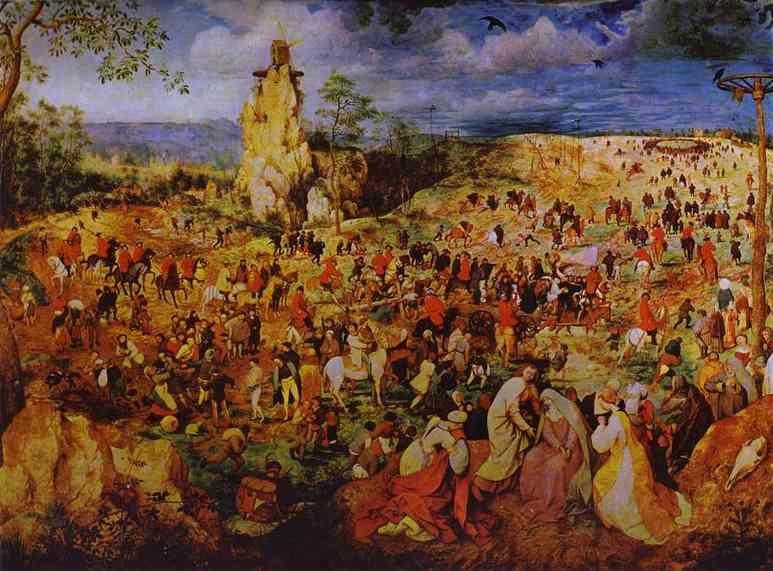
The Easter story has also inspired the best art. There are some decent images of Jesus' birth. But all painters of the Nativity succumb, to one degree or another, to an impulse known as "Ooooh, it's a liddle baby!" This sort of tweeness isn't possible in the cynicism leading up to the Crucifixion, the brutality of the event and the miracle afterwards. Pieter Brugel lashed out at the crowds in The Procession To Calvary, his astonishing depiction of the Crucifixion treated as a Sunday outing. (Pontificated on in more detail in an earlier posting.) Caravaggio played to his strengths too, showing a dark and disturbing Flagellation Of Christ by two satanic guards. Blood is missing from Andrea Mantegna's painting but only because it's all already drained from The Dead Christ; Jesus is as grey as a crypt, four gruesome holes in his body. There isn't, in fact, much optimism in most of the Easter paintings. The focus is on what we lost, not on what we've supposedly gained.

Especially in one of the defining images, Leonardo's The Last Supper. The last stage in Jesus' fatalistic trudge towards his death. The painting captures perfectly the poignancy of the event; and it anticipates the betrayals to come. Leonardo was superb at the precisely ordered group portrait and here it becomes more than an academic demonstration. Jesus sits at the head of the table and the centre of the picture, surrounded by his disciples. He sits alone, however. Those nearest him are leaning or even recoiling away. The ones on the fringes are staring at him, gossiping amongst themselves; but nobody is addressing him directly. He has lost them and he knows this. His face downturned, he spreads his hands out hopelessly. Jesus seems to be asking, what more can I do for you? Die for them – and Leonardo paints this as if it means he's failed.

It's a very human story, the Easter one. There's no constant interaction with a booming voice from the heavens. There's just a religious leader, a little too perfect for his or any other time. One who's betrayed and finally, torn apart by pain, seems to lose his own faith. It's a tragic tale too, the triumph of malice and avarice, and sometimes the Resurrection almost feels like a happy ending tacked on rather artificially. That's not the proper interpretation, I know, but maybe it's an excusable one. Because we do betray our saints and we do excuse our crooks. (Hello Mr Archer and pass on my regards to your new best mate, the Pope.) We do fail because of pettiness or greed or cowardice. We do it all the time and that's probably why somebody had to get himself nailed to a cross to redeem us.

All Your Easter Eggs In One Basket

It was just a story heard in a pub so I'm not sure if it's true. I'd like to think so, however. A supermarket recently claimed we had forgotten the true meaning of Easter eggs. They symbolise the rebirth of Christ, apparently. And so, by extension, buying and gorging mounds of chocolate at this time of year is our holy duty. Actual Christians complained about this so loudly that the supermarket was forced to apologise.

We thought that they weren't creative enough. They could have said, for example, that the crucifix was actually oval shaped. Or perhaps Jesus himself was. Why stop, too, with appropriating eggs? Take the Easter Bunny, for example. Perhaps this came about because when Christ rose from the tomb, he hop-hoppity-hopped away from it.

Of course eggs and bunnies aren't Christian images. They are pagan ones, just like holly and mistletoe and fir trees. There was a festival at springtime and another in midwinter long before Christianity emerged. They were linked directly to the seasons and their symbols reflect this. The winter ones are reassurances, plants which remain green when everything else has died. In spring comes a celebration, images of life and rebirth. The eggs are obvious, a more direct and less gooey substitute for the womb. The Easter bunny began as the March hare, which was rather mystifyingly given great significance by the old religions. The two are linked, incidentally; it was believed that hares hatched from eggs. Which were laid by lapwings, it seems, on the basis that both creatures live in fields. Clear logic was something else yet to appear in these societies.

It's obvious why the early Christian church appropriated the old festivals. The missionaries were doing a selling job. They wanted to give people something clearly recognisable and which didn't interfere with their pleasures too much. The Nativity didn't quite fit with the old solstice festival but did offer a cause for a straightforward celebration, something always needed in the middle of a grim winter. The Easter story, meanwhile, is perfect for spring. At its heart is death and rebirth. Jesus falls, lies in a tomb and rises again. You can take that, on one level, as a metaphor for the crops withering in autumn and miraculously springing to life again when the seasons change.

There are some Christians who don't like this. Now they've got the old festivals, they want to strip the last remaining pagan symbols from them. Get the Christmas trees out of Christmas, the Easter eggs out of Easter. Let's focus on what really matters. This always strikes me as rather ungrateful, turning on your sponsors when you no longer need them. It's a peculiarly irreligious attitude too. After all, holy events aren't just ones which happened two thousand years ago to a narrow cast of characters. Look at other images of Easter: daffodils, blossom, fluffy chicks. They can be rather hard to take on a full stomach, but in their purest form they are symbols of life. Life suddenly bursting out, life at its most unexpected and glorious. And if you can't see the touch of God in these constant miracles, what exactly is the point in believing in Him?

Thursday, April 05, 2007

Well Duh pt. 67

There's been two poll s recently which studied, as Basil Fawlty would say, the bleeding obvious. A couple of months ago, The Guardian discovered that parents didn't know what their teenage offspring get up to. Mums and dads seemed to assume their little angles were sharing cups of Horlicks and playing pinball at the youth club. Instead said angels were, of course, drinking, taking drugs and fornicating with each other. This week a poll of teachers announced that schoolchildren were influenced by what they saw on television. They especially liked repeating catchphrases, the more antisocial the better.

Well, to mimic a thousand American programs, duh. I'm not sure who conducts these surveys or why they don't use a simpler methodology called 'remembering their own childhoods.' Of course teenagers break the law and don't tell their parents. It's half of the essential teenage experience. (The other half being getting depressed and telling absolutely everyone about that). When asked if she knew what I used to get up to my mum replied, no, and she didn't want to either. May this attitude be passed down many generations.

And schools are awash with bad imitations of Catherine Tate and Little Britain today? I recall being swamped with equally dreadful ones of Mr T, Lenny Henry (in his early "Ohhhhh-Kaaayy" years) and Neil from The Young Ones. Children find something they like and mimic it. It's a natural habit and, as this post has oh-so-subtly demonstrated, not confined to the young. Anyway, what do teachers expect children to talk about amongst themselves? Their bloody maths homework?

I do, however, applaud them singling out Catherine Tate's snotty girl character for special criticism. The one with the phrase "Am I bovvered?" as the sole 'joke' in each and every sketch. I know somebody who repeats this often and gratuitously, to the dismay of all around him. That person is my sixty year old father, but that's beside the point. Ban it from our screens. Ban it now.