Friday, January 12, 2007

Another Galaxy

David Beckham has never really fitted in. He emerged with a batch of talented young players at Man Utd in the mid 1990's but was never quite part of the gang. 'Fergie's Fledglings' (and journalists were rummaging frantically through thesauruses to find an alliterative collective name to match The Busby Babes) were mainly local lads with sensible haircuts. They scurried about a lot and played short passes. Nicky Butt was a fine example, a tireless perpetrator of actions tactically critical but invisible to the naked eye. Beckham was always too southern and too flash. From his ludicrous lob of Neil Sullivan in 1995 to his juvenile red card in the 1998 World Cup to his Spice Girl marriage and bewildering array of hairstyles, his career was a constant scream for attention. Nobody was surprised that he became the first of the brood to flee the nest – or possibly be ferociously kicked out of it by Alex Ferguson.

At Real Madrid, though, he went to the opposite extreme at the wrong time. His 'private' life briefly supplanted the most tiresome of soap operas, largely thanks to an imperfect understanding of how a mobile phone text function works. He rarely shone on the pitch, however. Beckham arrived during the era of the galacticos, superannuated stars who did absolutely nothing of value but looked great while failing to do it. Here the epitome was Roberto Carlos, a hilariously inept defender whose sole function was to violently thump free kicks 50 yards over the bar. Beckham just couldn't compete. Shunted from his favourite right midfield slot, he tried proving his worth by scurrying about and playing short passes. Even his hair grew more rational. He turned himself into Nicky Butt.

Hopefully he will find a proper home at LA Galaxy. It hasn't started well, however. When news of his contract - £70,000 a day, a virgin sacrifice tied to the rocks each month and all the ambrosia he can drink – came out, Beckham assured us he wasn't moving for the money. He was attracted by the massive potential of the club and the massive potential of football in America and so on. And who in his new homeland was he trying to convince here? Fans of LA Galaxy, a team which sounds like an especially annoying nightclub, and the rest of the MLS will react like everyone in the football world – a sceptical roll of the eyes so violent it risks straining a muscle. They are only a small group, however. Most US football fanatics care solely about the Latin American countries where they were born or the high school team which their daughter plays for.

Many Americans do like money, however. They like celebrities too, and they especially like celebrities who flaunt their money shamelessly. Beckham needs to go for this market if he wants to make himself a genuine star in the States. He should wave his contract like a talisman and pretend that being the highest paid player in history magically makes him the best. He should cruise the chat show circuits, he should build a Beverley Hills mansion which makes Beckingham Palace look tasteful and humble. It's likely to help football in America. Previously a stunted, stigmatised immigrant, the sport is suddenly offering the absurd salaries of basketball and attracting the corresponding attention. LA Galaxy's attendances will surge, part of the new crowd being enthusiastic teams of auditors wondering how the hell they can afford it. And if Beckham really gives it his best, if he pushes his image to the max, perhaps nobody will notice that he's an ageing trundler who can manage about three half-decent crosses per game.

Sunday, January 07, 2007

Speak Softly And Carry A Big Neocon

I knew it couldn't last. From the start, George Bush's presidency has been marked by a refusal to compromise. To enemies, to different viewpoints, to the basic framework of common sense. Undeterred by the fact that he won his first election through methods which would have embarrassed the yellowest of banana republics, he instantly purged Washington of liberals and replaced them with fanatical, often barely sane right wingers. That set a tone which rarely altered. Whether invading Iraq because he wanted to, refusing to rebuild New Orleans because most of the people made homeless were black or trying to appoint to the Supreme Court a woman with little judicial experience but who used to dangle him on his knee when he was a wee wee boy, Bush's shamelessness has been almost breathtaking.

Last November, though, the tone abruptly changed. The White House was embracing centrist policies, we heard. It was embracing the forbidden delights of bipartisan policies with both arms. It really, really loved the Democratic Party. This sudden passion possibly came because said party now controlled the Senate and could, if it wished, starve Bush of all funding and put his friends on trial for an astonishing array of misdemeanours.

For some Republicans, the conversion appears permanent. Arnold Scharzenegger, for example, has convincingly reinvented himself as a liberal eco-warrior. (Though the wording of his latest announcements, where he compared himself to Saul on the road to Damascus, hints that he may have damaged more than his legs in his recent skiing accident). Perhaps Bush also meant what he said for a while. Something inside him seems to have snapped, however. He listened to James Baker's recommendation for a rapid troop withdrawal from Iraq and negotiations with Iran and Syria. He listened and laughed quite a lot in private and is now preparing an alternative Blueprint For Peace. We don't, as yet, know for definite that Bush intends throwing pretty much the entire American army into the Middle East. But there are clues in Friday's reshuffling of the top military personnel. The two generals currently in Iraq, both sympathetic to Baker's report, are being withdrawn. In their place comes David 'Ripper' Petraeus and William 'Fallout' Fallon (I may have made these nicknames up myself), men renowned for tearing their enemies to bits and dancing on the fragments.

I knew it couldn't last and I'm quite glad it hasn't. In today's grey world, with identical parties battling over miniscule issues and careerist politicians propelled entirely by image, we need people who refuse to taint their beliefs. The American neocons, together with the Muslim fundamentalists, are one of the few significant groups left who are driven by ideology. Both have overlooked a few small points – that the aim should be to build a utopia rather than a dystopia, that the destruction of the world is not actually a good thing. But nobody's perfect.

Saturday, December 23, 2006

Yo Ho Ho etc.

I was going to write a much longer piece about Christmas. The theme would be The Irrational Yet Immutable Rituals And How They Make Christmas A Vibrant And Thoroughly Modern Festival. The title needed some work. And now I realise that I can't be bothered to finish any of it. There's presents to wrap, bells to ring etc. So instead, here's three aspects which to me epitomise the true spirit of the holiday.

1. Mashed Potatoes Nobody ever wants to eat the things. We've got turkey, sausages and stuffing on our plate (or in my case, a rather wonderful nutloaf). We've got sprouts and roast potatoes too, we've got figgy pudding to come and we've been gorging on chocolates all day. To a very full stomach, a white and largely tasteless lump doesn't really have much appeal. We take a tiny spoonful each and the vast majority gets thrown away. But if you leave out the mashed potatoes, everyone would complain. They are part of The Meal, they must be there. And I would complain as loud as anybody.

2. Santa Claus. Santa Claus is a god, let's make no mistake about that. He flies across the sky, he has supernatural powers, he enters our homes, he even has his own mantras. Most importantly, he makes moral judgements and rewards or punishes accordingly. Yet, though Bart Simpson said Christmas "celebrates the birth of Santa," he was generated by the festival not vice versa. He only became a central component after it was relatively mature. And after his one night of power he sinks back into the Arctic ice for another year. His jurisdiction is also limited to the very young. We are expected to believe in him absolutely for our first few years and then reject him as an essential part of maturing. And his sanctions only take the form of presents or the lack thereof; Black Peter and his club were given the boot a long time ago. Compartmentalised, materialistic, even partly designed by a fizzy drink corporation – if you ever wondered what sort of deity modern society would create, look no further than Santa Claus.

3. The Media Build-Up Some rituals shift over the years, others stay the same. A while ago the favourite was Santas Behaving Badly. Jolly men in red suits would have a few bevvies and start fights, or urinate in the street, or enter a stranger's house to take away rather more than a glass of sherry and a mince pie. Nowadays we hear a lot about councils in Tamworth or St Albans refusing to put up Christmas lights lest it offends the three Buddhist families in their ward. Nobody really cares, even the people in the affected towns. But they're always seized on by national papers on permanent PC Watch as symbols of our national decline. Other stories have an eternal appeal. Babies abandoned; old people abandoned; holidaymakers stranded in airports. "It shouldn't happen over Christmas" the writers wail, apparently believing that natural laws decree everyone should be happy and loved for one particular day a year. These tales always play well, tapping into the Victorian sentimentality which is still vital in shaping the festival. But they forget that the most striking image of Christmas is still one of absolute poverty: a stranded mother giving birth in a stable.

Sunday, December 10, 2006

A Million To One, They Said

Greeted last week's news that there may be running water on Mars with a blend of excitement and frustration. Excitement because water is a basic prerequisite of life. And if some is still flowing on Mars' surface, rather than being locked up in permafrost around the poles, then living organisms could be existing around it. They won't be much, of course, just some rubbish form of algae. But life on another planet is still a major discovery; and life on Mars, because of H G Wells and David Bowie, especially evocative.

Frustration because nobody's actually sure about the water yet. They've just studied patterns of rock falls and concluded they were most likely caused by a stream which quickly evaporated. Then again, maybe they weren't. They could also have been made by rocks just, you know, falling. The only way to be certain, it seems to me, is to actually put somebody on the surface and ask them if anything's bubbling out of the ground. Instead NASA continues to rely on vague, blurry snapshots taken by unmanned probes. Logical deduction based on partial evidence is sometimes a necessary part of science. But there really is no substitute to actually being there. After all, in 1492 a Genoan set off westwards from Portugal with all existing knowledge telling him that he wouldn't hit land before India.

And the chances of the life on Mars being human seem remote right now. It hasn't gone well in recent decades, our great conquest of space. We got to the nearest possible destination and then just stopped. All recent shuttle voyages have been devoted to repairing the International Space Station. The ones which go ahead, that is, because the shuttles seem to be falling apart even quicker than the ISS itself. The ISS is a promising development, and a great name, but I'm not certain what actually happens there. Probably more pictures taken of distant galaxies from which scientists can make remarkably dubious deductions.

I know space travel costs a lot. And the American government needs their funds to meet their core aims: making billionaires even richer and knocking the Middle East to pieces. But mankind, we're always told, is supposed to be an explorer. Not just a peerer and a guesser. I'm also worried that if we ever do make contact with intelligent life from the stars, the prediction closest to the truth will be Douglas Adams'. Where we're irritably told by the aliens that their plans for demolishing Earth have been on public display at Alpha Centauri "only four light years away… If you can't be bothered to take an interest in local affairs that's your lookout."

Tolerance, British Style

Tony Blair's latest contribution to the multi-culturalism debate could have been worst. The language was less than diplomatic – essentially "Respect our values of tolerance or piss off home, you dirty wogs." But there's nothing wrong with his central message, that Britain shouldn't welcome people who then go on to actively hate Britain.

What puzzled me is how he segued into the issue of wearing veils in public. There may be an automatic link between women covering their faces and men planting bombs on public transport. I've never seen it, though it seems obvious to Blair. Also a matter of "plain common sense" for him is that Kirklees Council was correct to fire a teaching assistant for refusing to remove her veil in the classroom. Being able to see somebody's face, he implied, is essential to the pedagogic process. Now it's been a long time since I was a pupil, but I don't recall the details of a teacher's face being very important. Unless they were especially unusual, of course, in which case you got to make fun of them. The correct posture in the classroom was to gaze apathetically at your desk. You tried not to look at the teacher at all. That only encouraged them to ask you questions and nobody wants that.

Women wearing veils should only be a concern when they are forced to do so against their wishes. Many aren't. And even when they are, these sweeping bans punish them rather than those bullying them. Being denied access to Jack Straw's constituency offices, which Blair also defended, is one thing and rather a blessing in disguise. But being fired for wearing an item of clothing central to your culture? It's not really British tolerance at its most impressive.

Saturday, December 02, 2006

Time To Roll The Credits Please

We've all seen Hollywood blockbusters like this. They start well enough; taut atmosphere, sinister bad guys, menacing soundtrack. Then they just seem to lose it. Everyone's killing everyone and a plot to blow up a small municipal bookstore somehow becomes something threatening the whole galaxy. There's nothing to do but wait for the villain to die his third and final death so the credits can arrive.

So it is with the Alexander Litvinenko story. For a while it was possible to ignore the human tragedies or broader political implications and just enjoy it as a rollicking good yarn. The beginning was intriguing enough: a former KGB agent poisoned in London, most likely by the modern equivalent of the KGB. For days one astounding revelation followed another. They culminated in the news that Litvinenko had polonium-210 slipped into his sushi and the maginifcent Guardian headline 'The Radioactive Spy.' But once again, things have gotten out of hand. The so-called radiation 'trails' appear to have ended up covering most of Europe. Now Litvinenko's associate, Mario Scaramella, seems to have been poisoned too and you wonder where things are going to end. It's no longer possible to willingly suspend disbelief; or indeed the question "why didn't they just shoot him for Christ's sake?"

It began as a John le Carre and has turned into a James Bond. And anyone who's seen Casino Royale, or indeed any Bond film made in the last twenty five years, will know that's not a compliment. At this rate matters will culminate in Big Ben exploding while the hero (John Reid played by Sean Connery, possibly) rescues the woman in the nick of time. We needed a break from David Cameron, Pete Docherty's 47th drug bust and the Iraqi 'Not A Civil War, Not On Your Life' insurgency, but this is a bit much.

Sunday, November 26, 2006

'Flatford Mill'


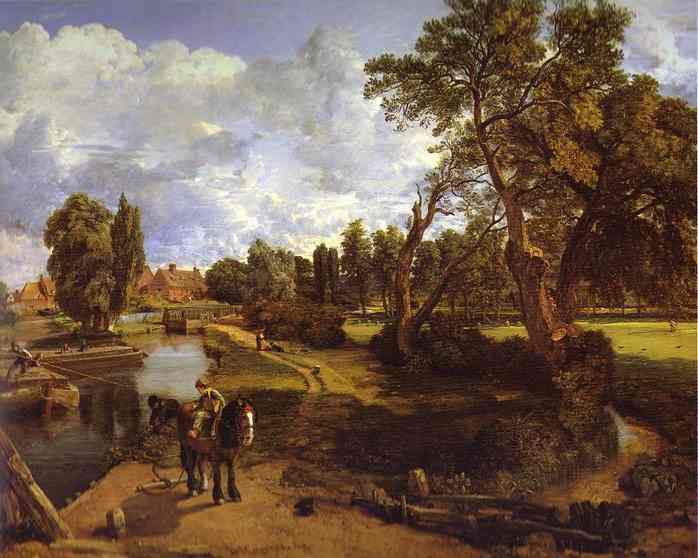
My parents had John Constable table mats when I was a child. Serious critics tend to excuse the great artists when they become consumer goods, saying it's a simple case of a glorious vision being perverted. My opinion is that the artists who get picked usually deserve it. Buy an Impressionist coaster set and you'll probably get Monet's water lilies, not Degas' vaudeville girls. Canalletto's Venetian picture postcards make good mouse mats, Caravaggio's dark melodramas don't. The people who produce these things knows that what sells in the home furnishing market is the idyllic and the bland. There are a lot of Constable table mats.

Flatford Mill has been chosen here but any number of Constable's works would have sufficed. He followed a template with minimum variety. In the foreground are generally one or two small figures. Few details can be made out on them. We learn little from even the most careful study. They are Rustics and their job is to look quaint. Constable put them to work on varying rural tasks which his aristocratic patrons liked to see doing so long as the labourer is not themselves. Here they are performing something mystifying involving boats. Elsewhere they might be fishing or driving a cart. The figures by Flatford Mill are young boys, which was a common Constable trick. Children look quaint almost by default. And they exude an innocence which seeps out over the whole painting and smothers any questions about the facts of rural life.

The figures, though, are shrivelled by their surroundings. This is a device sometimes to stunning effect. See Fragonard's Grand Cascade At Tivoli, for example, to see a demonstration of humanity's insignificance compared to nature, or Goya's Colossus for our helplessness in the face of disaster. But it doesn't quite work when the landscapes are as tedious as Constable's. What does he give us? Blue and green, green and blue. Green grass, blue sky, blue river, green leaves; the green of the trees even reflected in the blue water. There is a small brown patch in the foreground, some tiny red cottages in the distance and this is quite radical for Constable. He rarely admitted any breaks in his verdant utopias. No acknowledgement, for example, that sometimes leaves fall off trees, grasses parch and the sun occasionally sets.

And the eye searches for relief in the colour scheme because so little else is happening at Flatford Mill. Nobody is coming to intrude on the boys. No wind rustles the trees. No birds fly across the sky. All is neat and tidy, perfectly ordered by the artist. This is a flat and lifeless scene, removed from reality and stripped of any deeper meaning.

There's nothing wrong with creating from the imagination or even following a template. Lowrie, for one, basically painted the same picture his whole life and it was always several steps from sanity. But Lowrie was interesting because nobody had done anything quite like him before. Many had prior to Constable, even more have since. He either had the least fertile imagination possible or he let it be filled by others. The ruling classes, basically. His paintings are embodiments of the laziest clichés about England. The 'green and pleasant land,' that evocation of timeless plenty which is forever used to excuse all our failings. I can't look at Flatford Mill without remembering John Major quoting Orwell's grisly lines about spinsters cycling to village churches. Or The Day Today's spoof propaganda film: a jolly policeman smoking a bifta while a voice drones "This is England. And it's all right. Everything's all right…"

Everything isn't, of course. It certainly wasn't in 1817 when Flatford Mill was painting. A godless alliance of capitalists and aristocrats were stripping the last few rights from the rural poor. The happy, faceless peasants which Constable painted were being thrown off the land and into the workshops and proto-factories which comprised the first, worst stage of the Industrial Revolution. His scenes were outdated even when he painted them. But at best he ignored these changes, at worst he ignored the agents implementing them. As a result he gave us unnatural nature scenes and social commentaries with no social worth whatsoever. On to the dinner table with them all, where at least they can perform one useful function.

Thursday, November 16, 2006

A Glorious Revolution?

Currently reading The Glorious Revolution, Edward Vallance's account of the events in 1688 which replaced James II with William and Mary on the British throne. Vallance is a revisionist to some extent, of course. Any historian who doesn't at least claim to be rewriting history won't find a publisher nowadays. He points out that the Glorious Revolution wasn't exactly a revolution. Though it had wide support in a Protestant England terrified of the Catholic, authoritarian James, it was basically a Dutch invasion which led to the crowning of a Dutch duke. (Mary was co-ruler only in name, partly on her own insistence). Most of the gentry went over to William's side when his armada landed. James was rather inconveniently left without an army and fled without a fight. But he would have probably lost anyway.

Nor, Vallance, states, was the 'Revolution' very Glorious. Outside of England it certainly wasn't bloodless. Rebellions against William in Ireland and Scotland culminated in the massacres of the Boyne and Glencoe. The Scottish resistance rumbled on for half a century until the final bloodshed at Culloden. No sooner was William comfy on the throne then he began a war with France which Britain could neither win nor afford. Vallance is also sceptical that 1688 marked, as is generally asserted, the birth of English liberty. William paid a little more attention to Parliament but only after packing it full of loyal Anglicans. Free speech was growing at the time, especially in the coffee house phenomenon, but in spite rather than because of government policy. The English Bill of Rights was certainly feeble compared to the American version. It was simply a reaffirmation of existing liberties, which were remarkably few. Unlike forty years earlier, there was no belief that the country could actually do without a monarch.

Vallance also gives a partial defence of James II. He wasn't trying to forcibly re-convert Britain to Catholicism, as was often claimed. His only legislation tried to reduce the civil but systematic discrimination against Catholics. His less laudable actions, from butchering the followers of a feeble uprising to rigging parliamentary elections, were fairly standard for the time. But his brusque personality and habit of increasing his standing army excited fears of absolutist rule, quite apart from his religion. I would have probably shared this paranoia. James was becoming increasingly authoritarian after only three years. Who knows what he would have been like if power had time to corrupt him properly?

Anyway, his true character is beside the point. Most people didn't want James. There was an energetic attempt to exclude him from the succession during the last years of his brother's reign. They stuck with him for a while, saw he was apparently as bad as they thought and simply replaced him. Britain still had to have a king, it seemed, but Britain would have the king it wanted. The notion of a divine right to rule died abruptly. And I think that the modern British attitude to its monarchy began to be created in its place. You can see a line, if not a direct one, leading from the Glorious Revolution to the events in Westminster this week. Where an overdressed woman announces the legislation to be introduced by 'her' government – yet is still only a hired orator for the elected rulers.

Saturday, November 11, 2006

When A Shite Is Not A Shite

A linguistic dispute is currently raging in English football. On Wednesday referee Graham Poll denied Everton's claims for a penalty and then dismissed their striker James McFadden. McFadden, he alleges, called him a "fucking cheat." The striker has denied the charge. He was abusing the decision, not the referee himself. Furthermore, the phrase he used was "fucking shite."

It's an interesting defence given that McFadden was sent off for foul and abusive language. Effectively he's saying that his crime is twice as bad as originally thought. But of course he was actually punished for abusing the referee, not for cussing. The 'foul and abusive language' charge is only ever used tactically. If footballers were red carded each time they swore, every pitch would be cleared of players within five minutes of kick off.

So let this be a lesson to all you youngsters. When you swear at a referee, which you almost certainly will, speak loudly and clearly. Just in case, use a word that states you may still love the sinner while hating the sin. McFadden has demonstrated the dangers of "fucking shite." "Fucking shit" may be misinterpreted as "fucking tit," "fucking crap" as "fucking twat." I personally recommend "fucking bollocks." A little clumsy, perhaps, but guaranteed to ensure you stay on the pitch till the final whistle.

Sunday, November 05, 2006

Guy Fawkes' Night

As a child, my favourite part of Guy Fawkes' Night was probably the gingerbread men. They had to be eaten in a particular way, naturally. You bit the arms and legs off first. Then you munched through the torso until all you had left was a decapitated head. This would be consumed with painstaking care, ideally the eyes left till the very last.

Nowadays my favourite part is explaining the festival to foreigners. "Fawkes," I say, "Was a Catholic who tried to blow up King James and his parliament. He was caught, and he and his accomplices were executed in an especially gruesome fashion. So now every year we make effigies of him, throw him on a bonfire and watch the fucker burn. Then we let off fireworks in celebration. And we let all the kiddies watch." If my audience doesn't look suitably horrified, I go on to tell them about the gingerbread men.

Every year there are protests about Guy Fawkes' Night. Especially in York, where Fawkes was born and raised. Local voices are always calling for him to be shown more respect, unabashed that our second most famous son was a rather dim wannabee mass murderer. (Our most famous, the Emperor Constantine, did actually manage to kill a lot of people though was considerably brighter.) I suppose these have some validity. In these religiously sensitive times, it's not good to be ceremonially burning a prominent Catholic. Though things have improved slightly; originally the effigies were of the Pope rather than Fawkes.

But the night isn't really about the thwarting of some remote, half-baked Catholic plot. That's just become the modern peg for an older urge; just as the birth of Jesus and the switch of calendars are to some extent for Christmas and New Year. Guy Fawkes' Night is about defying the season. The nights are encroaching, the chill is mounting. For one evening we like to build great beacons against the darkness. And against the creatures once thought to lurk there. It's probably no coincidence that Guy Fawkes' Night lies close to the older festival of Halloween. The ghosts who emerge are supposed to be vanquished by All Saints Day the following morning. Just in case any aren't, however, here's a barrage of bangers and rockets to scare them off.

Most countries have a night when they let off a barrel load of fireworks. The British may have chosen an especially perverse excuse for ours. But it's really no odder than the Americans or the French letting off their fireworks in the middle of summer, when they need them least of all.