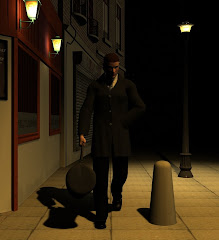
The Guardian recently highlighted a new phenomenon on our streets, comical and disturbing in equal measure. The Mosquito, an ultrasonic device which apparently emits regular, high-pitched beeps only audible to the under-25's. It is designed to be fitted to shops and the like, and to make any loitering teenagers so annoyed that they will eventually skulk off. The aim is to stop them indulging in that act which has so blighted our cities – Hanging Around and Sometimes Swearing.
This is amusing because I can't imagine for a second that this dog-whistle-in-reverse can ever work. The human ear changes a little as we age, I know. But is there really a switch that suddenly flicks on one's 25th birthday preventing you hearing anything above a certain frequency? And even if the science holds, the effect surely won't be what is intended. If youths are ever annoyed by something, youths with enough time to identify the source and a propensity to petty vandalism – well, that object is going to become a lot of serrated metal and cut wires fairly soon. Besides, who's to say that teenagers will be repelled by repetitive beeps? This is, after all, the generation which rediscovered the joys of illegal raves. They just need to bring along a beatbox and the Mosquito will supply the soundtrack for their evenings.
More disturbing is the intention. Mosquitoes aren't burglar alarms. They aren't anything to do with crime prevention. They are designed to deny people access to areas which are supposedly open to the public. Not all people either – note the targeting, even if it doesn't work in practice. Mosquitoes are the next stage in an increasingly vicious campaign against youth. It's a war which has included Asbos – punishments which don't require convictions or juries or proof – and a Prime Minister talking about the handily nebulous idea of "anti-social behaviour." Now it's going to the next level. Excluding teenagers from the streets entirely, only one step away from blanket curfews.
The posters for Mosquitoes apparently show a hoodie screaming in pain. Of course they used this image. The hoodie, an object rivalled only in modern demonology by the burqa. (Why is our society so reassured by the sight of human hair anyway?) The icon of the "feral gangs," in the words of the Daily Mail, who have taken over the night time streets. Not by committing crimes all that often, you understand. But simply by the foul act of Hanging Around and Sometimes Swearing.
Moral panic towards the young is nothing new. Stanley Cohen coined the phrase in his analysis of the huge campaigns whipped up against tiny groups of mods and rockers in the 1950's. But it seems particularly intense at the moment, when hysteria is so fashionable but the choice of targets are so restricted. If journalists want to frighten their readers but don't want to seem like racists, they usually have to pick on teenagers.
Asked if they support devices like the Mosquito, people often cite their own nervousness towards groups of teenagers. They usually seem a little awkward saying this, however. There is some recognition that it's silly to be scared of undernourished youths in silly jumpers doing nothing more than HASS-ing. And it is irrational. It's a phobia and it can be beaten. The first step is to keep the Daily Mail and their ilk a safe distance away. Perhaps with some sort of ultrasonic device.
Thursday, March 22, 2007
An Anti-Social Crime


Friday, March 09, 2007
King Balthazar
Genealogy is the same most of the time. I'm sure I would have loved to meet my great-great-great uncle, even if he had been a birdwatcher. But I'm not that interested in his life. He would have been a tailor or a minister because nearly everyone's was. Or a blacksmith or a farmer or so on. Taken as a mass, the facts of ordinary people can form social history. On an individual level there's some interesting stories to b found. But generally, families aren't enthralling. They drifted around the country getting on with things, occasionally reproducing and/or dying. Genealogy is the collection of names, knowledge for the sake of it.
Occasionally, though, surprising ancestors can be found. Like those of the magnificently named Balthazar Napoleon de Bourbon. Historians are now fairly sure that Balthazar would be heir to the throne of France, if only there was still a throne of France. Which is hinted at by his name but not his person – a very Indian looking Indian lawyer living in Bhopal. The link seems to come from a rather demented sixteenth century nephew of Henry IV who 'swashbuckled' – i.e. blundered – around the world and founded a long line of Indian Bourbons. Somehow they survived, too obscure for even Robespierre to track them down and eradicate them.
Balthazar himself doesn't seem too excited by the revelations. Not surprisingly given that a) the last proper King of France got decapitated and b) there's no money. "Bourbon on the rocks" he calls his family, which is quite a good joke for someone with royal blood. Though he's filled his house with French geegaws, he isn't given himself airs. Tess of the D'urbevilles' life was ruined by genealogy. The discovery of a distant connection to the local wealthy family filled her father with pretensions, starting the chain of events which eventually destroyed her. Any daughters of King Balthazar will probably escape the same fate.
Thursday, March 01, 2007
The Man From Another Planet
My main objection to the show, however, concerns the title. It's clever enough. The Brave Old World which Simm lands on is made to look so thuggish and unrefined that it does seem like another planet sometimes. David Bowie's song Life On Mars was also released in 1973. Another notable event that year was my birth. So I've got to accept that during my lifetime, every facet of society has changed almost beyond recognition? Nothing seems all that different, to be honest.
It's going to get worst too. The decade of my adolescence, the 1980's, is currently very recognisable. It's the era of choice for the retro-bars. This is actually quite fun; I can tell people that I hated leg warmers and the New Romantics at the time and hate them just as much now. But they're going to go out of fashion soon and stay out this time. The magazine editors will move on to the 1990's and start pretending they love ripped jeans and Britpop. And the whole of my childhood will sink into an incomprehensible murk, as distant from modern life as pantaloons, rationing or Glenn Miller.
Friday, February 23, 2007
The Long And Short Of It
The biggest contrasts were between Peter Hain, Northern Ireland Secretary, and John Reid, Home Secretary. Hain's replies were multi-sectioned wonders. They weren't that badly phrased but they just never ended. On the issue of when British troops should withdraw from Iraq, for example: "We should bring our troops home as soon as the situation on the ground allows and not stay a day longer than is needed to enable a safe handover to the Iraq people and their democratically elected government."
And that was before he started squirming. Asked if an enquiry about the war should be held after Tony Blair leaves office, he really lets go. I won't quote his last sentence in full. But it's got over 60 words and turns, apparently spontaneously, into an epic saga detailing all Blair's achievements in office. It's no wonder Hain has been a success in Northern Ireland. Sinn Fein and the Ulster Unionists must agree to anything just to shut him up.
John Reid, meanwhile, simply answers "No" to three of the five questions. Even when he bothers with actual sentences there are mitigating circumstances. Saying "when the time is right" in response to the British withdrawal seems uncharacteristically chatty. But he was actually just repeating one of the three options given in the question. Effectively his answer was "Box C please, Noel." As for claiming "I cannot answer a hypothetical question" when asked if he would support a future military strike on Iran – well, it's hard to see how this could have been phrased more concisely. "That's a hypothetical question" would raise the rebuttal "So what?" "I don't know" was what he was really saying, but that would make him look at fault rather than the interviewer. And Reid is a master at transferring the blame.
Opinions will vary on whether he appears succinct or arrogant, whether Hain comes across as an intellectual or a windbag. But I can guess who's won the support of your standard lazy journalist. Reid has given them some neat soundbites in the past, mainly about how bloody awful his Home Office is. If he gets into Downing Street, though, they may have to put in some effort to fill their column inches. With Hain, they'll just have to switch the microphones on and sit back.
Saturday, February 17, 2007
Empires
I'm not sure how Livy knows these speeches so well. One, for example, was delivered as a general was preparing to flush out some barbarians from a mountain chain in the middle of Turkey. It's unlikely that a clerk was faithfully jotting down every word. I suspected that Livy invented most of them. But then a blitheness about the veracity of accounts is also a feature of traditional history. This has some advantages. Livy was exploring what was then relatively uncharted territory. When modern historians do the same (looking at the 7th and 8th centuries, for example), they spend most of their time moaning about the paucity of evidence. Livy just gets on with it. His only comments on methodology is to occasionally observe that one historian claims 40,000 enemy soldiers were slaughtered in a battle, another that ten men were slightly wounded and two more contracted nasty head colds. It's worth noting that nobody complains about the lack of sources for Roman times. After all, we have Livy. Who based his statements on… what, exactly?
Like all historians from history, Livy comes with a Handle With Care notice. He was writing as the Imperial structures were first solidifying under Augustus. Like many men at the time, he saw this as degenerating the Roman spirit. Accordingly, he sometimes over-exaggerates the dignity and grandeur of the Republic as he analysis its rise. No modern historians carry such a warning, incidentally, even though their works are increasingly subjective. We just have to remember that all interpretations are filtered through Western, capitalist, democratic minds. But Livy's approach is definitely indicative of his culture. His belief in his, often unsubstantiated, statements mirrors the confidence of the Romans. Yet this self-assurance rarely, under the Republic at least, transformed into vanity and certainly not into a dubious concept like destiny. The Romans believed they would become greater and greater, but also believed in planning for this. So they painstakingly laid out a baffling network of structures across the Empire. This meticulousness is copied in the dense mat of facts which Livy rolls out.
All histories carry parallels and warnings about modern times. Rome under the Republic was an oligarchy not a democracy. It was also a rigidly stratified society which accepted slavery as a natural condition. But the extent to which they limited the potential power of any one individual was remarkable. The highest office, that of Consul, could only be held for a single year, was hemmed in by other institutions and was always shared with another Consul of equal rank. Compare that with the Emperors who came later, enjoying untrammelled authority and turning themselves into living gods; or even with our own presidents and prime ministers. One result was a dearth of hero-worship which puts our set-'em-up-and-knock-'em-down ethos to shame. Scipio Africanus, greatest general of the Republic, who defeated Hannibal and all his elephants to save Rome – even Scipio spent his last years pursued by an embezzlement charge. He just got off through the force of his reputation, and by dying rather opportunely, but it was a close thing. Livy seems both disapproving of this treatment and also rather awestruck that it was ever possible. We can link this restriction of the individual with the lack of personal vanity in politics, the faith in institutions rather than destiny. And also conclude that the approach was the right one. After all, the Emperors didn't build most of the Roman Empire. The legions of prosaic Consuls did that. Those flashy demi-gods we love so much just inherited it. And then let it, piece by piece, fall apart.
One of the central events in this volume of Livy is the Second Macedonian War. Threatened by the ambitious Philip of Macedon, the Greek states – nominally independent but clients of Rome – appealed for help. The fascinating part of the war isn't Livy's interminable accounts of the numerous battles but the aftermath of Rome's victory. It promptly withdrew all its legions and garrisons and gave the Greek towns their independence back. Livy is as entranced by this benevolence as the grateful Greeks. The propagandist in him coming to the fore, he doesn't mention the economic interests which Rome was protecting, nor their concerns that if Philip conquered Greece he would turn to Italy next. Nonetheless, you can only be so cynical about the event. Rome had performed an action atypical of any era. Starting a war to preserve another country's autonomy and not welching on the bargain afterwards.
It reminded me of America in World War II. They never really had to enter that conflict. Pearl Harbour could just as easily have frightened them into doing a deal with Hitler. They came to Britain's aid, though, and they liberated Western Europe and then they left again. Well, sort of. I wonder what would have happened if they had withdrawn as thoroughly as the Romans pulled out of Greece, if the Soviet Union had done likewise after emancipating Eastern Europe. It would probably still just have been a matter of time. After all, Rome's hold on its Greek clients grew firmer and firmer until they were just vassals in an empire. But maybe right now we wouldn't be where we are. With America convinced it has the right to do whatever it wants anywhere in the world, with all reason subordinate to the ideology of its greatness. Led by an enfeebled Senate and an Emperor of with the common sense of Caliglua and, on occasion, the sanity of Nero.
Saturday, January 27, 2007
Montgomery Bush
His motives were similar to George Bush's, though less ambitious. Monty Burns wanted to increase dependence on his horribly unsafe power plant. Bush wishes to protect the rights of all polluters everywhere. I also wonder if the President is considering some of the other radical eco-solutions from The Simpsons. In another episode, Springfield got so horribly polluted that they just packed the whole town up and moved it somewhere else. Is Bush already scouting out other planets and collecting tugships and an awful lot of rope?
Mr Burns was eventually thwarted when he was shot by the Simpsons' baby, Maggie. I'm not, of course, suggesting that America's toddlers take such a radical step. But the current climate in Washington is so surreal, I wouldn't be surprised if it happens anyway.
Friday, January 26, 2007
Blinding Faith
So much for having the coolest Archbishop in England. When John Sentamu came to York, I thought we were getting something. The man from Uganda was a former victim of Idi Amin, a campaigner against racism and capitalism's more brutal excesses. He started well too, speaking wisely about faith and compassionately about job losses in the city. But he seems to be stumbling on the subject which trips up most of his church. Homosexuality.
The government is finally looking to bring Catholic adoption agencies into something resembling the modern era. These agencies have been freely excluding couples who can provide a happy, supportive home to orphans but happen to be of a shared sex. It's ludicrous that they have been allowed to do this for so long. As Harriet Harman said in an uncharacteristic moment of insight, "You can't be a little bit against discrimination." Labour has been hitherto largely because of a sustained lobbying campaign by church members, including some in the Cabinet. In one of those heart-warming examples of how bigotry can unite rival churches, the Anglicans have sided with their former Catholic enemies.
The Catholic defence is the usual one. Homosexuality is against the teachings of their church, full stop. Essentially each man is pointing up the hierarchy and saying "It's his fault," until the chain of guilt leads all the way to the man in Rome. Who could, I suppose, say he's just following lessons learnt when he was a young lad in the Hitler Youth. Protestants never have that excuse. So, in eerily similar statements, John Sentamu and Rowan Williams are citing freedom of conscience. Personal ethics are at stake, they say, and these should never be a matter of legislation.
Williams has caved in so often on the matter of homosexuality that the Health & Safety Executive now warn people not to stand too close to him. But, as said, I expected more of Sentamu. Never mind that all freedoms are always going to have parameters set by the government, that some individual consciences are basically evil, that Idi Amin probably thought he was following his when he locked up Sentamu. That's obvious enough, though possibly not to the Archbishop. What Sentamu maybe should have considered was whether his conscience was telling him the right thing.
What exactly is the defence anyway? It isn't the Canal Street cruisers which the adoption agencies are excluding. It is couples who can prove they are in a stable relationship and can provide a prosperous home. This isn't fair on the children being denied that, never mind the couples themselves. And what the hell is the issue with homosexuality anyway? It's condemned in the Bible a couple of times. Many things are and are freely indulged now, even by churchmen. It prevents the couples from breeding naturally. Well, the days when the human race needed to go forth and multiply are over. With over 6.5 billion of us in the world, perhaps we've multiplied a little too much. Some details in the Bible are antiquated. It's time to stop clinging onto them and focus on the main message. Gay couples can show devotion and fidelity, to each other and their families, and that's in line with God's teachings. He didn't say He was the God of Love, only to add "Oh, except for these kinds…"
The steps should be: work out if your conscience is correct. Then defend its freedom. Sentamu needs to be careful. Soon he'll be saying that government policies are political correctness gone mad, and then there will really be no hope for him.
Thursday, January 25, 2007
'Nighthawks'
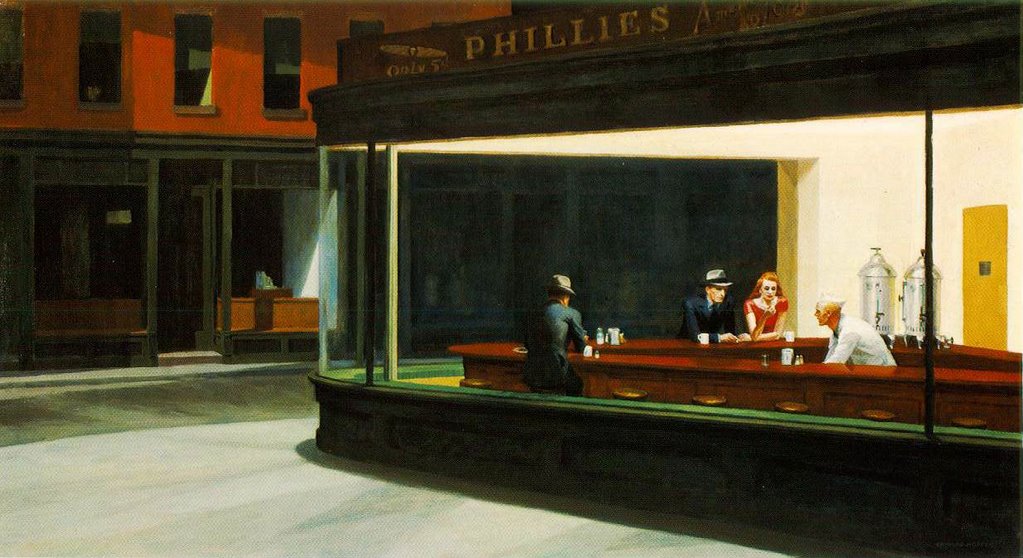
Can you be a great artist without leading a classic artist's life? Edward Hopper thought so. He had perhaps the least eventful existence of any successful painter. It was entirely spent in the same city, New York, and mostly even in the same studio. He started as a commercial artist and made the transition to an independent one with absurd tranquillity. He married his wife Jo in 1924 and saw no reason not to stay married to her until his death forty three years later. There was no apparent turmoil, no flamboyance and no self-destruction.
Of course you don't need any of that if you're brilliant – which Hopper certainly was. Its absence, though, might influence the sort of art you create. Hopper became known as a 'neo-realist.' His scenes, apparently only one stage away from photography, are of mundane little nooks and corners, the unremarkable sidestreets of the modern world. A better word for him is actually a 'hyper-realist;. There is nothing dramatic or beautiful to distract us from his visions of normality. We are forced to focus on the real world as it is – and see the truths he has subtly placed inside.
Nighthawks is effectively a picture of two halves. The left hand side gives a classic Hopper image. Though he painted some pastorals too, he tended to focus on towns or cities. And they are urban landscapes from which all trace of nature has been removed. Take The City, where the flat tops of the buildings compose a new form of terrain which stretches to the horizon. His cityscapes lack something else too. Namely people, the things for which they were supposedly created. The shops in Drug Store and Early Sunday Morning apparently serve nobody and are served by nobody. They have no function. Likewise the dark street in Nighthawks. It could have been made picturesque or menacing. But it is simply empty in every sense, a place without a soul, and so becomes almost pitiful.
The other half of the painting is dominated by the harsh glare of the coffee house. Hopper could do light and shade better than anyone since Caravaggio. He used them quite differently, however. Caravaggio was theatrical, his striking beams of light piercing thick pools of gloom and illuminating every wrinkle of his actors. Hopper's lights are generally weak little beacons standing alone. The lamps of the petrol station in Gas, struggling to keep at bay the threatening shadows of the night forest. And those of Nighthawks' coffee shop, which is revealed to be almost as empty as the street outside. It is the epitome of bleakness. Blank walls, an unpainted door, the only adornments the two water heaters and a few scattered utensils. If we saw this place in real life, we would walk straight past. But now we are forced to stare inside.
Four figures are there, a surprisingly high number for Hopper. More typical is how he has placed them. None are looking at each other. Nobody ever does in his works, not even the young lovers on a Summer Evening. One man is turned away, half his body and apparently all of his mood swallowed by gloom. The couple in the middle may be together but there is no connection between them. The woman examines her fingernails in a classic posture of boredom. She seems thoroughly uninterested in her partner, who in turn gazes out at us with disappointment on his sharp features. The only figure who is at all animated is the bartender, pausing in a task to stare out of the window. Follow his gaze, though, and you see he is looking at nothing at all – just the empty street.
This purposelessness is everywhere in the scene. These are not nighthawks engaged in illegal pleasures or depraved hedonism. They sit in this drab little room because they have nowhere else to go. They are alienated even from each other; their loneliness emphasised cruelly by the line of empty bar stools in the foreground. Each one, you feel, comes here every night to sit in silence. And when the place closes they walk home alone through the empty streets.
What can you do if you're an artist who has never experienced true tragedy? You can try to do this if you choose. Create horribly believable visions of explicable, everyday misery.
Friday, January 12, 2007
Another Galaxy
At Real Madrid, though, he went to the opposite extreme at the wrong time. His 'private' life briefly supplanted the most tiresome of soap operas, largely thanks to an imperfect understanding of how a mobile phone text function works. He rarely shone on the pitch, however. Beckham arrived during the era of the galacticos, superannuated stars who did absolutely nothing of value but looked great while failing to do it. Here the epitome was Roberto Carlos, a hilariously inept defender whose sole function was to violently thump free kicks 50 yards over the bar. Beckham just couldn't compete. Shunted from his favourite right midfield slot, he tried proving his worth by scurrying about and playing short passes. Even his hair grew more rational. He turned himself into Nicky Butt.
Hopefully he will find a proper home at LA Galaxy. It hasn't started well, however. When news of his contract - £70,000 a day, a virgin sacrifice tied to the rocks each month and all the ambrosia he can drink – came out, Beckham assured us he wasn't moving for the money. He was attracted by the massive potential of the club and the massive potential of football in America and so on. And who in his new homeland was he trying to convince here? Fans of LA Galaxy, a team which sounds like an especially annoying nightclub, and the rest of the MLS will react like everyone in the football world – a sceptical roll of the eyes so violent it risks straining a muscle. They are only a small group, however. Most US football fanatics care solely about the Latin American countries where they were born or the high school team which their daughter plays for.
Many Americans do like money, however. They like celebrities too, and they especially like celebrities who flaunt their money shamelessly. Beckham needs to go for this market if he wants to make himself a genuine star in the States. He should wave his contract like a talisman and pretend that being the highest paid player in history magically makes him the best. He should cruise the chat show circuits, he should build a Beverley Hills mansion which makes Beckingham Palace look tasteful and humble. It's likely to help football in America. Previously a stunted, stigmatised immigrant, the sport is suddenly offering the absurd salaries of basketball and attracting the corresponding attention. LA Galaxy's attendances will surge, part of the new crowd being enthusiastic teams of auditors wondering how the hell they can afford it. And if Beckham really gives it his best, if he pushes his image to the max, perhaps nobody will notice that he's an ageing trundler who can manage about three half-decent crosses per game.
Sunday, January 07, 2007
Speak Softly And Carry A Big Neocon
Last November, though, the tone abruptly changed. The White House was embracing centrist policies, we heard. It was embracing the forbidden delights of bipartisan policies with both arms. It really, really loved the Democratic Party. This sudden passion possibly came because said party now controlled the Senate and could, if it wished, starve Bush of all funding and put his friends on trial for an astonishing array of misdemeanours.
For some Republicans, the conversion appears permanent. Arnold Scharzenegger, for example, has convincingly reinvented himself as a liberal eco-warrior. (Though the wording of his latest announcements, where he compared himself to Saul on the road to Damascus, hints that he may have damaged more than his legs in his recent skiing accident). Perhaps Bush also meant what he said for a while. Something inside him seems to have snapped, however. He listened to James Baker's recommendation for a rapid troop withdrawal from Iraq and negotiations with Iran and Syria. He listened and laughed quite a lot in private and is now preparing an alternative Blueprint For Peace. We don't, as yet, know for definite that Bush intends throwing pretty much the entire American army into the Middle East. But there are clues in Friday's reshuffling of the top military personnel. The two generals currently in Iraq, both sympathetic to Baker's report, are being withdrawn. In their place comes David 'Ripper' Petraeus and William 'Fallout' Fallon (I may have made these nicknames up myself), men renowned for tearing their enemies to bits and dancing on the fragments.
I knew it couldn't last and I'm quite glad it hasn't. In today's grey world, with identical parties battling over miniscule issues and careerist politicians propelled entirely by image, we need people who refuse to taint their beliefs. The American neocons, together with the Muslim fundamentalists, are one of the few significant groups left who are driven by ideology. Both have overlooked a few small points – that the aim should be to build a utopia rather than a dystopia, that the destruction of the world is not actually a good thing. But nobody's perfect.