Sunday, August 09, 2009
Coniston - 29/7/09
Coniston - 28/7/09
Coniston - 27/7/09
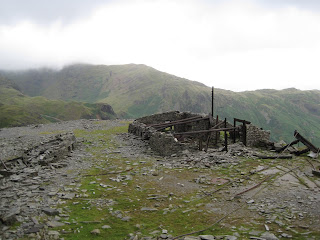
Rapid change of plans today. The forecast said the rest of the week will be monsoons, basically. So I decided to get a day's walking done while it was only raining occasionally. Scrounged a lift off Gav to Coniston and set off on the same lane as yesterday. Well, actually I set off on a different lane initially, but all my walks begin in confusion. Crossed the stream on an extremely old and quaint miner's bridge and took a path climbing up the hillside out of Coppermines Valley. Got wet on the lane with the shelter of the trees; got absolutely drenched in another shower on the exposed hillside. The top of my target, Coniston Old Man, was resolutely covered in clouds and I did start doubting my decision. Soon reached the remnants of the old mines, a few interesting derelict buildings but a hell of a lot of spoil heaps too. And what with the parties shrieking up and down the mountain, I was soon agreeing with Wainwright on all points. A reliable sign of old age, I'm told. There were some views as I got higher, allowing me to witness every other part of the country save mine bathed in sunshine. And they vanished as I broke the cloud barrier. Slogged through increasingly grim country; got lost, thankfully surrounded by people getting equally lost so I
felt less silly; passed some spots which I'm sure would have yielded spectacular views if, you know. The summit offered uplifting sights of a party of gets taking the only shelter from the phenomenal wind which appeared from nowhere. It now has my fags and lighter, which I dropped in a protracted moment of confusion. The sensible thing would have been to just go back. So I set off on the ridge path, thankfully well marked by cairns, towards Swirl How. And it was odd – the wind, the isolation and the total lack of visibility, or indeed point, somehow made it enjoyable. This feeling rather vanished when I was hit by a shower with drops the strength of a hailstorm. But gradually, grudgingly, the cloud started to lift. Eventually I was getting more views of Coniston; still in sunshine, the bastard. Even better was the sight of the Real Lake District on the other side, a mass of looming peaks. Swirl How was another trudge up but the descent was fun, a semi-scramble down something called Prison Ridge or thereabouts. The pass below was where I originally intended to begin the descent. But that isn't how my walks work and the peak ahead, Weatherlam, looked too inviting. It turned to to be a bit further than I thought but there were even better views, the cloud having lifted from the top of all the peaks. Including the Old Man, but never mind. Descended on a path which simply vanished half way through. You could see where to get to but there were some sharp drops with apparently no safe way down, and all around the hillside there were people staring at it with quizzical expressions. Finally got down, reaching a path curling back to Coppermines Valley and safety. A surprisingly good walk by the end. Less hearteningly, I've got both a bugger of a cold and a seizure on the way.
Coniston - 26/7/09
Coniston - 25/7/09
Picked up my my parents this morning at the rather decadent time of 10.00. A new route was devised which mainly involved crawling along really slow roads and getting stuck for about half an hour in Harrogate – not a good place to get stuck in any circumstances. We eventually made it up to the Dales, which looked very nice in the clear sunshine. Stopped at a Little Chef which amazed us by not being awful, saw a bunch of cows standing in a lake as a sort of protest, passed a factory specialising in 'wound management' (i.e. plasters). Finally saw the Lakes in the distance and then, after an age, got out of bloody Yorkshire. Had lunch on a tiny road halfway up a hillside with more mountains in the distance – and that's been the theme of the day. We're not at Patterdale this year, right in the heart of the Lakes. We're on the edge, in an area officially known as 'kind of near Coniston', and the 360 degree view of the peaks which Patterdale enjoys is more like 20 degrees. We're also travelling back in time somewhat; the villages we passed through seem to have been preserved in the 1960's without the help of a Sunday evening TV show. Stopped at Ulverstone, the nearest town of any significance, for shopping, drove alone a rather good estuary for a while, made several turns up increasingly narrow and windy lanes and finally found the house, despite the best intentions of the designers. It was allegedly once a vicarage and the Ye Olde aspect is being pushed mightily. Open fireplaces, creaking roof beams, a bath suite that seems to have been pinched wholescale from the Castle Museum and legions of flies in the pantry-cum-kitchen. For once everyone didn't arrive at once. We were here miles before the others, allowing me to pinch the only bedroom with that 20 degree view – of the Coniston range, incidentally. My stepbrother Gav and his kids finally arrived, having got repeatedly lost on the way here. A bit later came my sister Christine and Uncle Bill, who's got a week's pass from psychiatric hospital. And he must have felt he was back there again after I spent a lot of time running after my nieces Emily and Gemma, all of us screaming. Though I'm glad to say the elder girl, Lorna, seems to be cultivating a more restrained, bookish persona. Only another seven years or so and she'll be ready for full teenage angst.
Wednesday, July 15, 2009
Nature Is Closed For The Forseeable Future
Legislation That Seems To Have Been Inspired By An Episode Of The Simpsons Part 512: Arnie 'I'm As Stupid As I Look And That Takes Some Doing' Schwarzenegger has come up with a new solution to California's budget deficit. That's the budget deficit he was elected to solve and which has now grown to $26bn. He's proposing to shut down virtually all California's national parks. Terminate them, if you will.
Now, I'm a little shaky on the American national parks, but I gather that they're not quite like the British ones. They're the only rural places where people are allowed to wander freely, the rest being private farmland with no rights of way. Arnie is basically wanting to close nature.
Two thoughts come to mind. One is that Californians are going to get really fat. Even fatter than they are now. That's what happens when you deny people the chance to exercise. So if obesity starts to suddenly rocket, for once McDonald's Ginormous Size Burgers (or whatever) won't be to blame. It will be Arnie and his superbly chiselled body. The other thought: how do you shut down nature anyway? I guess there are two possible things Arnie could do. He could simply fire all the park rangers, close down the information centres and let the areas become wildernesses again, free to man and beast. Or he could put whopping great fences around them all and shoot anyone trying to get in. Arnie is a member of the Republican Party. Which option do you think he'll choose?
Some of the many criticism of the plans say they are short sighted on economic grounds. Closing the parks will stem a revenue stream for the state, however meagre. Unfortunately I think Arnie is less myopic than people suspect. He will be left with a great deal of land doing nothing, costly to police but much of it in spectacular locations. How soon before he starts accepting bids from developers looking to build yet more Exclusive Executive Housing? And even if California decides in the future that it can reopen the parks, the sold land will be lost forever. A plan worthy of C. Montgomery Burns himself.
Friday, July 10, 2009
Yet Another Gate
So that's this week's Grand Villains sorted out. The group who excite days of inflammatory headlines, public – i.e. media – outrage, chin-stroking analysis and calls for regulation, castigation and annihilation. I'm surprised there's anybody left. After expense-fiddling politicians, greedy bankers, crooked TV companies, women in burkhas, children in hoods, worshippers of Islam and (time after time) asylum seekers comes... the print media. The ones who always lead these moral panics. There's a whiff of the French Revolution here, the original persecutors ending up on the guillotine themselves. Though it's rather less bloody, of course, and much, much duller.
Basically, the claims go, the News of the World hired a legion of Philip Marlowes to bug and burgle assorted public figures. Then, when the figures found out, it paid them thumping out-of-court settlements to stop the cases coming to light. Which they have now anyway, largely thanks to the hush money paid to PFA head Gordon Taylor. The BBC has been gleefully leading with the story, probably still sore from the kicking which the NotW gave it over the phone-in scandal and the Queen docu-fiasco. The motive of the Guardian, which broke the story, is slightly different. “Murdoch's £1m bill for hiding dirty tricks” bellows the headline, and phrases like “Murdoch executives” and “Murdoch company” appear throughout. Nobody has yet profited by going after Rupe, as Setanta has just discovered, but the Guardian clearly thinks it worth another shot.
What stands out, as is so often the case, is the absurdity of it all. Gordon Taylor is one of the few high-profile union leaders left and so a hate figure for the NotW. There was conceivably an effort being made to destroy him. A couple of politicians, Tessa Jowell and John Prescott, were also bugged. But so were two agents, Sky Andrews and the egregious Max Clifford. The paper wasn't conducting an investigation into the secret mechanism of Britain here. It wanted gossip and tittle-tattle. Surely it could have just made all that up, as it usually does? Instead, though, it paid a lot of money to private investigators and a lot more to camouflage their actions. Even with Murdoch's funds to draw upon, this is a shocking waste for an industry supposedly in crisis. There is also similarities to the great scandals of the 1990's. From Bill Clinton to Jeffrey Archer, what got them was not the original act but what they later did to hide that act. If everyone wasn't so damn cautious all the time there would be a lot more happiness around.
Anyway, the journalists have been exposed by the journalists. We know how it works now. More papers will probably be pulled into the miasma. The whole industry will don a hair shirt and promise to reform itself. A great many self-righteous articles will appear; Gordon Brown will fire off some pompous sound bites and maybe appoint someone like Alan Yentob as Journalism Tsar. And then the next Grand Villains will appear. Personally I'm hoping for the novelists. They're too smug by half. And they must have done something. Everyone has; which is why these calls of outrage are always so shrill. Get your torches, you vengeful mob, and head off to Bloomsbury.
Saturday, October 04, 2008
Rome 16/9/08
Well, the Galleria Borghese is one thing I'm destined not to do. Yesterday, like everywhere else, it was closed. Today I climbed up from Plaza del Popola, past the amazing viewpoint over the city and the disturbing beggar who sits on the stairs. Had a pleasant stroll through the Villa Borghese, once a private estate and now a public park. One highlight was the Piaza di Siena, a large oval space where you'd expect a lake or a lawn. Instead there's just a load of packed earth. To add extra surreal touches, parrots were squealing in the trees overhead. Finally got to the gallery to see a sign saying, full, advance tickets only. How can a gallery be closed? Especially this one, it's huge. So had to got to the Gallery of Modern Art elsewhere in the park. It was OK, if rather dominated by some bloke whose one idea was that large means good. There was some interesting pieces behind him, though, particularly from the Italian wave of Impressionists.
Meandered back to Popola afterwards and popped into Santa Maria dei Miracoli, one of the churches which frames Via del Corso. It was a nice, unpretentious little place, another rotunda with refreshingly subdued decoration. I then tried once more to navigate to the Trevi Fountain. 
Eventually managed it this time, after losing my way and temper occasionally, and got a surprise. I was expecting, well, just a fountain. Instead it's a huge structure taking up the whole façade of a substantial building. A fountain does form part of it, but is almost incidental. You'd definitely call it baroque, you might easily call it hideous, but it certainly tries hard. Then went another backstreet way back to what I call the Dogs Bollocks of Rome, noting en route an alley which decided it had to have four covered bridges over it. Had lunch on a wall overlooking Trajan's Markets, Trajan's Column, Trajan's Anything Else. If it's Trajan's, as a rule, it's good.
Unable to stop myself I then took a farewell look at the Forum. I said it all earlier, so will just add: the place seems just as astonishing in later views. Then went into the Capitoline Museum. This was allegedly the first proper museum in the world, built in the Renaissance to house Roman relics. The first floor especially is fantastic. Part is housed in an ancient Roman temple, so the air of antiquity is enhanced by ancient brick barrel arched ceilings. There's also galleries overlooking the Forum and Palatine, giving me yet more farewell views of them.. The Renaissance rooms are almost overwhelming, each wall covered in a huge mural which illustrates part of Roman history. They have the famous bronze she-wolf, with its two suckling twins unfortunately added in later times. There's also the huge Marcus Aurelius statue, once housed in the Piazza del Campidoglio until they noticed it was falling apart. A lot of Renaissance paintings are upstairs, which reminded me that one can quickly grow bored of Renaissance paintings. They certainly didn't skimp on the paint though; one canvas must have needed a cherry picker to complete. Fantastic museum, despite the excessively snotty staff.
Afterwards I made a brief call to the Mametine, the old Roman prison. There's just two rooms open, an entrance chamber and a cell underground. It had the grim, claustrophobic air of all old dungeons, with added clamminess to the air. St Peter once allegedly nutted the wall, causing a fountain to miraculously spring up; after long in there I'd have been doing the same. (The headbutt, if not the miracle). Then popped into another church, where the presence of a single genuine worshipper eventually cleared the premises of all tourists. And then there was more wandering of back streets. Rome is a great place for it, with picturesque old buildings lining remarkably clean alleyways. The only trouble is that even here you're at risk of being run over by crazed scooters. The few pedestrian 'streets' are not so much alleys as cracks. Visited another church – if you're low on funds you tend to dive into any open church doors you see – this one a bit more Catholic. A daffy Bernini statue stood up front, and I'm not sure of the old lunatic designed the building itself but he might as well have done. Garish, and over-decorated again, with some beautiful paintings adorning the walls of the many side chapels. Nice to see some stained glass for once. Less sure about what seemed to be the waxed corpse of a past bishop underneath an alter.
Later on I managed to visit the Piazza Navona without it bringing on any seizures. It stands on the site of an old Roman arena and still has the contours, being a huge, sweeping rectangle.
Three fountains decorate it. Sadly the central one, apparently the best, was under scaffolding. This, however, was one of the few examples I saw of the alleged Roman custom of keeping all their sites closed for perpetual maintenance. Walked back along the underused Tiber, got another look at the wonderful Sonte Sant Angelo bridge and found a novel way to get lost; following a city wall when I should have been following the Vatican's defences. And that was more or less it. I'm rather aware that each day on this vacation was slightly worst than the previous one. Nonetheless, they had a hell of a high point to descend from. Wonderful place.
Saturday, March 01, 2008
How To Not Exist
In the absense of any interest in writing new posts lately, here's the opening paragraphs from an old novel I'm clearly not going to finish.
To the left was the station, a mass of gently curving girders emanating an inexplicable beauty. Equally bizarrely it was one of the largest stations in the land, in a city emphatically not one of the biggest; although it was chiefly full of people trying to go somewhere other than Marston. Stretching out ahead, almost beyond the reach of the eye, tumbling gently down a slight incline, were the city walls. The ersatz city walls, rebuilt by the Victorians, and so given a sombre perfection free of the miserable terror which inspired the original set. Standing, just to continue the jumble of authenticity and propaganda, on tall, functional grass banks which became a beautiful speckled pattern of daffodils every spring. The walls ended at a broad lazy river which was bridged by fussy Edwardian iron. And beyond that, the cathedral. The vast temple, so beautiful that it is hideous and vice versa. The creation of an ancient society which could do nothing well except create vast temples, doggedly rebuilt after the many occasions it had burnt or fallen down. The cause of the city, really, and certainly the donor of its entirely undeserved label of 'city.' The cathedral which waited haughtily for the tiny settlement around it to grow as magnificent as it was. Which waited in vain, even when industrial sprawls elsewhere accidentally shrivelled their own cathedrals into toys; which seemed at times to be considering moving to a more fitting location but finally accepted its role as a very large rock in a small pond. A cathedral still dominating a city which was not a city and which no longer believed in God.
And to the right of the famous panorama? What could you see there? Well, you would have to actually stand there to find out. The vision to the right did not exist in any of the pamphlets. There would always be a careful positioning of the cameras, the focus obstinately fixed onto the centre-left of the horizon. More recently, too, a drag of the mouse and a click of the crop emblem to eliminate any lingering traces. The building standing to the right was a pariah, a solitary outcast. It should not, could not exist.
Dark brown concrete. That was the building's final audacious touch which had made it special. That won the awards on its birth in the 1960's, when hideous architecture was as prized as free love, and which would ensure its revilement forever after. There were many other things bad about the building, of course. The unapologetic bulk of it, standing seven floors high in a mainly double-story town. The asymmetrical sprawl of the place, leaving people uncertain as to whether it was a complex or a single structure; and if the latter, why it bothered being so since this clearly did no good. One of the tallest towers was stuck sort of middle-left, the other some way to the right. Around them were a host of meandering annexes which looked like careless later additions though the building was actually designed as a whole. There was a central courtyard… Or rather, there was a courtyard, with the main reception hiding deferentially in one corner. It may have been in the centre or it may not have been. Nobody was certain where that was or where most of the edges were either.
All this was impressive. Likewise the decision to use concrete, the most belligerently ugly building material ever invented by mankind. And to leave the great walls free of any decoration which might soften their impact just a little. But dark brown concrete? So that, on gloomy mornings, the building squatted like a collapsing star, threatening to pull all the light and facile beauty of Marston into its hideous flanks? That was genius of a sort. It deserved awards. It deserved to not exist.
The timid main reception area, Sushma discovered, was really just a clearing house. Visitors only arrived to receive directions to the smaller receptions of the various companies hidden inside the building which did not exist. These directions were almost always wrong because internally there was no logic either. Few of the companies occupied a single, clearly defined space. They owned little clusters scattered hither and thither. Their territories frequently shifted, like medieval dukedoms in the midst of a convoluted war of religion. Their receptions drifted according to the vagaries of battle and were only ever a desk behind a door. The companies were happy with this state, content, to remain as invisible as their host. They were not the sort to build beautiful headquarters in prime locations, to worry about market penetration and brand diversification. They were small firms selling specialised goods and services which most people had never heard of, would need a long lecture about before they understood them and would buy even then. And the firms simply wished to continue selling their wares to the small cadre of connoisseurs who had always bought them. Such companies seemed the antitheses of modern capitalism. In fact, from one perspective, they represented the system in its most perfect form. They did not sell dreams or lifestyles. They just made money.
Costoq Rail was the largest of them. In the old days when vital services were still nationalised it had technically been part of the state. Always an odd part, however, and lying remarkably far from actual government. It was a self-contained consultancy unit which did small, fiddly things to small, fiddly parts of the railway track. No senior manager had ever learnt whether any of the actions carried out were entirely necessary. However, as they affected huge metal objects which travelled at something approaching the speed of sound, some prudence was considered necessary. The consultancy somehow split from the rest of the railway infrastructure units in the chaos which followed the government's decision to privatise all its essential functions and so leave itself with nothing useful to do at all. The consultants continued doing exactly the same things, only now charged much more for them as they were working for a separate entity. Several years later they were swallowed up by Costoq International, a vague conglomerate going through a phase of 'market diversification.' Namely, swallowing up companies in sectors where they did not belong. So the Permanent Way Design Consultancy became Costoq Rail; thus exchanging a name which none of its employees could say to one which they could not spell. That, so far, had been the only change effected by the takeover.
Or almost the only one. Sushma, who had pulled the above information from the company website after her agency told her about the job, discerned signs of corporate modernity pushing at the old railway mentality. The fact that there was actually a website, for one. Many small engineering firms still jeered at such fripperies. A degree of effort had been made with the reception area too. There was a huge day-glo orange board behind the desk boasting the new company name and logo; which, like most corporate motifs, seemed a product of a junior art class. The website was simply a digital version of the leaflets, however. Both tried reaching out to the public with a few photographs of men in hard hats smiling awkwardly. Then they flung themselves into esoteric descriptions of complicated actions conducted on rail tracks in unfashionable parts of the countryside. And the reception was really just another desk behind a door. Manning it was a genial, elderly lady who greeted the sporadic visitors as if they arriving for a bridge morning, threw occasional homilies at the impatiently waiting Sushma and tried to master Minesweeper the rest of the time.
The room itself was testament that open plan does not automatically result in light and air. Almost all illumination came from the humming tubes set in the dispiritingly low ceilings. Most of the carpet was nasty dark blue. Random strips of nasty dark green and red intervened, as if somebody had decided to redecorate and then ran out of materials or motivation. The stale, chilly air was filled with drones of antiquated computers, the squeals of dying printers. And the chatter of sleepy workers easing into a Monday morning, female voices discussing cruel television programmes, male ones dissecting unjust football results.
The building where they worked was hidden. The building where they worked had been ordered to not exist.
And this was a difficult feat. Because the building where they worked lay in the most famous segment of Marston. And Marston itself had considerable renown amongst the sterner class of tourist. The building was – or should have been – part of the vista which epitomised the city. The scene which appeared by default in the brochures and leaflets, which summed up what Marston offered its visitors. A sort of composite history, not confined to any one period but incorporating elements from many epochs so long as they were twee and vaguely authentic. An image of history generally given captions beginning with "Merrie" or "Ye Olde."
To the left was the station, a mass of gently curving girders emanating an inexplicable beauty. Equally bizarrely it was one of the largest stations in the land, in a city emphatically not one of the biggest; although it was chiefly full of people trying to go somewhere other than Marston. Stretching out ahead, almost beyond the reach of the eye, tumbling gently down a slight incline, were the city walls. The ersatz city walls, rebuilt by the Victorians, and so given a sombre perfection free of the miserable terror which inspired the original set. Standing, just to continue the jumble of authenticity and propaganda, on tall, functional grass banks which became a beautiful speckled pattern of daffodils every spring. The walls ended at a broad lazy river which was bridged by fussy Edwardian iron. And beyond that, the cathedral. The vast temple, so beautiful that it is hideous and vice versa. The creation of an ancient society which could do nothing well except create vast temples, doggedly rebuilt after the many occasions it had burnt or fallen down. The cause of the city, really, and certainly the donor of its entirely undeserved label of 'city.' The cathedral which waited haughtily for the tiny settlement around it to grow as magnificent as it was. Which waited in vain, even when industrial sprawls elsewhere accidentally shrivelled their own cathedrals into toys; which seemed at times to be considering moving to a more fitting location but finally accepted its role as a very large rock in a small pond. A cathedral still dominating a city which was not a city and which no longer believed in God.
And to the right of the famous panorama? What could you see there? Well, you would have to actually stand there to find out. The vision to the right did not exist in any of the pamphlets. There would always be a careful positioning of the cameras, the focus obstinately fixed onto the centre-left of the horizon. More recently, too, a drag of the mouse and a click of the crop emblem to eliminate any lingering traces. The building standing to the right was a pariah, a solitary outcast. It should not, could not exist.
Dark brown concrete. That was the building's final audacious touch which had made it special. That won the awards on its birth in the 1960's, when hideous architecture was as prized as free love, and which would ensure its revilement forever after. There were many other things bad about the building, of course. The unapologetic bulk of it, standing seven floors high in a mainly double-story town. The asymmetrical sprawl of the place, leaving people uncertain as to whether it was a complex or a single structure; and if the latter, why it bothered being so since this clearly did no good. One of the tallest towers was stuck sort of middle-left, the other some way to the right. Around them were a host of meandering annexes which looked like careless later additions though the building was actually designed as a whole. There was a central courtyard… Or rather, there was a courtyard, with the main reception hiding deferentially in one corner. It may have been in the centre or it may not have been. Nobody was certain where that was or where most of the edges were either.
All this was impressive. Likewise the decision to use concrete, the most belligerently ugly building material ever invented by mankind. And to leave the great walls free of any decoration which might soften their impact just a little. But dark brown concrete? So that, on gloomy mornings, the building squatted like a collapsing star, threatening to pull all the light and facile beauty of Marston into its hideous flanks? That was genius of a sort. It deserved awards. It deserved to not exist.
The timid main reception area, Sushma discovered, was really just a clearing house. Visitors only arrived to receive directions to the smaller receptions of the various companies hidden inside the building which did not exist. These directions were almost always wrong because internally there was no logic either. Few of the companies occupied a single, clearly defined space. They owned little clusters scattered hither and thither. Their territories frequently shifted, like medieval dukedoms in the midst of a convoluted war of religion. Their receptions drifted according to the vagaries of battle and were only ever a desk behind a door. The companies were happy with this state, content, to remain as invisible as their host. They were not the sort to build beautiful headquarters in prime locations, to worry about market penetration and brand diversification. They were small firms selling specialised goods and services which most people had never heard of, would need a long lecture about before they understood them and would buy even then. And the firms simply wished to continue selling their wares to the small cadre of connoisseurs who had always bought them. Such companies seemed the antitheses of modern capitalism. In fact, from one perspective, they represented the system in its most perfect form. They did not sell dreams or lifestyles. They just made money.
Costoq Rail was the largest of them. In the old days when vital services were still nationalised it had technically been part of the state. Always an odd part, however, and lying remarkably far from actual government. It was a self-contained consultancy unit which did small, fiddly things to small, fiddly parts of the railway track. No senior manager had ever learnt whether any of the actions carried out were entirely necessary. However, as they affected huge metal objects which travelled at something approaching the speed of sound, some prudence was considered necessary. The consultancy somehow split from the rest of the railway infrastructure units in the chaos which followed the government's decision to privatise all its essential functions and so leave itself with nothing useful to do at all. The consultants continued doing exactly the same things, only now charged much more for them as they were working for a separate entity. Several years later they were swallowed up by Costoq International, a vague conglomerate going through a phase of 'market diversification.' Namely, swallowing up companies in sectors where they did not belong. So the Permanent Way Design Consultancy became Costoq Rail; thus exchanging a name which none of its employees could say to one which they could not spell. That, so far, had been the only change effected by the takeover.
Or almost the only one. Sushma, who had pulled the above information from the company website after her agency told her about the job, discerned signs of corporate modernity pushing at the old railway mentality. The fact that there was actually a website, for one. Many small engineering firms still jeered at such fripperies. A degree of effort had been made with the reception area too. There was a huge day-glo orange board behind the desk boasting the new company name and logo; which, like most corporate motifs, seemed a product of a junior art class. The website was simply a digital version of the leaflets, however. Both tried reaching out to the public with a few photographs of men in hard hats smiling awkwardly. Then they flung themselves into esoteric descriptions of complicated actions conducted on rail tracks in unfashionable parts of the countryside. And the reception was really just another desk behind a door. Manning it was a genial, elderly lady who greeted the sporadic visitors as if they arriving for a bridge morning, threw occasional homilies at the impatiently waiting Sushma and tried to master Minesweeper the rest of the time.
The room itself was testament that open plan does not automatically result in light and air. Almost all illumination came from the humming tubes set in the dispiritingly low ceilings. Most of the carpet was nasty dark blue. Random strips of nasty dark green and red intervened, as if somebody had decided to redecorate and then ran out of materials or motivation. The stale, chilly air was filled with drones of antiquated computers, the squeals of dying printers. And the chatter of sleepy workers easing into a Monday morning, female voices discussing cruel television programmes, male ones dissecting unjust football results.
Sunday, January 06, 2008
With A Bang And A Whimper
I got terrified of nuclear war in my early teens. Oddly enough, it was Frankie Goes To Hollywood's Two Tribes video, the one with Reagan and Chernenko wrestling, which sparked it off. For some reason, the sight of two fat, elderly men grunting together in a ring really brought home the threat. For years afterwards I listened trembling for the sound of air raid sirens. I didn't ask if York still had any air raid sirens, which it almost certainly didn't. I just assumed I would hear them. When I though I did one morning, I got a hell of a fright. It just turned out to be one of the new US-style police sirens. They might have warned me.
It was a good period to have nuclear fears, I learned later. In the mid 1980's the Cold War was hotter than any time since the early 60's. All my generation lacked were our equivalent of the Cuban Missile Crisis. Or so I thought until watching Channel 4's excellent documentary 1983: The Brink of Apocalypse last night. It turned out we had one after all. They just never told anyone.
The program meticulously plotted the events which created the atmosphere of 1983. Reagan helped start it, of course. After his election he behaved like any unbalanced old gentleman let out of the home, swaggering over the place stroking himself and introducing useful concepts like 'good' and 'evil' into international diplomacy. He ordered missiles to be built which were bigger, faster and painted in the colours of his own penis. He also started the 'Star Wars' program, a plan to shoot down missiles from space. This terrified the USSR as it would totally negate their nuclear deterrent and leave them helpless. The Soviet leadership, if anything even more elderly and senile than Reagan, retreated into full paranoia. Under the quivering command of Andropov, a man I only recall from an unfunny gangrene joke, they ordered their spies to actively search for signs that the West was planning war.
Unfortunately, their intelligence was terrible and ours was little better. Soviet spies performed tricks like count how many lights were on at the Ministry of Defence each night. If a lot were burning, one British commander pointed out, it usually meant the cleaners were hoovering the floors. The spies took it as a sign that our leaders were in there, plotting domination and cackling. We had a single double agent who could actually tell us what the Soviet politburo were thinking. We seemed to meet with him for half an hour once every other month. And staffed by moral absolutists on both sides, the notion of the governments actually talking to each other had become laughable.
In 1983 America invaded Grenada largely to prove they could. The USSR shot down a domestic Korean plane which was simply lost and was already heading out of Soviet air space. And one night a Russian monitoring station received a message from its spy satellite. Five missiles had been launched from America, one after another. The base commander override the message, reasoning that if missiles came they would come 14,000 all at once. He was right to assume a malfunction. The satellite computer had confused missiles with clouds, as one does. But a less stubborn or sensible man might have panicked and started the sequence which led to 'retaliation.' Suddenly the lyrics of Nina's 99 Red Balloons seem slightly less ludicrous.
And in this climate, NATO chose to hold huge war games called Operation Able Archer in west Germany. War games were common enough. They mocked up the conditions of nuclear attack, mainly to test communications between bases. In 1941, though, Nazi Germany had invaded the USSR initially under the guise of war games. 42 years later, the Kremlin decided was being repeated, though not as farce. Intercepted messages between NATO bases were treated as actual orders. The Soviet nuclear bases, submarines and bombers were put on red alert. The West noted these preparations but just chuckled, assuming rival war games. They continued taking Able Archer to its conclusion. As they did, Andropov's finger crept closer and closer to the red button. And then…
Then Able Archer simply ended. The Soviet generals, one assumes, simply dithered long enough to realise their mistake. They all went home again, presumably avoiding each other's faces. The next time the West met their double agent, they found out what had almost happened and got the shock of their lives. Even Reagan decided it was wise to start talking with the enemy again.
That's how our civilisation almost ended though. In a swamp of paranoia, miscommunication, incompetence and macho posturing. With both a bang and a whimper of "Eh? What?" I'm glad of the escape but you have to admit, it would have been fitting.
It was a good period to have nuclear fears, I learned later. In the mid 1980's the Cold War was hotter than any time since the early 60's. All my generation lacked were our equivalent of the Cuban Missile Crisis. Or so I thought until watching Channel 4's excellent documentary 1983: The Brink of Apocalypse last night. It turned out we had one after all. They just never told anyone.
The program meticulously plotted the events which created the atmosphere of 1983. Reagan helped start it, of course. After his election he behaved like any unbalanced old gentleman let out of the home, swaggering over the place stroking himself and introducing useful concepts like 'good' and 'evil' into international diplomacy. He ordered missiles to be built which were bigger, faster and painted in the colours of his own penis. He also started the 'Star Wars' program, a plan to shoot down missiles from space. This terrified the USSR as it would totally negate their nuclear deterrent and leave them helpless. The Soviet leadership, if anything even more elderly and senile than Reagan, retreated into full paranoia. Under the quivering command of Andropov, a man I only recall from an unfunny gangrene joke, they ordered their spies to actively search for signs that the West was planning war.
Unfortunately, their intelligence was terrible and ours was little better. Soviet spies performed tricks like count how many lights were on at the Ministry of Defence each night. If a lot were burning, one British commander pointed out, it usually meant the cleaners were hoovering the floors. The spies took it as a sign that our leaders were in there, plotting domination and cackling. We had a single double agent who could actually tell us what the Soviet politburo were thinking. We seemed to meet with him for half an hour once every other month. And staffed by moral absolutists on both sides, the notion of the governments actually talking to each other had become laughable.
In 1983 America invaded Grenada largely to prove they could. The USSR shot down a domestic Korean plane which was simply lost and was already heading out of Soviet air space. And one night a Russian monitoring station received a message from its spy satellite. Five missiles had been launched from America, one after another. The base commander override the message, reasoning that if missiles came they would come 14,000 all at once. He was right to assume a malfunction. The satellite computer had confused missiles with clouds, as one does. But a less stubborn or sensible man might have panicked and started the sequence which led to 'retaliation.' Suddenly the lyrics of Nina's 99 Red Balloons seem slightly less ludicrous.
And in this climate, NATO chose to hold huge war games called Operation Able Archer in west Germany. War games were common enough. They mocked up the conditions of nuclear attack, mainly to test communications between bases. In 1941, though, Nazi Germany had invaded the USSR initially under the guise of war games. 42 years later, the Kremlin decided was being repeated, though not as farce. Intercepted messages between NATO bases were treated as actual orders. The Soviet nuclear bases, submarines and bombers were put on red alert. The West noted these preparations but just chuckled, assuming rival war games. They continued taking Able Archer to its conclusion. As they did, Andropov's finger crept closer and closer to the red button. And then…
Then Able Archer simply ended. The Soviet generals, one assumes, simply dithered long enough to realise their mistake. They all went home again, presumably avoiding each other's faces. The next time the West met their double agent, they found out what had almost happened and got the shock of their lives. Even Reagan decided it was wise to start talking with the enemy again.
That's how our civilisation almost ended though. In a swamp of paranoia, miscommunication, incompetence and macho posturing. With both a bang and a whimper of "Eh? What?" I'm glad of the escape but you have to admit, it would have been fitting.
Subscribe to:
Posts (Atom)