Thursday, April 19, 2007

This Our Manifesto

The exceedingly weak joke made at the end of the last post and all the fuss made over what's-his-name's code of conduct for blogs – you know, the one who keeps getting himself photographed holding a hammer looking really, really hard – has made me think about this blog. Not rules for it as such but an ethos, an underlying meaning. After all it's been going for over a year, with over 70 posts now and about 2 semi-regular readers. (One being my mum.) What, condensed, are the messages I am trying to say?

After skimming through past posts, I think I am conveying 5 central points to the world:

1. Art is nice
2. Capitalism is nasty
3. George Bush – booooo!
4. The kids are all right
5. God exists (probably)

And of course the central point, one which unites most blogs throughout the world:

I have slightly too much free time

Freedom!

Just spent the last three days in hospital. To be specific: fastened to a machine in a solitary hospital room, a camera following my every move and a microphone capturing every sound. About twenty electrodes were superglued to my head, another four selloped to my temples and shoulders. I wasn't allowed to leave the room throughout. I did leave it once, in fact, storming out on Tuesday after a dispute with the nurses far too lengthy and dull to relate here. But I returned quickly and otherwise I was good. All this was a test to find out why my brain keeps going wrong, basically; if I really do have epilepsy or if I have to tear up that membership badge and join a far more exclusive club. Or so they said. As these hospital tests get increasingly baroque, I'm getting the feeling that they've just given up and are messing with me.

I've yet to learn the results, thanks partly to leaving the hospital a day earlier than I probably should. However, you always learn some things from these experiences. Here are a few of my reflections:

Nurses are genuinely nice. All of them, without exception. The ones on Ward 38 of York District Hospital at least. Or rather, nice to your face – I overheard one, forgetting that my room was opposite the nurses' station, slagging me off to her colleagues. But I'd been a stroppy bugger just before and, in her place, I'd have said a lot worst.

Staying in hospital is embarrassing if you're not sick. And you're not sick really if you have my level of epilepsy. (Or whatever the hell it is). You have a few periods of lying helpless and twitching, and the rest of the time you're fine. So it's awkward when nurses, due to aforementioned niceness, are forever popping in to pour you glasses of water or adjust your bed. They probably get affronted too when you keep telling them you can do it all yourself. And then they slag you off behind your back.

Always being on camera makes you want to do terrible things. Rubbing my genitals in my case, I'm afraid. It was a constant temptation whenever I was lying on the bed. And it's not something I want to do normally – I'm lying on my bed right now and I don't feel the urge at all. Perhaps it was just a need to shock and get away with it. If I'd given in – and I didn't once, I'm glad to say – and been confront ed about it, I could just have yelled "There's something wrong with my brain! Why do you think I'm here?"

Hospital cleaners have a different status to other cleaners. Whenever I see them in offices or hotels or wherever, I feel sorry for them. They're doing a rubbish job for little money. Whenever I saw the woman who cleaned my room, I envied her. After all, she wasn't hooked to a bloody machine with fifty wires glued to her bloody head.

Hospital rules can be a little rigid. When they finally unplugged me, they sent a porter with a wheelchair to take me to the room where my wires would be removed. I told him I really didn't need a wheelchair. He replied that if sent with one, he had to push his target back in it "in case something happened." So if you saw a youngish man being wheeled through the corridors today, don't feel sorry for him. The look of acute embarrassment I wore wasn't the product of mental disorder. I was just embarrassed.

I smoke because I like to. I was a bit apprehensive about all those cigarette-free days, of course. As it turned out I coped absolutely fine, thanks in part to some seriously out-of-date nicotine gum pinched from my dad. And when I stepped off hospital grounds today, I instantly lit up. It was lovely; and so is the cigarette I'm smoking right now.

Freedom is wonderful, especially when abused. Upon getting home, after washing half a gallon of glue out of my head, I popped to a nearby shop for a minor purchase. Then I popped to another nearby shop for another minor purchase. Then I popped to yet another nearby shop for yet another minor purchase. Just because I could.

Being in hospital turns you into a self-obsessed narcissist. All the fussing over you, all the questions about yourself… it's natural, I think. This my excuse for lapsing into archetypal blog territory right now. Back soon, I promise, to dissecting trivial stories in The Guardian and musing on paintings I know nothing about.

Monday, April 09, 2007

Betrayals

The Easter story has always been the best in the Bible. There is, as mentioned below, death and rebirth. There's blood and sacrifice and suffering and blood. There's a great deal of blood, in fact. It's no wonder that Mel Gibson, in his Passion of the Christ, was able to make a previously unseen link between the Gospels and Quentin Tarentino.

More importantly the Easter story also has a wide range of human actions. Mostly of the worst kind. There's the fickleness of crowds, the feebleness of conciliatory politicians. There are crises of faith everywhere. There's even a crisis of faith from the son of God, for heaven's sake; an astonishing passage even in a text which breaks many rules of what you should do when establishing a new religion. Above all else, there are betrayals. Judas', of course. Even though Jeffrey Archer is currently peddling line, I still believe that Judas has been slightly harshly treated by posterity. He was basically a cipher after all, taking Jesus to a death which was necessary for human salvation. Besides, Judas wasn't alone. Everyone let Jesus down ultimately.

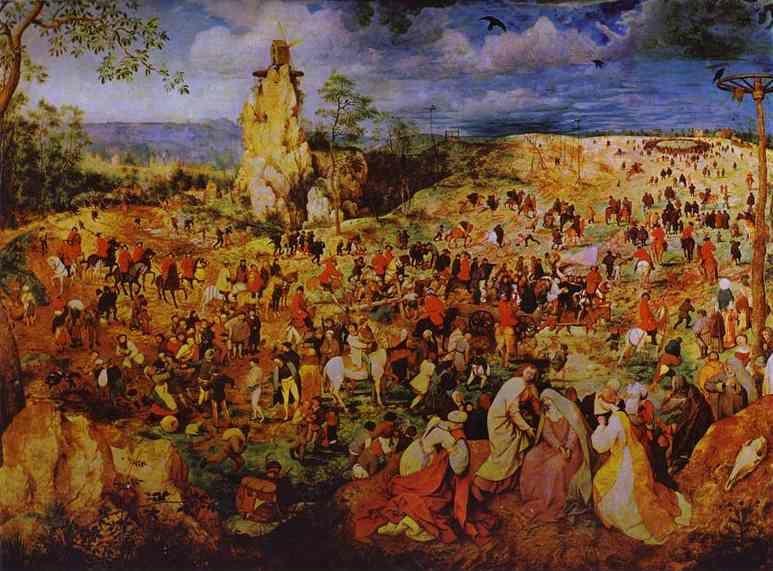
The Easter story has also inspired the best art. There are some decent images of Jesus' birth. But all painters of the Nativity succumb, to one degree or another, to an impulse known as "Ooooh, it's a liddle baby!" This sort of tweeness isn't possible in the cynicism leading up to the Crucifixion, the brutality of the event and the miracle afterwards. Pieter Brugel lashed out at the crowds in The Procession To Calvary, his astonishing depiction of the Crucifixion treated as a Sunday outing. (Pontificated on in more detail in an earlier posting.) Caravaggio played to his strengths too, showing a dark and disturbing Flagellation Of Christ by two satanic guards. Blood is missing from Andrea Mantegna's painting but only because it's all already drained from The Dead Christ; Jesus is as grey as a crypt, four gruesome holes in his body. There isn't, in fact, much optimism in most of the Easter paintings. The focus is on what we lost, not on what we've supposedly gained.

Especially in one of the defining images, Leonardo's The Last Supper. The last stage in Jesus' fatalistic trudge towards his death. The painting captures perfectly the poignancy of the event; and it anticipates the betrayals to come. Leonardo was superb at the precisely ordered group portrait and here it becomes more than an academic demonstration. Jesus sits at the head of the table and the centre of the picture, surrounded by his disciples. He sits alone, however. Those nearest him are leaning or even recoiling away. The ones on the fringes are staring at him, gossiping amongst themselves; but nobody is addressing him directly. He has lost them and he knows this. His face downturned, he spreads his hands out hopelessly. Jesus seems to be asking, what more can I do for you? Die for them – and Leonardo paints this as if it means he's failed.

It's a very human story, the Easter one. There's no constant interaction with a booming voice from the heavens. There's just a religious leader, a little too perfect for his or any other time. One who's betrayed and finally, torn apart by pain, seems to lose his own faith. It's a tragic tale too, the triumph of malice and avarice, and sometimes the Resurrection almost feels like a happy ending tacked on rather artificially. That's not the proper interpretation, I know, but maybe it's an excusable one. Because we do betray our saints and we do excuse our crooks. (Hello Mr Archer and pass on my regards to your new best mate, the Pope.) We do fail because of pettiness or greed or cowardice. We do it all the time and that's probably why somebody had to get himself nailed to a cross to redeem us.

All Your Easter Eggs In One Basket

It was just a story heard in a pub so I'm not sure if it's true. I'd like to think so, however. A supermarket recently claimed we had forgotten the true meaning of Easter eggs. They symbolise the rebirth of Christ, apparently. And so, by extension, buying and gorging mounds of chocolate at this time of year is our holy duty. Actual Christians complained about this so loudly that the supermarket was forced to apologise.

We thought that they weren't creative enough. They could have said, for example, that the crucifix was actually oval shaped. Or perhaps Jesus himself was. Why stop, too, with appropriating eggs? Take the Easter Bunny, for example. Perhaps this came about because when Christ rose from the tomb, he hop-hoppity-hopped away from it.

Of course eggs and bunnies aren't Christian images. They are pagan ones, just like holly and mistletoe and fir trees. There was a festival at springtime and another in midwinter long before Christianity emerged. They were linked directly to the seasons and their symbols reflect this. The winter ones are reassurances, plants which remain green when everything else has died. In spring comes a celebration, images of life and rebirth. The eggs are obvious, a more direct and less gooey substitute for the womb. The Easter bunny began as the March hare, which was rather mystifyingly given great significance by the old religions. The two are linked, incidentally; it was believed that hares hatched from eggs. Which were laid by lapwings, it seems, on the basis that both creatures live in fields. Clear logic was something else yet to appear in these societies.

It's obvious why the early Christian church appropriated the old festivals. The missionaries were doing a selling job. They wanted to give people something clearly recognisable and which didn't interfere with their pleasures too much. The Nativity didn't quite fit with the old solstice festival but did offer a cause for a straightforward celebration, something always needed in the middle of a grim winter. The Easter story, meanwhile, is perfect for spring. At its heart is death and rebirth. Jesus falls, lies in a tomb and rises again. You can take that, on one level, as a metaphor for the crops withering in autumn and miraculously springing to life again when the seasons change.

There are some Christians who don't like this. Now they've got the old festivals, they want to strip the last remaining pagan symbols from them. Get the Christmas trees out of Christmas, the Easter eggs out of Easter. Let's focus on what really matters. This always strikes me as rather ungrateful, turning on your sponsors when you no longer need them. It's a peculiarly irreligious attitude too. After all, holy events aren't just ones which happened two thousand years ago to a narrow cast of characters. Look at other images of Easter: daffodils, blossom, fluffy chicks. They can be rather hard to take on a full stomach, but in their purest form they are symbols of life. Life suddenly bursting out, life at its most unexpected and glorious. And if you can't see the touch of God in these constant miracles, what exactly is the point in believing in Him?

Thursday, April 05, 2007

Well Duh pt. 67

There's been two poll s recently which studied, as Basil Fawlty would say, the bleeding obvious. A couple of months ago, The Guardian discovered that parents didn't know what their teenage offspring get up to. Mums and dads seemed to assume their little angles were sharing cups of Horlicks and playing pinball at the youth club. Instead said angels were, of course, drinking, taking drugs and fornicating with each other. This week a poll of teachers announced that schoolchildren were influenced by what they saw on television. They especially liked repeating catchphrases, the more antisocial the better.

Well, to mimic a thousand American programs, duh. I'm not sure who conducts these surveys or why they don't use a simpler methodology called 'remembering their own childhoods.' Of course teenagers break the law and don't tell their parents. It's half of the essential teenage experience. (The other half being getting depressed and telling absolutely everyone about that). When asked if she knew what I used to get up to my mum replied, no, and she didn't want to either. May this attitude be passed down many generations.

And schools are awash with bad imitations of Catherine Tate and Little Britain today? I recall being swamped with equally dreadful ones of Mr T, Lenny Henry (in his early "Ohhhhh-Kaaayy" years) and Neil from The Young Ones. Children find something they like and mimic it. It's a natural habit and, as this post has oh-so-subtly demonstrated, not confined to the young. Anyway, what do teachers expect children to talk about amongst themselves? Their bloody maths homework?

I do, however, applaud them singling out Catherine Tate's snotty girl character for special criticism. The one with the phrase "Am I bovvered?" as the sole 'joke' in each and every sketch. I know somebody who repeats this often and gratuitously, to the dismay of all around him. That person is my sixty year old father, but that's beside the point. Ban it from our screens. Ban it now.

Thursday, March 29, 2007

Widening The Gulf

So, let me se if I've correctly interpreted the stance of the British tabloids? It's morally repugnant for Iran to parade the fifteen captured British Navy personnel on television. And yet it's perfectly decent to splash pictures from that broadcast all over your front pages? Thus causing the families of the sailors, especially of Faye Turney who seems to be made the star of the show, considerably more distress?

Of course, the hypocrisies of the British media are being dwarfed by others. It's OK to patrol the waters of a country you illegally invaded on the whim of America – as long as you stay out of the waters of a country you're merely about to invade on the whim of America? Mohammed said women in public must cover their heads, but would have nothing to say about a woman being displayed as a trophy of a war that's not even started yet? It's a squalid affair and getting worst each day. And, whatever occurred in the Shatt al-Arab waterway last week, it should have been over by now. The diplomats ought to have sorted it out between themselves, quietly and behind the curtains. That's what they're there for. But Blair blundered in, strutting about in front of the EU leaders. So Ahmadinejad had to start blundering and strutting in response. Two weak men mainly held up by bluster, and they've quickly reduced it to the level of the playground. "They were in my waters." "No, they were in my waters" etc. And trapped in the middle are the only real innocents; because whichever bloody waters they were in, they would only have been there because they were sent.

However this mess resolves itself, Ahmadinejad is likely to regret it. It's unlikely to start a war on it's own. Britain isn't Israel. We don't care enough about our soldiers to fight for them. But it's got the blood of the tabloids up. They didn't care much hitherto about Iran building nuclear reactors or funding Hizbullah or any other tricky issues. Humiliating a young British woman though – that they can understand. Ahmadinejad is already being manoeuvred into the role of Brutal Arabian Dictator which was forcibly vacated by Saddam Hussein. That his name is hard to spell and even trickier to pun with could cause problems. The fact that he was actually elected could cause some qualms too, albeit rather less. That shouldn't stop the journalists, however. When they want to make someone a folk devil they usually get the job done. With the headline "Who do you think you are kidding Mr Ahmadinejad?" The Sun has already begun the Hitler comparisons.

Why should Ahmadinejad care about this? Because it will make the task of selling an Iranian war to the British public considerably easier. The one honest reason for invading Iraq, after all, was "Saddam is nasty." And a real tabloid clamour may even push a British government into attacking. Blair has always capitulated to the newspapers on all major issues sooner or later. David Cameron goes even further, making the improvement of his image his sole consistent policy. The capture of one boat won't start a war, but suddenly it feels like the build-up to one.

Tuesday, March 27, 2007

Ozymandias, King of Kings

I saw Rick Witter on Friday night. It was a bit dispiriting. You may recall Rick Witter: former schoolmate of mine, former lead singer of Shed Seven, former pop star. He wasn't on stage when I saw him. He was just having a drink in the Punchbowl, a smart but not especially fashionable pub in York city centre. Nor did the place exactly erupt when he walked in. The only people who seemed to recognise him were me and my friend; and that's just because we went to school with him.

"He's keeping it real," my friend suggested. But I've never been in favour of celebrities doing this. Like royalty and football players, they have a template they should adhere to. When Witter goes out on a Friday night, he ought to step large. He should be sniffing coke in a London nightclub, berating his agent who's angling to book him a place on Celebrity Big Brother. Not having a drink in places like the Punchbowl in provincial little York, along with the rest of us tossers.

The more depressing thought is that maybe Witter has no choice nowadays. It's been a while since Shed Seven split up, I know, and his new band don't seem to be going anywhere. I'd always assumed, though, that he was still lit up by the half-glow of former celebrities, still getting a few invites and bookings. Maybe not. His life might have become an arc so perfect that even Hollywood screenwriters would reject it as unrealistic. And he's back precisely where he started, the point most of us never left anyway, wondering if his years of chart stardom were just a dream.

Thursday, March 22, 2007

An Anti-Social Crime

The Guardian recently highlighted a new phenomenon on our streets, comical and disturbing in equal measure. The Mosquito, an ultrasonic device which apparently emits regular, high-pitched beeps only audible to the under-25's. It is designed to be fitted to shops and the like, and to make any loitering teenagers so annoyed that they will eventually skulk off. The aim is to stop them indulging in that act which has so blighted our cities – Hanging Around and Sometimes Swearing.

This is amusing because I can't imagine for a second that this dog-whistle-in-reverse can ever work. The human ear changes a little as we age, I know. But is there really a switch that suddenly flicks on one's 25th birthday preventing you hearing anything above a certain frequency? And even if the science holds, the effect surely won't be what is intended. If youths are ever annoyed by something, youths with enough time to identify the source and a propensity to petty vandalism – well, that object is going to become a lot of serrated metal and cut wires fairly soon. Besides, who's to say that teenagers will be repelled by repetitive beeps? This is, after all, the generation which rediscovered the joys of illegal raves. They just need to bring along a beatbox and the Mosquito will supply the soundtrack for their evenings.

More disturbing is the intention. Mosquitoes aren't burglar alarms. They aren't anything to do with crime prevention. They are designed to deny people access to areas which are supposedly open to the public. Not all people either – note the targeting, even if it doesn't work in practice. Mosquitoes are the next stage in an increasingly vicious campaign against youth. It's a war which has included Asbos – punishments which don't require convictions or juries or proof – and a Prime Minister talking about the handily nebulous idea of "anti-social behaviour." Now it's going to the next level. Excluding teenagers from the streets entirely, only one step away from blanket curfews.

The posters for Mosquitoes apparently show a hoodie screaming in pain. Of course they used this image. The hoodie, an object rivalled only in modern demonology by the burqa. (Why is our society so reassured by the sight of human hair anyway?) The icon of the "feral gangs," in the words of the Daily Mail, who have taken over the night time streets. Not by committing crimes all that often, you understand. But simply by the foul act of Hanging Around and Sometimes Swearing.

Moral panic towards the young is nothing new. Stanley Cohen coined the phrase in his analysis of the huge campaigns whipped up against tiny groups of mods and rockers in the 1950's. But it seems particularly intense at the moment, when hysteria is so fashionable but the choice of targets are so restricted. If journalists want to frighten their readers but don't want to seem like racists, they usually have to pick on teenagers.

Asked if they support devices like the Mosquito, people often cite their own nervousness towards groups of teenagers. They usually seem a little awkward saying this, however. There is some recognition that it's silly to be scared of undernourished youths in silly jumpers doing nothing more than HASS-ing. And it is irrational. It's a phobia and it can be beaten. The first step is to keep the Daily Mail and their ilk a safe distance away. Perhaps with some sort of ultrasonic device.

Friday, March 09, 2007

King Balthazar

Some hobbies are only ever interesting to their followers. Others occasionally throw up items of fascination for the rest of us. Birdwatching is a good example of the former. When someone remarks that they saw a grey-breasted winchat on Kirkham Ings I find myself, as PG Wodehouse used to say, waiting for the punchline. The twitcher's life, chasing after obscure dippers and plovers blown off course onto ghastly beaches on Teesside, can only be experienced from the inside. It's all just names and numbers to the rest of us. Especially as the birds concerned are usually just little brown tweeting things.

Genealogy is the same most of the time. I'm sure I would have loved to meet my great-great-great uncle, even if he had been a birdwatcher. But I'm not that interested in his life. He would have been a tailor or a minister because nearly everyone's was. Or a blacksmith or a farmer or so on. Taken as a mass, the facts of ordinary people can form social history. On an individual level there's some interesting stories to b found. But generally, families aren't enthralling. They drifted around the country getting on with things, occasionally reproducing and/or dying. Genealogy is the collection of names, knowledge for the sake of it.

Occasionally, though, surprising ancestors can be found. Like those of the magnificently named Balthazar Napoleon de Bourbon. Historians are now fairly sure that Balthazar would be heir to the throne of France, if only there was still a throne of France. Which is hinted at by his name but not his person – a very Indian looking Indian lawyer living in Bhopal. The link seems to come from a rather demented sixteenth century nephew of Henry IV who 'swashbuckled' – i.e. blundered – around the world and founded a long line of Indian Bourbons. Somehow they survived, too obscure for even Robespierre to track them down and eradicate them.

Balthazar himself doesn't seem too excited by the revelations. Not surprisingly given that a) the last proper King of France got decapitated and b) there's no money. "Bourbon on the rocks" he calls his family, which is quite a good joke for someone with royal blood. Though he's filled his house with French geegaws, he isn't given himself airs. Tess of the D'urbevilles' life was ruined by genealogy. The discovery of a distant connection to the local wealthy family filled her father with pretensions, starting the chain of events which eventually destroyed her. Any daughters of King Balthazar will probably escape the same fate.

Thursday, March 01, 2007

The Man From Another Planet

I'm currently enjoying the second series of BBC1's light drama, Life On Mars. For those who don't know it, John Simm plays a Manchester cop catapulted, for reasons yet to be made clear, back to 1973. Most of the comedy comes from the conflict between Simm's modern methods and those of his old-fashioned new colleagues. It's a contrast of TV clichés really. Simm's careful, forensic approach to crime-solving would get him a role in CSI: Salford. The other coppers, beating up suspects before sinking ten pints in the local boozer, would just have to change their accents to walk straight into The Sweeney. Simm is keeping his origins secret, incidentally, explaining his unorthodox style by saying he comes from Hyde. This is presumably a regional joke which gets them roaring with mirth on the East Lancs Road. I don't get it, personally.

My main objection to the show, however, concerns the title. It's clever enough. The Brave Old World which Simm lands on is made to look so thuggish and unrefined that it does seem like another planet sometimes. David Bowie's song Life On Mars was also released in 1973. Another notable event that year was my birth. So I've got to accept that during my lifetime, every facet of society has changed almost beyond recognition? Nothing seems all that different, to be honest.

It's going to get worst too. The decade of my adolescence, the 1980's, is currently very recognisable. It's the era of choice for the retro-bars. This is actually quite fun; I can tell people that I hated leg warmers and the New Romantics at the time and hate them just as much now. But they're going to go out of fashion soon and stay out this time. The magazine editors will move on to the 1990's and start pretending they love ripped jeans and Britpop. And the whole of my childhood will sink into an incomprehensible murk, as distant from modern life as pantaloons, rationing or Glenn Miller.