Sunday, December 10, 2006

A Million To One, They Said

Greeted last week's news that there may be running water on Mars with a blend of excitement and frustration. Excitement because water is a basic prerequisite of life. And if some is still flowing on Mars' surface, rather than being locked up in permafrost around the poles, then living organisms could be existing around it. They won't be much, of course, just some rubbish form of algae. But life on another planet is still a major discovery; and life on Mars, because of H G Wells and David Bowie, especially evocative.

Frustration because nobody's actually sure about the water yet. They've just studied patterns of rock falls and concluded they were most likely caused by a stream which quickly evaporated. Then again, maybe they weren't. They could also have been made by rocks just, you know, falling. The only way to be certain, it seems to me, is to actually put somebody on the surface and ask them if anything's bubbling out of the ground. Instead NASA continues to rely on vague, blurry snapshots taken by unmanned probes. Logical deduction based on partial evidence is sometimes a necessary part of science. But there really is no substitute to actually being there. After all, in 1492 a Genoan set off westwards from Portugal with all existing knowledge telling him that he wouldn't hit land before India.

And the chances of the life on Mars being human seem remote right now. It hasn't gone well in recent decades, our great conquest of space. We got to the nearest possible destination and then just stopped. All recent shuttle voyages have been devoted to repairing the International Space Station. The ones which go ahead, that is, because the shuttles seem to be falling apart even quicker than the ISS itself. The ISS is a promising development, and a great name, but I'm not certain what actually happens there. Probably more pictures taken of distant galaxies from which scientists can make remarkably dubious deductions.

I know space travel costs a lot. And the American government needs their funds to meet their core aims: making billionaires even richer and knocking the Middle East to pieces. But mankind, we're always told, is supposed to be an explorer. Not just a peerer and a guesser. I'm also worried that if we ever do make contact with intelligent life from the stars, the prediction closest to the truth will be Douglas Adams'. Where we're irritably told by the aliens that their plans for demolishing Earth have been on public display at Alpha Centauri "only four light years away… If you can't be bothered to take an interest in local affairs that's your lookout."

Tolerance, British Style

Tony Blair's latest contribution to the multi-culturalism debate could have been worst. The language was less than diplomatic – essentially "Respect our values of tolerance or piss off home, you dirty wogs." But there's nothing wrong with his central message, that Britain shouldn't welcome people who then go on to actively hate Britain.

What puzzled me is how he segued into the issue of wearing veils in public. There may be an automatic link between women covering their faces and men planting bombs on public transport. I've never seen it, though it seems obvious to Blair. Also a matter of "plain common sense" for him is that Kirklees Council was correct to fire a teaching assistant for refusing to remove her veil in the classroom. Being able to see somebody's face, he implied, is essential to the pedagogic process. Now it's been a long time since I was a pupil, but I don't recall the details of a teacher's face being very important. Unless they were especially unusual, of course, in which case you got to make fun of them. The correct posture in the classroom was to gaze apathetically at your desk. You tried not to look at the teacher at all. That only encouraged them to ask you questions and nobody wants that.

Women wearing veils should only be a concern when they are forced to do so against their wishes. Many aren't. And even when they are, these sweeping bans punish them rather than those bullying them. Being denied access to Jack Straw's constituency offices, which Blair also defended, is one thing and rather a blessing in disguise. But being fired for wearing an item of clothing central to your culture? It's not really British tolerance at its most impressive.

Saturday, December 02, 2006

Time To Roll The Credits Please

We've all seen Hollywood blockbusters like this. They start well enough; taut atmosphere, sinister bad guys, menacing soundtrack. Then they just seem to lose it. Everyone's killing everyone and a plot to blow up a small municipal bookstore somehow becomes something threatening the whole galaxy. There's nothing to do but wait for the villain to die his third and final death so the credits can arrive.

So it is with the Alexander Litvinenko story. For a while it was possible to ignore the human tragedies or broader political implications and just enjoy it as a rollicking good yarn. The beginning was intriguing enough: a former KGB agent poisoned in London, most likely by the modern equivalent of the KGB. For days one astounding revelation followed another. They culminated in the news that Litvinenko had polonium-210 slipped into his sushi and the maginifcent Guardian headline 'The Radioactive Spy.' But once again, things have gotten out of hand. The so-called radiation 'trails' appear to have ended up covering most of Europe. Now Litvinenko's associate, Mario Scaramella, seems to have been poisoned too and you wonder where things are going to end. It's no longer possible to willingly suspend disbelief; or indeed the question "why didn't they just shoot him for Christ's sake?"

It began as a John le Carre and has turned into a James Bond. And anyone who's seen Casino Royale, or indeed any Bond film made in the last twenty five years, will know that's not a compliment. At this rate matters will culminate in Big Ben exploding while the hero (John Reid played by Sean Connery, possibly) rescues the woman in the nick of time. We needed a break from David Cameron, Pete Docherty's 47th drug bust and the Iraqi 'Not A Civil War, Not On Your Life' insurgency, but this is a bit much.

Sunday, November 26, 2006

'Flatford Mill'


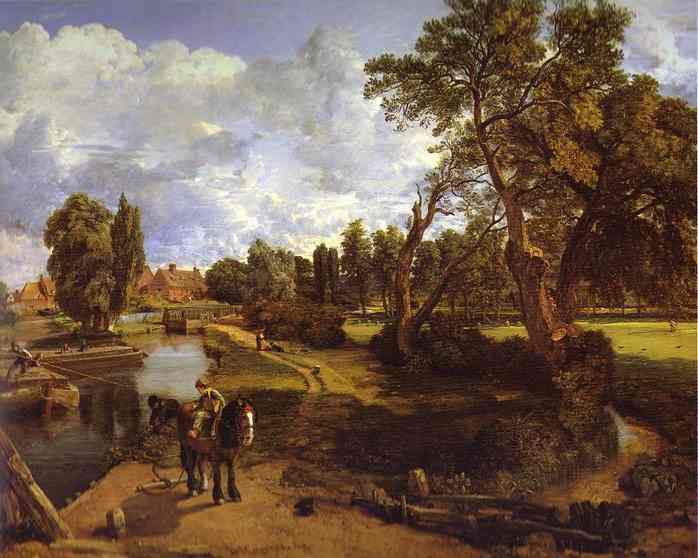
My parents had John Constable table mats when I was a child. Serious critics tend to excuse the great artists when they become consumer goods, saying it's a simple case of a glorious vision being perverted. My opinion is that the artists who get picked usually deserve it. Buy an Impressionist coaster set and you'll probably get Monet's water lilies, not Degas' vaudeville girls. Canalletto's Venetian picture postcards make good mouse mats, Caravaggio's dark melodramas don't. The people who produce these things knows that what sells in the home furnishing market is the idyllic and the bland. There are a lot of Constable table mats.

Flatford Mill has been chosen here but any number of Constable's works would have sufficed. He followed a template with minimum variety. In the foreground are generally one or two small figures. Few details can be made out on them. We learn little from even the most careful study. They are Rustics and their job is to look quaint. Constable put them to work on varying rural tasks which his aristocratic patrons liked to see doing so long as the labourer is not themselves. Here they are performing something mystifying involving boats. Elsewhere they might be fishing or driving a cart. The figures by Flatford Mill are young boys, which was a common Constable trick. Children look quaint almost by default. And they exude an innocence which seeps out over the whole painting and smothers any questions about the facts of rural life.

The figures, though, are shrivelled by their surroundings. This is a device sometimes to stunning effect. See Fragonard's Grand Cascade At Tivoli, for example, to see a demonstration of humanity's insignificance compared to nature, or Goya's Colossus for our helplessness in the face of disaster. But it doesn't quite work when the landscapes are as tedious as Constable's. What does he give us? Blue and green, green and blue. Green grass, blue sky, blue river, green leaves; the green of the trees even reflected in the blue water. There is a small brown patch in the foreground, some tiny red cottages in the distance and this is quite radical for Constable. He rarely admitted any breaks in his verdant utopias. No acknowledgement, for example, that sometimes leaves fall off trees, grasses parch and the sun occasionally sets.

And the eye searches for relief in the colour scheme because so little else is happening at Flatford Mill. Nobody is coming to intrude on the boys. No wind rustles the trees. No birds fly across the sky. All is neat and tidy, perfectly ordered by the artist. This is a flat and lifeless scene, removed from reality and stripped of any deeper meaning.

There's nothing wrong with creating from the imagination or even following a template. Lowrie, for one, basically painted the same picture his whole life and it was always several steps from sanity. But Lowrie was interesting because nobody had done anything quite like him before. Many had prior to Constable, even more have since. He either had the least fertile imagination possible or he let it be filled by others. The ruling classes, basically. His paintings are embodiments of the laziest clichés about England. The 'green and pleasant land,' that evocation of timeless plenty which is forever used to excuse all our failings. I can't look at Flatford Mill without remembering John Major quoting Orwell's grisly lines about spinsters cycling to village churches. Or The Day Today's spoof propaganda film: a jolly policeman smoking a bifta while a voice drones "This is England. And it's all right. Everything's all right…"

Everything isn't, of course. It certainly wasn't in 1817 when Flatford Mill was painting. A godless alliance of capitalists and aristocrats were stripping the last few rights from the rural poor. The happy, faceless peasants which Constable painted were being thrown off the land and into the workshops and proto-factories which comprised the first, worst stage of the Industrial Revolution. His scenes were outdated even when he painted them. But at best he ignored these changes, at worst he ignored the agents implementing them. As a result he gave us unnatural nature scenes and social commentaries with no social worth whatsoever. On to the dinner table with them all, where at least they can perform one useful function.

Thursday, November 16, 2006

A Glorious Revolution?

Currently reading The Glorious Revolution, Edward Vallance's account of the events in 1688 which replaced James II with William and Mary on the British throne. Vallance is a revisionist to some extent, of course. Any historian who doesn't at least claim to be rewriting history won't find a publisher nowadays. He points out that the Glorious Revolution wasn't exactly a revolution. Though it had wide support in a Protestant England terrified of the Catholic, authoritarian James, it was basically a Dutch invasion which led to the crowning of a Dutch duke. (Mary was co-ruler only in name, partly on her own insistence). Most of the gentry went over to William's side when his armada landed. James was rather inconveniently left without an army and fled without a fight. But he would have probably lost anyway.

Nor, Vallance, states, was the 'Revolution' very Glorious. Outside of England it certainly wasn't bloodless. Rebellions against William in Ireland and Scotland culminated in the massacres of the Boyne and Glencoe. The Scottish resistance rumbled on for half a century until the final bloodshed at Culloden. No sooner was William comfy on the throne then he began a war with France which Britain could neither win nor afford. Vallance is also sceptical that 1688 marked, as is generally asserted, the birth of English liberty. William paid a little more attention to Parliament but only after packing it full of loyal Anglicans. Free speech was growing at the time, especially in the coffee house phenomenon, but in spite rather than because of government policy. The English Bill of Rights was certainly feeble compared to the American version. It was simply a reaffirmation of existing liberties, which were remarkably few. Unlike forty years earlier, there was no belief that the country could actually do without a monarch.

Vallance also gives a partial defence of James II. He wasn't trying to forcibly re-convert Britain to Catholicism, as was often claimed. His only legislation tried to reduce the civil but systematic discrimination against Catholics. His less laudable actions, from butchering the followers of a feeble uprising to rigging parliamentary elections, were fairly standard for the time. But his brusque personality and habit of increasing his standing army excited fears of absolutist rule, quite apart from his religion. I would have probably shared this paranoia. James was becoming increasingly authoritarian after only three years. Who knows what he would have been like if power had time to corrupt him properly?

Anyway, his true character is beside the point. Most people didn't want James. There was an energetic attempt to exclude him from the succession during the last years of his brother's reign. They stuck with him for a while, saw he was apparently as bad as they thought and simply replaced him. Britain still had to have a king, it seemed, but Britain would have the king it wanted. The notion of a divine right to rule died abruptly. And I think that the modern British attitude to its monarchy began to be created in its place. You can see a line, if not a direct one, leading from the Glorious Revolution to the events in Westminster this week. Where an overdressed woman announces the legislation to be introduced by 'her' government – yet is still only a hired orator for the elected rulers.

Saturday, November 11, 2006

When A Shite Is Not A Shite

A linguistic dispute is currently raging in English football. On Wednesday referee Graham Poll denied Everton's claims for a penalty and then dismissed their striker James McFadden. McFadden, he alleges, called him a "fucking cheat." The striker has denied the charge. He was abusing the decision, not the referee himself. Furthermore, the phrase he used was "fucking shite."

It's an interesting defence given that McFadden was sent off for foul and abusive language. Effectively he's saying that his crime is twice as bad as originally thought. But of course he was actually punished for abusing the referee, not for cussing. The 'foul and abusive language' charge is only ever used tactically. If footballers were red carded each time they swore, every pitch would be cleared of players within five minutes of kick off.

So let this be a lesson to all you youngsters. When you swear at a referee, which you almost certainly will, speak loudly and clearly. Just in case, use a word that states you may still love the sinner while hating the sin. McFadden has demonstrated the dangers of "fucking shite." "Fucking shit" may be misinterpreted as "fucking tit," "fucking crap" as "fucking twat." I personally recommend "fucking bollocks." A little clumsy, perhaps, but guaranteed to ensure you stay on the pitch till the final whistle.

Sunday, November 05, 2006

Guy Fawkes' Night

As a child, my favourite part of Guy Fawkes' Night was probably the gingerbread men. They had to be eaten in a particular way, naturally. You bit the arms and legs off first. Then you munched through the torso until all you had left was a decapitated head. This would be consumed with painstaking care, ideally the eyes left till the very last.

Nowadays my favourite part is explaining the festival to foreigners. "Fawkes," I say, "Was a Catholic who tried to blow up King James and his parliament. He was caught, and he and his accomplices were executed in an especially gruesome fashion. So now every year we make effigies of him, throw him on a bonfire and watch the fucker burn. Then we let off fireworks in celebration. And we let all the kiddies watch." If my audience doesn't look suitably horrified, I go on to tell them about the gingerbread men.

Every year there are protests about Guy Fawkes' Night. Especially in York, where Fawkes was born and raised. Local voices are always calling for him to be shown more respect, unabashed that our second most famous son was a rather dim wannabee mass murderer. (Our most famous, the Emperor Constantine, did actually manage to kill a lot of people though was considerably brighter.) I suppose these have some validity. In these religiously sensitive times, it's not good to be ceremonially burning a prominent Catholic. Though things have improved slightly; originally the effigies were of the Pope rather than Fawkes.

But the night isn't really about the thwarting of some remote, half-baked Catholic plot. That's just become the modern peg for an older urge; just as the birth of Jesus and the switch of calendars are to some extent for Christmas and New Year. Guy Fawkes' Night is about defying the season. The nights are encroaching, the chill is mounting. For one evening we like to build great beacons against the darkness. And against the creatures once thought to lurk there. It's probably no coincidence that Guy Fawkes' Night lies close to the older festival of Halloween. The ghosts who emerge are supposed to be vanquished by All Saints Day the following morning. Just in case any aren't, however, here's a barrage of bangers and rockets to scare them off.

Most countries have a night when they let off a barrel load of fireworks. The British may have chosen an especially perverse excuse for ours. But it's really no odder than the Americans or the French letting off their fireworks in the middle of summer, when they need them least of all.

Saturday, November 04, 2006

Nine Films To Never See Even If You Live To A Thousand

Guys and Dolls
Let's be clear: all musicals are bad. Especially trying, though, are musicals based on stories which totally corrupt the whole damn point of the original. Liza Minelli turning Goodbye To Berlin into Cabaret sets the teeth on edge. But this one really wins the award. Damon Runyan's short stories are minor classics. He wrote of hustlers, gangsters and whores, their tawdry menace never quite dissipated by his humour and unique literary style. This can not, I repeat not, be represented by a man in spats swinging round a lamp post singing "Luck be a lady tonight."

Absolute Beginners
Whereas this has a whole-hearted awfulness which transcends the commonplace awfulness of the musical genre. It is a film you watch in fascination from beginning to end, wondering how anyone could possibly have created it, produced it, acted in it. I mean, did nobody realise? There is an earnest plot detailing the rise of the far right in England and that's interspersed with a seemingly infinite number of scenes where Lionel Blair gets kicked in the goolies. And those are the best bits. My mind has blotted out most of the rest.

Pretty Woman
On this, the first and last words belong to Bongwater: 'Richard Gere with his oh-so Zen films and their oh-so Zen messages like: Hey, it's fun to be a prostitute! I wish I could spread my legs across Hollywood Boulevard! Because that's all we want, isn't it girls? Sucking and shopping, sucking and shopping… But it's the feel-good movie of the year, it's the feel-good movie of the decade, it's the feel-good movie of the millennium!'

Charlie's Angels
Probably not the worst Hollywood blockbuster but the one which really snapped my patience with the whole bloody business. The stubborn refusal to even consider anything original. The smirk-smirk, 'we're so clever' (just not clever enough to do anything original) treatment given to modern updates. And above all, the damn slo-mo everywhere. I mean, why do they think action is more exciting if it happens in slow motion? It doesn't. It's just slower. If this film had proceeded at a normal pace, it would have been over in 40 minutes and I might have used that extra hour of my life productively.

Four Weddings And A Funeral
In the early 1990's the British film industry finally seemed to be going somewhere. Pictures like The Full Monty and Trainspotting showed very different visions but ones both true and unique to the county. And then came Hugh Grant and Richard Curtis came along, and the template clanged down again. The whole of Britain reduced to a cliché; and not even our cliché of ourselves but America. A land where every Englishman is foppish and posh and rich and white. I still don't know from where I found the willpower to watch this dreck to the end. And though I've never dared watch them, I've heard Notting Hill and Love Actually are even worst.

Battlefield Earth
You probably didn't see this, put off the bad reviews, but may have thought, "Well, I bet it isn't that bad." Well I say unto you: it is. If anything, it's worst. There's regular hilarious sights of Fat John Travolta in a monkey suit. There's a nonsensical plot from insane cult leader and Travolta's guru, L Ron Hubbard. And there's somebody screaming "NO-O-O-O-O-O!" pretty much every ten minutes. Even if nothing happens to make them scream "NO-O-O-O-O-O!" they still do it. Perhaps they just realised what sort of a film they were stuck in.

Barb Wire
Remember Pamela Anderson, that icon of the 1990's? The woman who, thanks to constant cosmetic surgery, became a creature of long blond hair and massive lips and massive breasts and not much else? All men were supposed to lust after her but really she was as sexless as a piece of plastic; which was what she largely was, after all. This was her attempt to launch a movie career. She plays an in-your-face bar owner in one of those post-apocalypse wasteland deals. That was the by-line at least. Actually, it's just Casablanca. Not at first, admittedly; the transformation only happens gradually. Half-way through you start thinking "Hang on, this is a mite familiar," and by the end it only lacks Dooley Wilson tinkling away on the piano. Even her porno film with Tommy Lee would probably be more appealing. And thus ended Pamela Anderson's movie career.

Havana
And the Casablanca rip-offs roll on. Maybe I shouldn't lump this in with Barb Wire. But while that felt like it lasted about three hours, Havana actually has the nerve to actually be almost three hours. And it feels longer. All for a plot which every living creature on the planet knows the end to anyway. Perhaps they needed the time to cover the full astonishing gamut of Robert Redford's facial expressions: the concerned frown, the comedy flinch and, er, the other concerned frown.

Sleepless In Seattle
If I were God… Ah, if I were God. If I were God and I saw this, I'd forget any promises made with rainbows. I'd wipe the whole human race out and not make any exceptions this time. I'd make a new dominant species based on – well, lizards, birds, cockroaches, anything. Just as long as they were physically incapable of ever producing synthetic sentimental bullshit like this.

Tuesday, October 24, 2006

The Stink Of Old Suez

History can be a great comfort sometimes. Ever think, for example, that we've reached at the absolute nadir of Western-Middle East relations? That the 2003 invasion of Iraq was an unparalleled mixture of cynicism and incompetence? Then just learn about the Suez Crisis forty years ago and you'll realise that things, unbelievably, have actually been worst.

I always knew Britain's botched invasion of Egypt, after Colonel Nasser nationalised the Suez Canal, was a mess. It put a definitive end to both the dwindling British Empire and the (never very high) reputation of the then Prime Minister, Anthony Eden. But before I watched BBC2's excellent documentary Suez: A Very British Crisis, I didn’t realise how ludicrous things got. The trouble for Eden was that he was itching to attack Egypt as soon as the Canal was occupied but had no actual excuse. No British citizens were massacred, no ships were stopped from entering the waterway. France, though, came up with a Cunning Plan. Israel was persuaded to launch a sudden attack on Egypt, something it was prone to do in those days. French and British troops would then intervene as peacekeepers to protect the Canal; incidentally reoccupying it in the process. Butter, even in the desert, wouldn't melt in their mouths.

Fortunately this scheme got the dexterous planning it deserved. Suez... was full of hilarious and scarcely believable little details. America getting so exasperated by the secrecy that it sent U2 spy planes over its staunchest ally, Israel. Nasser coolly surveying British jets bombing his capital while Eden bricks it before a BBC broadcast. French pilots scrambled and not actually given maps of their destination until they are in the cockpit, which is so dark they almost can't read them.

The purest farce, though, came when Britain, France and Israel met in the suburbs of Paris to finalise their scheme. Israel sent their Prime Minister, who hated Britannica and was soon calling her an "old whore." Britain was initially represented by Selywn Lloyd, a Foreign Minister who "often had trouble relating to foreigners." After some tough negotiations, the diplomats nipped out to a nightclub where they watched a performance of the can-can. Finally a treaty is drawn up and signed. Eden was horrified when he learns of this, written documents understandably not fitting in with his concept of secret plots. He sent some flunkies back to Paris to try and persuade the French to burn the papers. They were put in a stateroom and the door was locked for several hours, for no discernable reason.

Shimon Peres, a junior member of the Israeli delegate, chuckles mightily when relating all this to the BBC cameras. I don't blame him. To call it redolent of a Yes Prime Minister episode is too complimentary to the actors. It's pure PG Wodehouse. The only difference being that Anthony 'Bertie' Eden didn't have a Jeeves to rescue him.

Thankfully. It's frightening that people like this got into power but would be even more terrifying if they had succeeded. And, as I said, the episode is slightly comforting. Today's rulers may not have much understanding of their job or their electorate, but at least they have a vague grasp of reality.

Friday, October 06, 2006

'The Night Watch'


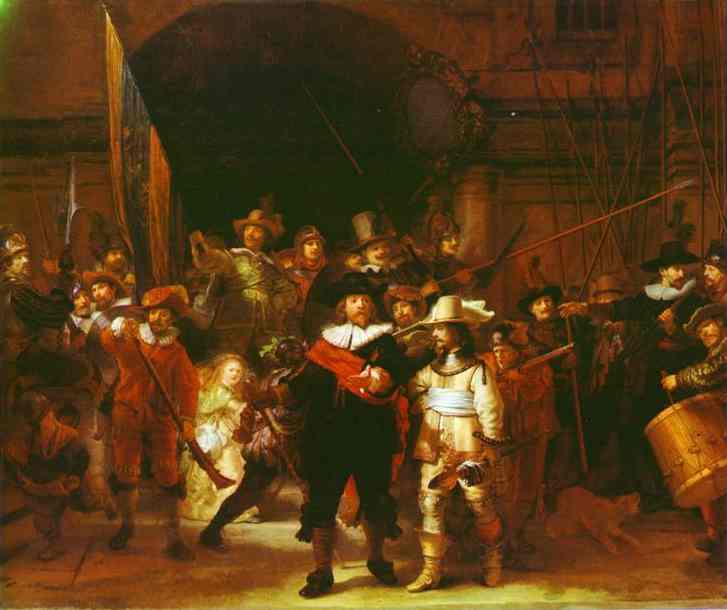
This probably isn't my favourite painting. But, outside the more demented fringes of surrealism, it has to be the one which gives me the most enjoyment. I can never look at it without raising a smile, partially patronising but mainly one of simple happiness. This is partly because of Paul Kidby's pastiche for the Terry Pratchett comic novel of the same name. But it's also because of what the original seems to show and what it really does reveal.

In a way, The Night Watch is one of Rembrandt's more constrained portraits. He was always a commercial artist dependent on patrons. In 1642 the Militia Company of Arquebusiers in Amsterdam commissioned him for a group portrait to hang on their headquarters' walls. An unflattering representation, one assumes, would have meant no cheque for Rembrandt. So he was not free to subject his models to the pitiless scrutiny he inflicted on his parents or, for that matter, himself. The Company is shown as a sturdy, impressive group of men striding out of the door and presumably to battle. Their Captain his instructing his lieutenant, the light playing over them to emphasise the red sash of one and the golden clothes of the other. The smartness of their attire would have been important to the Company. They were not just soldiers, they were declaring to the world – they were gentlemen too. In the background their troops prepare themselves; cleaning muskets, beating drums or just brandishing pikes. Even the ordering of the figures, a marvel of technical composition, had commercial considerations. Each man was given a prominence according to how much he had paid.

It was hard, though, to stop Rembrandt telling the truth. Some of his patrons were still painted with brutal objectivity; see the wizened merchant's wife Margaretha de Geer, for example. Two golden figures actually catch the eye in The Night Watch, and only one is a soldier. The other is the rather chubby young girl to the right of centre. It is generally thought that she, and the chicken which hangs from her belt, is a symbol of the company mascot. But she could just as easily be somebody's daughter who has wanders in. Regardless, her effect is to immediately undermine both the hierarchical structure and the militaristic statement of the group.

Look closer at the soldiers and these crumble further. Only the lieutenant is actually paying any attention to the captain. The rest are just getting on with their tasks as it suits them. One cleaning his rifle with a self-absorbed expression, one peering at his as if it has jammed, one raising the standard with a slow, ostentatious flourish. A few – the couple on the far right, for example – are simply gossiping. The lack of homogeneity becomes a problem too. There are one or two helmets on display, but the rank and file are almost as dandified as their officers. Some are youths, others white-bearded men. Rather than an army, this looks like a group of men playing at soldiers.

They were, of course. By the 1640's, 'militias' like the Company of Arquebusiers had lost all their original functions. Established to uphold the newly won Dutch independence, they soon became nothing but gentlemen's clubs. Pride and tradition kept them maintaining their training, their weapons and their military etiquette, but they were no more menacing than the Sealed Knot Society.

The Night Watch bears superficial resemblances to another masterpiece featuring a mass of pikes, Velasquez' The Surrender of Braga. Its meaning, though, is the exact opposite. Velasquez showed the Dutch and Spanish generals reaching an apparently amicable settlement. Yet the deportment of their respective troops shows that the former are really capitulating to the latter. What seems like peace is actually conquest. The Night Watch only came seventeen years after the events depicted but belongs to a far more optimistic era. Peace and prosperity had finally come to the Netherlands after their grim, protracted independence war. Rembrandt shows both erupting in what is supposed to be a statement of military might. This is what always makes me smile. That the men shown have reached a place comfortable enough to let them mess about a bit.